

Thorium: 5 Key Facts About Its Potential in Advanced Nuclear Energy
More abundant than uranium in the Earth's crust, thorium is attracting renewed interest in next-generation nuclear energy research. Long kept on the sidelines of conventional nuclear programs, this metal is now being studied for certain advanced reactors, particularly molten salt reactors (MSRs).
Its potential rests on several distinctive features. Depending on the configuration, the thorium cycle could limit the production of plutonium and minor actinides, while MSRs are able to operate at low pressure.
From its natural abundance to radioactive waste management, explore five scientific facts that shed light on thorium, its potential applications and the challenges tied to its use.
Fact #1: Thorium is more abundant than uranium in the Earth's crust
Thorium occurs naturally in rocks and soils, usually in low concentrations. On average, soils contain about 6 parts per million (ppm) of thorium [1], while its abundance in the continental crust is estimated at between 6 and 10 grams per tonne [5]. According to the International Atomic Energy Agency (IAEA), it is roughly 3 to 4 times more plentiful than uranium in the Earth's crust [4][5].
This relatively widespread presence makes it a geologically attractive resource, especially at a time when several countries are seeking to diversify their energy options and their supply chains for strategic minerals. The World Nuclear Association puts identified global thorium resources at approximately 6.4 million tonnes [1].
The largest recorded volumes are found in India, Brazil, Australia and the United States [1][2]. Canada also ranks among the countries with identified thorium resources, estimated at about 172,000 tonnes [1]. As with any mineral resource, however, its potential depends on deposit grade, geological setting, and the technical, economic and regulatory conditions surrounding development.
Table 1: Identified global thorium resources (main countries)
| Country | Identified resources (tonnes) |
|---|---|
| India | 846,000 |
| Brazil | 632,000 |
| Australia | 595,000 |
| United States | 595,000 |
| Canada | 172,000 |
| Other global resources* | 3,515,000 |
| World total | ~6,355,000 |
Source: World Nuclear Association, Thorium (October 2026) [1]
Fact #2: Natural thorium is a fertile material, not a direct fissile fuel
Unlike enriched uranium, thorium cannot be used directly as fissile fuel. Natural thorium consists almost entirely of thorium-232, a so-called fertile isotope: it can contribute to a nuclear cycle, but only after being converted into uranium-233 inside a reactor [3][4].
The distinction between fissile and fertile helps clarify its role:
Fissile: material whose nuclei can split when they absorb a slow neutron, releasing energy. Uranium-235 and plutonium-239 are examples.
Fertile: material that does not fission directly but can be converted into fissile material after absorbing a neutron.
In thorium's case, this conversion follows a transmutation sequence: thorium-232 absorbs a neutron and becomes thorium-233, which then decays into protactinium-233 and finally into uranium-233, a fissile isotope [6]. To start and sustain this process, however, a reactor needs an initial supply of fissile material, such as uranium-235 or plutonium-239 [3][4].
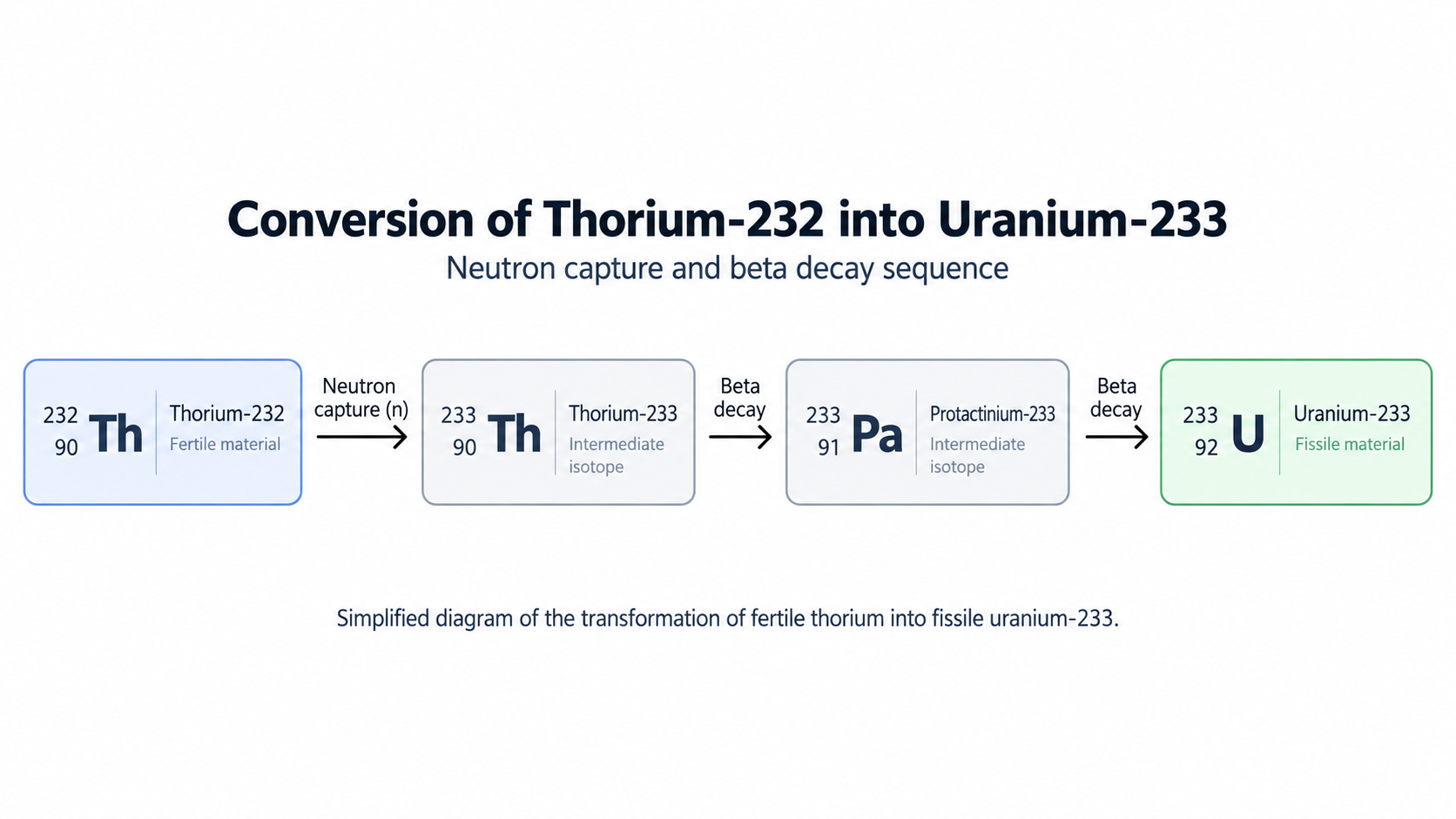
Figure 1: Flow diagram illustrating the Th-232 → Th-233 → Pa-233 → U-233 sequence
This characteristic does not diminish thorium's appeal. Rather, it shows that its potential hinges on reactor design and fuel cycle management. Protactinium-233, for instance, can itself absorb neutrons, which must be taken into account to optimize uranium-233 production [1].
A recent example illustrates this approach. In China, the TMSR-LF1 experimental molten salt reactor, located in Wuwei, was developed to study the use of thorium in an advanced nuclear system. This reactor relies on a starting fissile material, notably uranium-235, while making it possible to observe the conversion of thorium into uranium in an experimental setting [7][10].
This case neatly sums up thorium's role: it does not directly replace a fissile fuel, but it can contribute to a cycle in which thorium-232 is gradually converted into uranium-233.
Fact #3: Thorium-compatible molten salt reactors operate at low pressure
Molten salt reactors, or MSRs, are among the advanced nuclear technologies often associated with the thorium cycle. What sets them apart is not only the fuel being considered, but also the type of fluid used to carry heat: a liquid salt kept at high temperature.
In a conventional pressurized water reactor, the water must remain under very high pressure to stay liquid. A reactor of this kind typically runs at around 315°C and at a pressure of roughly 150 atmospheres [7]. By contrast, the fluoride salts used in several MSR concepts can remain liquid at high temperatures without such pressurization, generally between about 500°C and 1,400°C depending on the salts and designs involved [7].
This difference matters from an engineering standpoint. By operating close to atmospheric pressure, MSRs reduce some of the risks associated with highly pressurized systems. Several concepts also incorporate passive safety mechanisms, meaning they are designed to work without immediate human intervention or an active power supply. Some models, for example, include a plug of solidified salt (freeze plug) that melts in the event of overheating, allowing the salt to drain by gravity into tanks configured to halt the chain reaction [7].
These features help explain the interest in MSRs within advanced nuclear development. Their low-pressure operation and passive safety mechanisms make them an architecture under study for various fuel cycles, including the thorium-uranium-233 cycle.
Fact #4: Monazite is a major source of thorium associated with rare earths
Thorium is seldom considered a standalone resource. It most often occurs in minerals that also contain other elements of interest, particularly rare earths. This is notably the case for monazite, a rare-earth-bearing phosphate mineral found in certain mineral sands and historically recognized as one of the main mineral sources of thorium.
Monazite generally contains rare earths such as cerium, lanthanum and neodymium, along with thorium and sometimes uranium. This composition accounts for both its economic value and its natural radioactivity [8]. Depending on the origin and geological characteristics of the deposit, the thorium content of monazite can vary considerably [5].
Thorium resources are mainly associated with placers, carbonatites and certain rare-earth vein deposits [2]. In mineral sands, monazite is often found alongside other heavy minerals, such as ilmenite, rutile, zircon or sillimanite [5].
This mineralogical association is key to understanding thorium's potential. Globally, monazite is mined primarily for its rare earths, while thorium is generally a co-product or by-product that remains largely unrecovered [2]. Deposits containing it may therefore hold broader interest, especially when they are associated with strategic commodities such as rare earths, niobium, tantalum or titanium [5].
Fact #5: The thorium cycle stands out for its reduced production of heavy actinides
Radioactive waste management and the risk of diverting fissile materials are among the most sensitive issues in nuclear energy. The thorium-uranium-233 cycle does not eliminate these concerns, but it differs from the conventional uranium-plutonium cycle in two important respects: the nature of the waste produced and the possible presence of isotopes that complicate fuel handling.
Potentially lower long-term radiotoxicity: in a thorium cycle, the production of plutonium and minor actinides is generally much lower than in a uranium-plutonium cycle [3][4]. These minor actinides, such as neptunium, americium and curium, matter because they are major contributors to the long-term radiotoxicity of spent fuel. Producing less of them can therefore ease some of the challenges associated with nuclear waste, particularly over the periods when these elements dominate residual radiotoxicity [3]. The IAEA notes, for example, that in the specific case of thorium-based energy amplifiers, the resulting waste could have a radiotoxicity about 30 times lower than that of waste from uranium-based fuel during the first 30,000 years of cooling [4]. This figure, however, applies only to that configuration and should not be generalized to all thorium-fuelled reactors.
Proliferation resistance linked to uranium-232: when uranium-233 is produced from thorium, uranium-232 can also form [4]. This isotope is significant because its decay products, notably thallium-208, emit highly penetrating gamma radiation [9]. In practice, this radiological signature makes the fuel harder to handle, transport or divert without specialized shielding. It can thus strengthen proliferation resistance, while also adding technical constraints to the management of irradiated fuel.
Together, these two aspects explain why the thorium cycle continues to be studied in the context of advanced reactors. It is not a simple or universal solution, but it offers a different profile: less geared toward producing heavy actinides and harder to divert owing to the possible presence of uranium-232.
In summary: five facts to better understand thorium
Long sidelined by conventional nuclear power, thorium is now regaining a place in research devoted to next-generation energy technologies. The characteristics of its fuel cycle, combined with the active development of new-generation molten salt reactors, particularly in China, make it a resource that a number of scientific and industrial players continue to examine as part of efforts to diversify low-carbon energy sources.
Squatex keeps a close eye on developments in energy resources and critical minerals, some of which are tied to thorium deposits. Gaining a clearer understanding of the science behind these resources helps assess their potential in the context of the energy transition.
To stay informed about developments in this field, follow Squatex on LinkedIn.
References
[1] World Nuclear Association. "Thorium." World Nuclear Association, updated 1 October 2026. https://world-nuclear.org/information-library/current-and-future-generation/thorium
[2] U.S. Geological Survey. "Thorium." Mineral Commodity Summaries 2024. U.S. Geological Survey, 2024, https://pubs.usgs.gov/periodicals/mcs2024/mcs2024-thorium.pdf.
[3] National Nuclear Laboratory. Comparison of Thorium and Uranium Fuel Cycles. NNL (11) 11593 Issue 5, National Nuclear Laboratory, 2012. UK Government, https://assets.publishing.service.gov.uk/media/5a79a2bded915d0422069ebe/6300-comparison-fuel-cycles.pdf.
[4] International Atomic Energy Agency. Thorium Fuel Cycle — Potential Benefits and Challenges. IAEA-TECDOC-1450, International Atomic Energy Agency, 2005, https://www-pub.iaea.org/MTCD/Publications/PDF/TE_1450_web.pdf.
[5] International Atomic Energy Agency. Thorium Resources as Co- and By-Products of Rare Earth Deposits. IAEA-TECDOC-1892, International Atomic Energy Agency, 2019, https://www-pub.iaea.org/MTCD/Publications/PDF/TE-1892web.pdf.
[6] Energy Education. "Thorium Fuel Cycle." Energy Education, University of Calgary, n.d., https://energyeducation.ca/encyclopedia/Thorium_fuel_cycle.
[7] World Nuclear Association. "Molten Salt Reactors." World Nuclear Association, updated 21 Nov 2025, https://world-nuclear.org/information-library/nuclear-power-reactors/other/molten-salt-reactors.
[8] Gudyanga, Francis P. Minerals in Africa. CRC Press, 2020. Taylor & Francis, https://taylorandfrancis.com/knowledge/Engineering_and_technology/Materials_science/Monazite/.
[9] Dwijayanto, R. Andika Putra. "Characterising U-232 and Tl-208 Buildup and Decay on Thorium-Fuelled RGTT200K." Sigma Epsilon, vol. 25, no. 1, May 2021, pp. 1–8. Semantic Scholar, https://pdfs.semanticscholar.org/d251/ff501c2d2a8330bd4e0b21a45e031ae703e3.pdf.
[10] World Nuclear News. "Chinese molten salt reactor achieves conversion of thorium-uranium fuel." 4 November 2025. https://www.world-nuclear-news.org/articles/chinese-msr-achieves-conversion-of-thorium-uranium-fuel
