

CCS, CCUS, DAC, BECCS, mineral carbonation: what sets these carbon capture technologies apart?
The International Energy Agency (IEA), the Intergovernmental Panel on Climate Change (IPCC) and several governments regard carbon capture and storage (CCS) as an important tool in a number of scenarios aiming for carbon neutrality [1]. More broadly, CO₂ management covers a range of approaches, including CCS, CCUS, DAC, BECCS and mineral carbonation. These solutions come into play at different stages of the carbon cycle: some cut emissions at the source, others remove CO₂ already present in the atmosphere, while mineralization turns it into solid, stable carbonates. This article offers an overview of these technologies, how they operate and their main characteristics.
Five technologies, one shared goal: reducing CO₂ in the atmosphere
Although they all contribute to carbon management, these five major technology families work in different ways: some lower CO₂ emissions at the source, while others can draw CO₂ out of the atmosphere or convert it into stable minerals.
Table 1: Comparison of the main carbon capture and management approaches
| Technology | Source of captured CO₂ | Main storage method | Main destination of the CO₂ |
|---|---|---|---|
| CCS | Point sources (industry, energy) | Deep geological formations | Permanent geological storage |
| CCUS | Point sources | Geological storage + utilization | Use in products or processes and/or geological storage |
| DAC | Ambient air | Geological (DACCS) | Utilization or long-term geological storage |
| BECCS | Biomass (bioenergy) | Geological formations | Permanent geological storage |
| Mineral carbonation | Point sources or CO₂ dissolved in water | In situ mineralization (rock) | Conversion into solid carbonates in situ or ex situ |
Capturing CO₂ where it is produced: CCS and CCUS
Among carbon management approaches, CCS and CCUS operate mainly where CO₂ is generated, particularly at industrial and energy facilities. The two terms are closely related and their usage sometimes overlaps. CCS generally refers to a chain of capture, transport and permanent storage, whereas CCUS is mostly used when a CO₂ utilization pathway is added to storage or takes its place [1].
CCS: capturing CO₂ and storing it deep underground
CCS (Carbon Capture and Storage) covers the processes used to recover the CO₂ released by an industrial source or a power generation facility, then carry it to a site where it will be stored long term below ground [1]. The aim is to prevent part of the emissions from these activities from reaching the atmosphere.
The CCS chain involves three main steps:
Capturing the CO₂ from industrial gases. This can take place before combustion, after it in the flue gases, or through oxy-fuel combustion, which relies on an oxygen-rich mixture to produce a more concentrated CO₂ stream [2].
Transporting the compressed CO₂ to the storage site, mainly by pipeline or ship. Rail and trucks can also be used for certain volumes or over short distances [2].
Injecting it into a deep geological formation, such as a saline aquifer, a depleted oil or gas reservoir, or, in some cases, an unmineable coal seam [2].
Once injected, the CO₂ is held in place by several complementary mechanisms. Physical trapping confines it beneath an impermeable caprock or immobilizes it within the pores of the formation. Chemical trapping involves its dissolution in subsurface fluids and its reactions with the minerals present. Hydrodynamic trapping, for its part, refers to an extremely slow migration through deep formations over periods that can reach several million years [3]. Over time, these mechanisms help make the storage increasingly stable.
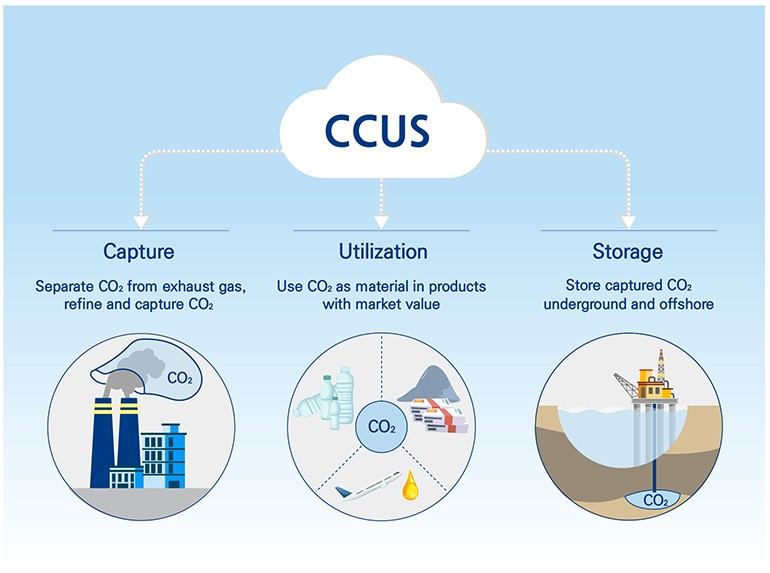
CCUS: putting captured CO₂ to use as well as storing it
CCUS (Carbon Capture, Utilization and Storage) follows the same capture and transport steps, but also allows the CO₂ to be used in a product or process. It is therefore not always an entirely separate technology from CCS, but rather a broader term that highlights utilization pathways [1].
Two main utilization routes stand out:
Enhanced oil recovery, or EOR, involves injecting CO₂ into a mature oil field to maintain reservoir pressure and help extract some of the remaining oil. A significant share of the CO₂ can stay in the formation, provided the site is operated and monitored as a storage project. According to the historical estimates cited, one tonne of injected CO₂ could yield roughly 0.1 to 0.5 tonnes of additional oil [1][2]. Data from 2010 put the cost of the EOR storage component at around USD 20 to 30/tCO₂, without necessarily including all capture and transport costs [2].
Product manufacturing uses CO₂ as a feedstock for certain synthetic fuels, chemicals or building materials. The climate benefit of these applications depends on the process involved, the energy consumed, the product being replaced and how long the carbon remains locked away. Some uses can retain CO₂ over a long period, while others release it back into the atmosphere quickly [1].
In short, CCS mainly refers to the long-term storage of CO₂ after capture, while CCUS also encompasses utilization pathways. The distinction therefore rests less on the capture method than on where the recovered carbon ultimately ends up.
Removing CO₂ from the atmosphere: understanding DAC and BECCS
Unlike CCS and CCUS, which mainly capture CO₂ at the source of an industrial or energy facility, DAC and BECCS can help remove carbon that is already in the atmosphere. They rely on different mechanisms. DAC separates CO₂ directly from ambient air, whereas BECCS first draws on the natural uptake of carbon by biomass.
These approaches are sometimes described as "negative emissions" technologies. The label applies when the captured CO₂ is stored durably and when the emissions generated by the entire process remain lower than the amount withdrawn from the atmosphere. Their balance therefore depends on the energy used, transport, storage infrastructure and, in the case of BECCS, the origin of the biomass.
DAC: capturing CO₂ straight from the air
DAC (Direct Air Capture) uses facilities that move ambient air over substances able to selectively retain CO₂. The captured gas is then released in concentrated form so it can be transported, stored or used in a product.
Because the CO₂ concentration in ambient air is much lower than in more concentrated gas streams, separating it generally comes with a higher energy penalty [4].
Two main families of processes are currently being developed:
Liquid solvents, used notably in Carbon Engineering's approach. A chemical solution absorbs the CO₂ contained in the air, and various treatments then recover it in concentrated form.
Solid sorbents, employed notably by Climeworks and Global Thermostat. The CO₂ binds to the surface of solid materials before being released, usually with heat, so it can be collected [4].
DAC refers only to the step of capturing CO₂ from the air. When the recovered CO₂ is then stored durably underground, the approach is called DACCS (Direct Air Carbon Capture and Storage). Temporary use of the CO₂, for example in a fuel that releases it again when burned, does not necessarily amount to permanent removal.
DAC has the advantage of being deployable independently of an industrial CO₂ source and of not relying on a biomass supply. Its rollout depends on access to low-carbon energy, equipment costs, heat and electricity requirements, as well as the availability of suitable options for transporting, using or storing the CO₂ [4].
BECCS: pairing bioenergy with carbon storage
BECCS (Bioenergy with Carbon Capture and Storage) combines energy production from biomass with the capture and geological storage of CO₂. As they grow, plants absorb atmospheric CO₂ through photosynthesis. When this biomass is later used to generate electricity, heat or fuels, the CO₂ released can be captured and then stored durably underground.
This combination gives BECCS a notable feature: it can both produce energy and help remove CO₂ from the atmosphere. For that removal to be truly net, the biogenic carbon must be stored over the long term, and the emissions generated along the whole chain (biomass production, transport, processing, capture and storage) must stay low enough [5][6].
The IPCC estimates that the average global technical potential of BECCS could reach about 5.9 GtCO₂ per year by 2050. Part of this potential, roughly 1.6 GtCO₂/yr, could be available at a cost below USD 100 per tonne of CO₂, with medium confidence [5]. These estimates illustrate how large a role BECCS could play in decarbonization strategies, without being a forecast of the level that will actually be deployed.
The development of BECCS also hinges on the availability of sustainably produced biomass. Where the biomass comes from, how land is used and the emissions tied to its supply chain directly shape the climate balance of the process [5]. The challenge is therefore less about maximizing biomass volumes than about integrating BECCS into systems where the resource, energy and geological storage can be mobilized coherently.
DACCS and BECCS thus offer two complementary pathways for removing CO₂ from the atmosphere. DACCS captures it directly from the air, whereas BECCS uses biomass as a natural absorption step before recovering and storing the carbon. Their development relies on different resources: DACCS depends mainly on access to low-carbon energy, while BECCS leans more heavily on a sustainable biomass supply and storage infrastructure.
Mineralizing carbon: turning CO₂ into stable minerals
Mineral carbonation involves chemically converting CO₂ into solid carbonates. In conventional geological storage, injected CO₂ is held within a formation by various physical and chemical mechanisms. Carbonation aims more directly at transforming it into new minerals, thereby providing an especially durable form of chemical storage [9].
This phenomenon occurs naturally in certain rocks, but it can also be accelerated through engineered processes. Its effectiveness depends in particular on the mineral composition of the formations, the presence of water, and their porosity and permeability [9].
How does mineral carbonation work?
CO₂ mineralization relies on a reaction between carbon and minerals rich in magnesium, calcium or iron. This interaction forms solid, chemically stable carbonates, locking the CO₂ durably into the rock [9].
Two main categories of rock are of particular research interest:
Basalts, volcanic rocks that contain reactive minerals and can have porosity well suited to fluid injection. CO₂ introduced into the formation can dissolve in water, then react with elements in the rock to form carbonates.
Ultramafic rocks, rich in magnesium and iron. Traces of natural carbonation have been observed in several regions where these rocks outcrop, notably in Oman, which attests to their ability to react with CO₂ over long periods [9].
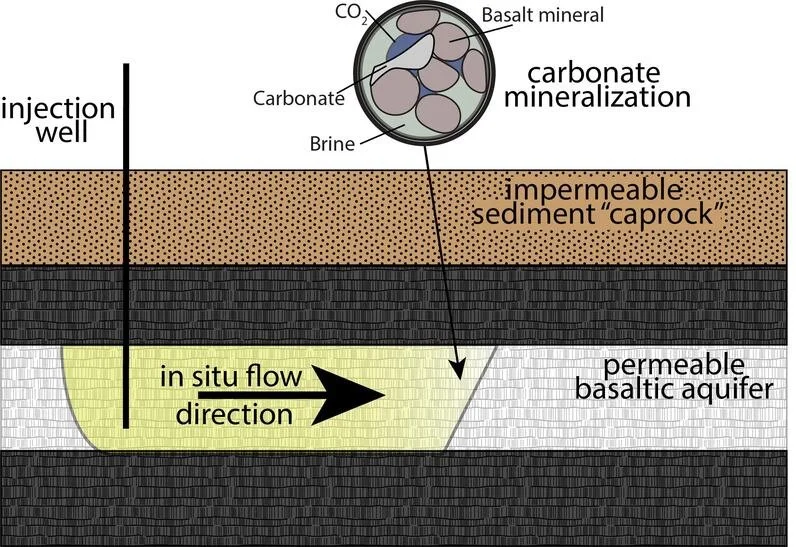
Image Source: Ocean Networks Canada
Carbonation can be carried out using two main approaches:
In situ mineralization: the CO₂, sometimes dissolved in water beforehand, is injected directly into a reactive geological formation. The reactions then unfold underground.
Ex situ mineralization: rocks, mine tailings or other materials rich in reactive minerals are processed at the surface, in facilities where reaction conditions can be controlled.
Both methods result in the formation of solid carbonates, though their implementation requirements differ. The in situ route depends notably on injectivity and fluid flow through the rock, while the ex situ approach may require extracting, crushing, transporting and treating large quantities of material.
Basalts and ultramafic rocks: formations well suited to CO₂ mineralization
Basalts and ultramafic rocks are of particular interest for CO₂ mineralization because of their composition. They contain minerals rich in calcium, magnesium and iron that can react with dissolved CO₂ to form solid, stable carbonates [8][10].
Basalts may also feature fractures and permeable zones that ease injection and fluid flow. Field trials have already demonstrated their capacity to mineralize CO₂: at the Wallula project in Washington State, about 60% of the injected CO₂ had mineralized after two years [8]. These findings complement those obtained with CarbFix in Iceland.
Ultramafic rocks such as peridotite are especially rich in magnesium and react strongly with CO₂-bearing fluids. In 2025, a pilot test conducted in the Samail ophiolite in Oman estimated that around 88% of the injected CO₂ had been converted into carbonates within 45 days [10].
These results highlight how well these formations can promote CO₂ mineralization. At the scale of a given site, their potential also depends on fluid circulation and access to reactive minerals. Porosity, permeability and fracture networks are therefore among the key properties to characterize before considering storage on a larger scale [8].
Possible links with natural hydrogen
Ultramafic formations are also of interest for the study of natural hydrogen. During serpentinization, water reacts with certain iron-rich minerals and can generate hydrogen underground. This process places these geological settings at the intersection of several research fields, including natural hydrogen production, CO₂ mineralization and the evolution of rock permeability.
These interactions remain complex and vary with formation composition and geochemical conditions. They nonetheless open up promising avenues for better understanding the potential of certain ultramafic rocks. A single formation can thus display several characteristics relevant to both energy exploration and carbon management, which strengthens the case for studying them in an integrated way.
The subsurface, a lever for decarbonization
The various approaches to carbon capture, utilization, removal and storage meet distinct needs. CCS mainly targets industrial emissions, CCUS adds utilization pathways, while DACCS and BECCS can remove atmospheric CO₂ under certain conditions. Mineral carbonation, for its part, immobilizes it as solid carbonates.
What emerges from this overview is that the geological subsurface, whether saline aquifers, basalts or ultramafic rocks, is proving to be a central strategic asset for decarbonization, on a par with the energy resources it may hold. These technologies show how geology can play an active part in managing atmospheric carbon, well beyond its traditional role as a source of extraction.
To stay up to date on developments in this field and follow the topics that interest Squatex, we invite you to join us on LinkedIn.
References
[1]: Wilson, Timothy. “What Is Carbon Capture and Storage (CCS)?” IEAGHG, 19 Jan. 2026. https://ieaghg.org/what-is-ccs/what-is-carbon-capture-and-storage-ccs/.
[2]: International Energy Agency ETSAP. “CO2 Capture and Storage.” IEA ETSAP Technology Brief E14, Oct. 2010. https://iea-etsap.org/E-TechDS/PDF/E14_CCS_oct2010_GS_gc_AD_gs.pdf.
[3]: International Energy Agency. CO2 Capture and Storage: A Key Carbon Abatement Option. OECD/IEA, 2008. https://iea.blob.core.windows.net/assets/7a2e4c6f-6cb3-4e40-9623-e1d61843c8ba/CCS_2008.pdf.
[4]: Scottish Government. Negative Emissions Technologies (NETS): Feasibility Study — Technical Appendices. 30 Nov. 2023. https://www.gov.scot/publications/negative-emissions-technologies-nets-feasibility-study-technical-appendices/pages/5/.
[5]: Nabuurs, Gert-Jan, et al. “Agriculture, Forestry and Other Land Uses (AFOLU).” Climate Change 2022: Mitigation of Climate Change. Contribution of Working Group III to the Sixth Assessment Report of the Intergovernmental Panel on Climate Change, edited by P. R. Shukla et al., Cambridge University Press, 2022, pp. 747–860. doi:10.1017/9781009157926.009. https://www.ipcc.ch/report/ar6/wg3/downloads/report/IPCC_AR6_WGIII_Chapter07.pdf.
[6]: Intergovernmental Panel on Climate Change. “FAQ 7.3: What Are Potential Impacts of Large-Scale Establishment of Dedicated Bioenergy Plantations and Crops and Why Is It So Controversial?” Climate Change 2022: Mitigation of Climate Change. Contribution of Working Group III to the Sixth Assessment Report of the Intergovernmental Panel on Climate Change, Cambridge University Press, 2022. https://www.ipcc.ch/report/ar6/wg3/downloads/faqs/IPCC_AR6_WGIII_FAQ_Chapter_07.pdf.
[7]: “CarbFix Demonstrates CO2 Storage Success.” Modern Power Systems, 16 June 2016. https://www.modernpowersystems.com/news/carbfix-demonstrates-co2-storage-success-4925515/.
[8]: Nisbet, H., et al. “Carbon Mineralization in Fractured Mafic and Ultramafic Rocks: A Review.” Reviews of Geophysics, vol. 62, no. 4, 17 Nov. 2024, e2023RG000815. doi:10.1029/2023RG000815. https://agupubs.onlinelibrary.wiley.com/doi/10.1029/2023RG000815.
[9]: Craig, James. “Review of CO₂ Storage in Basalts.” IEAGHG, 30 Jan. 2017. https://ieaghg.org/news/review-of-co2-storage-in-basalts/.
[10]: Matter, Juerg M., et al. “Rapid Mineralisation of Carbon Dioxide in Peridotites.” Communications Earth & Environment, vol. 6, 26 July 2025, article 590. doi:10.1038/s43247-025-02509-5. https://www.nature.com/articles/s43247-025-02509-5.
