

Underground Hydrogen Storage (UHS): How Does It Work?
How can large quantities of hydrogen be kept for several weeks, or even several months? Underground hydrogen storage (UHS) relies on suitable subsurface reservoirs. Hydrogen has already been stored industrially in salt caverns at Teesside since the 1970s and in Texas since 1983 [4].
With the growth of solar and wind power, UHS is attracting increasing interest for long-duration energy storage. Depending on the formation, the capacities being considered can range from GWh to TWh [1].
Salt caverns, depleted reservoirs or deep aquifers: how do these solutions work, what possibilities do they offer and which technical challenges still need to be overcome?
What Is Underground Hydrogen Storage (UHS)?
The Subsurface as a Large-Scale Energy Reservoir
In the context of underground hydrogen storage, hydrogen acts mainly as an energy carrier. Once produced or extracted, it can be injected into a geological formation, held there for a given period, then withdrawn when demand rises. This allows hydrogen to be stored and used at a different time from when it was produced or extracted.
One of the main advantages of UHS lies in the volumes involved. For stationary, long-duration applications, some underground formations offer capacities ranging from GWh to TWh [1] [2]. Surface technologies, such as pressurised tanks or cryogenic storage, generally provide more limited capacities than subsurface options [1]. Underground storage can therefore accommodate much larger energy volumes while limiting the surface footprint devoted to the reservoir itself.
In energy systems with a high share of renewables, this type of storage is being studied in particular to retain surplus electricity, converted into hydrogen, over long periods. It could also help supply sectors where direct electrification remains difficult, including certain industrial activities, shipping and heavy transport [1].
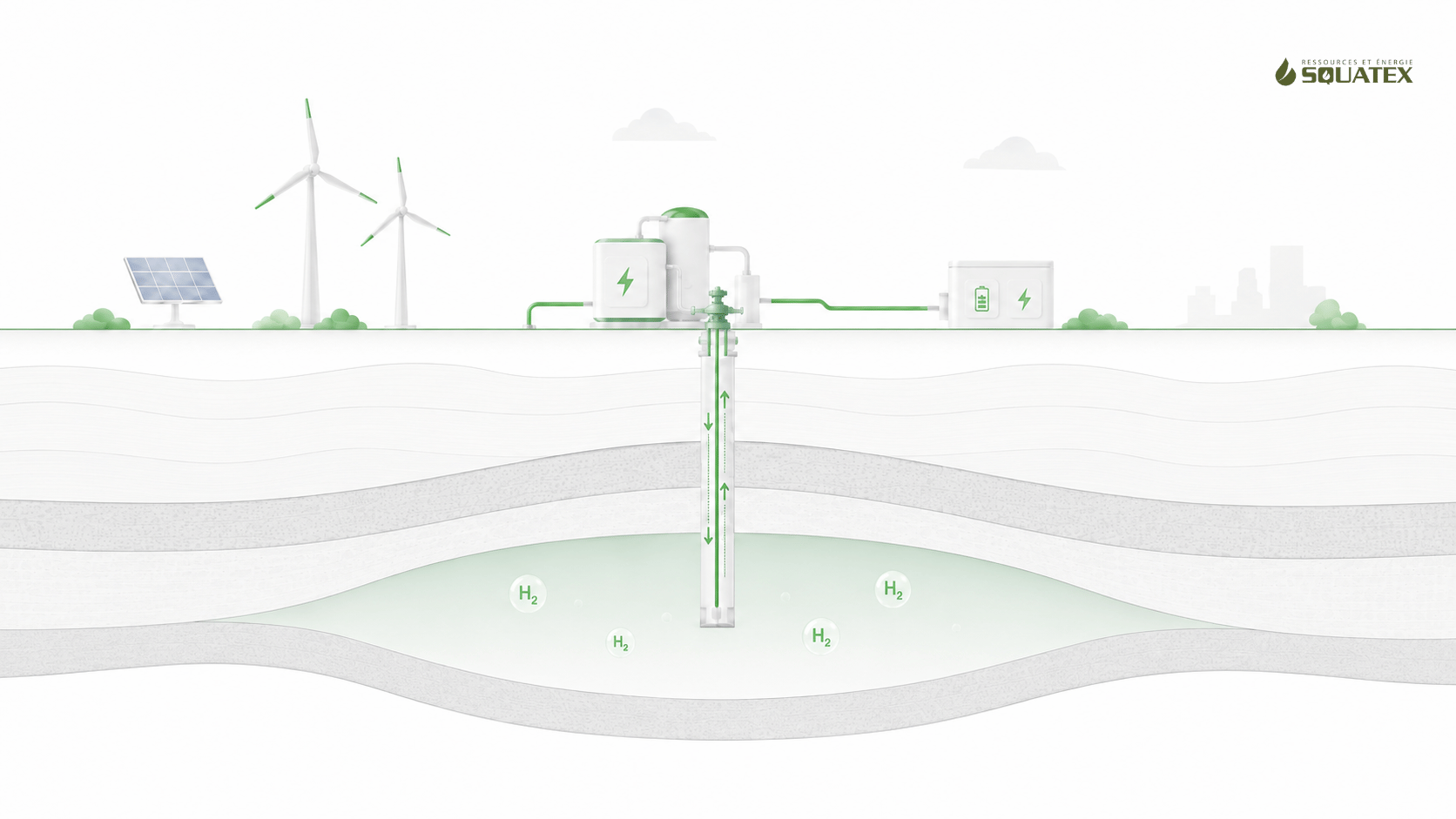
Familiar Principles, Adapted to the Properties of Hydrogen
Underground hydrogen storage draws partly on the experience gained with geological storage of natural gas, which has been used at scale for several decades. Some formations, notably salt caverns, depleted reservoirs and deep aquifers, can be considered for both types of gas [1]. The knowledge built up for natural gas thus provides a useful technical foundation, even though hydrogen's particular properties call for specific adaptations and validation.
The Teesside facilities in the United Kingdom, operating since the early 1970s, along with those on the Gulf Coast of Texas, in service since 1983, illustrate this industrial track record [4]. Historically, the hydrogen held there was mostly intended for chemical and petrochemical processes. Today, new pilot projects and demonstrators are exploring the use of underground hydrogen storage in energy systems that integrate more renewable sources [1].
The Four Main Underground Storage Options Studied for UHS
Underground hydrogen storage can rely on several types of formations, whose properties affect capacity, operating pressure, the amount of cushion gas required and how easily the hydrogen can be recovered. Four broad categories are generally considered: salt caverns, depleted hydrocarbon reservoirs, deep saline aquifers and lined rock caverns [1].
Salt Caverns
A salt cavern is created in a rock salt formation through solution mining. Water is injected to gradually dissolve the salt and form an underground cavity. The mechanical properties and very low permeability of salt help contain gases, which explains its historical use for storing natural gas and certain energy products [1] [2].
For hydrogen, a single cavern can offer a capacity in the range of 10 to more than 100 GWh, with relatively fast injection and withdrawal cycles [1]. Cushion gas requirements are also lower than in porous formations, at around 30% according to some estimates [2]. For static use or low cycling frequencies, pure hydrogen storage in salt caverns has reached a high level of technological maturity, up to TRL 9 [1].
Depleted Hydrocarbon Reservoirs
Depleted reservoirs are former oil or gas fields from which most of the hydrocarbons have been extracted. Their porosity allows them to hold large volumes of gas, while their production history often provides valuable data on the geology, pressure and behaviour of the reservoir [1].
Their potential capacity can reach the TWh scale, even for some relatively small reservoirs [1]. They are mainly considered for longer storage periods, with withdrawal that may be spread over several weeks or months. Their use with pure hydrogen nonetheless remains less mature than that of salt caverns, with an estimated TRL of 3 to 4 [1].
Deep Saline Aquifers
A deep saline aquifer is a porous rock formation containing highly mineralised water, usually located several hundred metres below the surface. Some aquifers are already used to store natural gas, but their behaviour in the presence of hydrogen is less well documented [1].
These formations can offer TWh-scale capacities and occur in many geological settings. However, they require a large proportion of cushion gas to maintain the pressure conditions needed for the reservoir to operate. Depending on site characteristics, this share can amount to roughly 45 to 80% of the stored gas volume [2]. Their technological maturity for pure hydrogen is still fairly low, with an estimated TRL of 2 to 3 [1].
Lined Rock Caverns
Lined rock caverns (LRC) are cavities excavated in hard rock and fitted with a lining designed to contain pressurised gas. Unlike salt caverns, their construction does not depend on a large salt deposit, which can broaden the range of possible locations [1].
Their capacity is generally in the order of several tens of GWh [1]. For pure hydrogen storage, their maturity is estimated at around TRL 5, which still corresponds to a technology development and demonstration phase [1].
Table 1: Comparison of the four main underground hydrogen storage options
| Technology | Source of captured CO₂ | Main storage method | Main destination of the CO₂ |
|---|---|---|---|
| CCS | Point sources (industry, energy) | Deep geological formations | Permanent geological storage |
| CCUS | Point sources | Geological storage + utilization | Use in products or processes and/or geological storage |
| DAC | Ambient air | Geological (DACCS) | Utilization or long-term geological storage |
| BECCS | Biomass (bioenergy) | Geological formations | Permanent geological storage |
| Mineral carbonation | Point sources or CO₂ dissolved in water | In situ mineralization (rock) | Conversion into solid carbonates in situ or ex situ |
Sources : [1] Armitage, BGS 2025 ; [2] Jahanbakhsh et al., 2024
Why Do Salt Caverns Play Such an Important Role in UHS?
Among the formations studied for underground hydrogen storage, salt caverns have one of the longest industrial track records. Their appeal rests on a combination of favourable geological properties, relatively flexible operating conditions and limited cushion gas needs [1][2].
Geological Properties Well Suited to Hydrogen Storage
Halite, the main mineral in rock salt, has low reactivity with hydrogen, which limits direct interactions between the gas and the host rock [2]. Its very low permeability also helps keep the gas contained. In a salt cavern, exchanges with the surface occur mainly through the well, whose integrity is a key element of the storage system.
Salt caverns offer several sought-after features for UHS:
Low permeability, which favours gas containment.
Limited interactions with the salt rock, helping preserve hydrogen quality.
Relatively low cushion gas requirements compared with porous formations [2].
Fast injection and withdrawal cycles, suited to uses that call for greater flexibility [1].
Industrial track record, notably thanks to facilities operated for several decades [4].
Cushion Gas and Working Gas: What Is the Difference?
Beyond geological properties, the usable capacity of a storage site also depends on how much hydrogen can be recovered. Two components must therefore be distinguished: cushion gas, which stays in the reservoir to maintain a minimum pressure compatible with operations, and working gas, which can be injected and then withdrawn during storage cycles [2].
In salt caverns, cushion gas typically accounts for around 30% of the gas volume, leaving roughly 70% as working gas [2]. This ratio is generally more favourable than in depleted reservoirs, where cushion gas can reach 50 to 60%, and in saline aquifers, where it ranges between 45 and 80% [2].
What Is the Global Potential of Salt Caverns?
These characteristics partly explain the interest in salt caverns for large-scale storage. But beyond how each one operates individually, what potential could they represent worldwide?
A modelling study published online in 2025 assessed the global potential of hydrogen storage in salt caverns. Depending on the geological availability scenarios used, these formations could provide enough capacity to balance the equivalent of 43 to 66% of global electricity demand [3].
The same study estimates that around 197 PWh of the theoretical storage potential could be usable once various geological and land-use constraints are taken into account [3]. This figure would exceed, by two orders of magnitude, the seasonal storage needs associated with the 2050 net zero scenario used as a benchmark in the analysis.
These estimates show the scale of the theoretical potential, without representing capacity that is already available. Turning them into reality depends in particular on site characteristics and on mastering the technical constraints of underground storage.
The Main Technical Challenges of Underground Hydrogen Storage
Although geological gas storage benefits from several decades of industrial experience, hydrogen has properties that require particular attention. Its small molecular size, its interactions with certain materials and its behaviour in porous formations can affect the integrity of facilities, the amount of recoverable gas and its purity.
Hydrogen Embrittlement and Well Integrity
In an underground storage system, the well carries hydrogen between the surface and the geological reservoir. Its integrity is therefore essential to keep the gas contained throughout injection and withdrawal cycles. Yet exposure to hydrogen can affect some of the materials used in these installations, particularly metal components.
One phenomenon under study is hydrogen embrittlement, which can reduce the cracking resistance of certain metals. A recent review reports, based on experimental data on pipeline steels, a 30 to 50% decrease in fracture toughness, along with faster fatigue crack growth [6].
Well integrity also depends on several other components, including cement and sealing materials. Damage to these components, along with processes such as microbially influenced corrosion, can compromise gas containment.
Microbial Activity in Porous Formations
In porous reservoirs, such as saline aquifers and some depleted hydrocarbon fields, microorganisms naturally present underground can interact with the injected hydrogen. Certain microbial communities are able to use it in their metabolism, which can reduce the amount of recoverable hydrogen and alter the composition of the stored gas [5].
The extent of these reactions depends heavily on reservoir conditions, notably temperature, salinity, nutrient availability and the microbial populations present. Observed or estimated losses therefore vary considerably from one setting to another [5].
Hydrogen Purity and Gas Recovery
In porous formations, the injected hydrogen can also mix with fluids and gases already present in the reservoir, such as methane or CO₂. This can lower the purity of the recovered hydrogen and require additional separation or treatment steps [5]. The choice of cushion gas and the initial composition of the reservoir must therefore be considered when designing the storage site.
Recovery can also be influenced by flow phenomena within the rock. Capillary fingering, for instance, occurs when hydrogen advances unevenly through the pore network rather than as a uniform front. Part of the gas can then remain trapped in the pores, reducing the quantity that can be withdrawn [5].
UHS in the Context of the Energy Transition
As the share of solar and wind increases in some grids, the mismatch between electricity generation and demand can widen across different timescales. Underground hydrogen storage is one of the solutions being explored to hold large amounts of energy over extended periods and complement shorter-duration storage technologies.
The origin of the hydrogen can vary, however. It may be produced by electrolysis from electricity, but it can also come from geological resources in the case of natural hydrogen. In both cases, when large volumes need to be held before use, storage, transport and supply management become a separate issue from production.
Complementing Batteries for Long-Duration Storage
Electrochemical batteries are particularly well suited to short-duration balancing, notably on an intraday basis.
In renewable-powered systems, surplus electricity can be converted into hydrogen through electrolysis, then stored in a geological formation for later use. This approach has a lower round-trip efficiency than batteries, but some analyses indicate that its economic appeal can grow when storage durations are long and costs depend more on energy capacity than on power [7].
Natural hydrogen follows a different logic, since it is already present underground before being extracted. Its potential development could nonetheless raise similar needs for intermediate or large-scale storage between production areas and end uses. Storage is thus a link in the supply chain that can be considered independently of where the hydrogen comes from.
Conclusion: Towards a Better Understanding of Underground Storage
Underground hydrogen storage builds on principles already proven in certain industrial applications, but its deployment at a larger scale still hinges on a number of technical and geological parameters. Salt caverns, depleted reservoirs, deep aquifers and lined rock caverns offer different possibilities depending on the volumes sought, the storage duration and the characteristics of the site.
Well integrity, interactions with materials, microbial activity and the purity of the recovered gas remain at the heart of ongoing research. As hydrogen uses evolve, whether it is produced by electrolysis or sourced from natural geological resources, storage needs could also diversify.
In this context, gaining a better understanding of the subsurface and its properties is becoming essential to assess the right solutions for each region and each project.
To stay informed about developments in this sector, follow Squatex on LinkedIn.
References
[1] Armitage, Tim. Underground Hydrogen Storage: Insights and Actions to Support the Energy Transition. British Geological Survey, Feb. 2025. NERC Open Research Archive, https://nora.nerc.ac.uk/id/eprint/540084/1/science-briefing-note-hydrogen-storage.pdf.
[2] Jahanbakhsh, Amir, et al. "Underground Hydrogen Storage: A UK Perspective." Renewable and Sustainable Energy Reviews, vol. 189, 2024, article 114001. Elsevier, https://doi.org/10.1016/j.rser.2023.114001.
[3] Franzmann, David, et al. "Energy Storage Autonomy in Renewable Energy Systems Through Hydrogen Salt Caverns." arXiv, 2025. arXiv, https://arxiv.org/pdf/2504.12135.pdf.
[4] International Energy Agency. Global Hydrogen Review 2023. IEA, 2023. https://iea.blob.core.windows.net/assets/cb9d5903-0df2-4c6c-afa1-4012f9ed45d2/GlobalHydrogenReview2023.pdf.
[5] Gomez Mendez, Ianna, et al. "Insights into Underground Hydrogen Storage Challenges: A Review on Hydrodynamic and Biogeochemical Experiments in Porous Media." Energy & Fuels, vol. 38, no. 21, 2024, pp. 20015–20032. American Chemical Society, https://doi.org/10.1021/acs.energyfuels.4c03142.
[6] Chen, Yuxi, et al. "Hydrogen barrier coatings for pure hydrogen/hydrogen-blended natural gas pipelines: a focused review". Ind. Chem. Mater. 2026; https://doi.org/10.1039/d6im00033a
[7] Kadlag, Sanjay Dhondiba. "Hydrogen as Seasonal Energy Storage for Renewable Energy Systems." Journal of Advance and Future Research (JAAFR), vol. 4, no. 2, February 2026, pp. 701–704. https://rjwave.org/jaafr/papers/JAAFR2602079.pdf
