

Why is Zinc an Essential Micronutrient for Humans and Plants
Mainly used in industry, particularly for steel galvanization, zinc is also a key ingredient in a range of alloys. Its applications, however, go well beyond its metallurgical properties. This metal is also an essential micronutrient for the human body, as well as for plant growth and development.
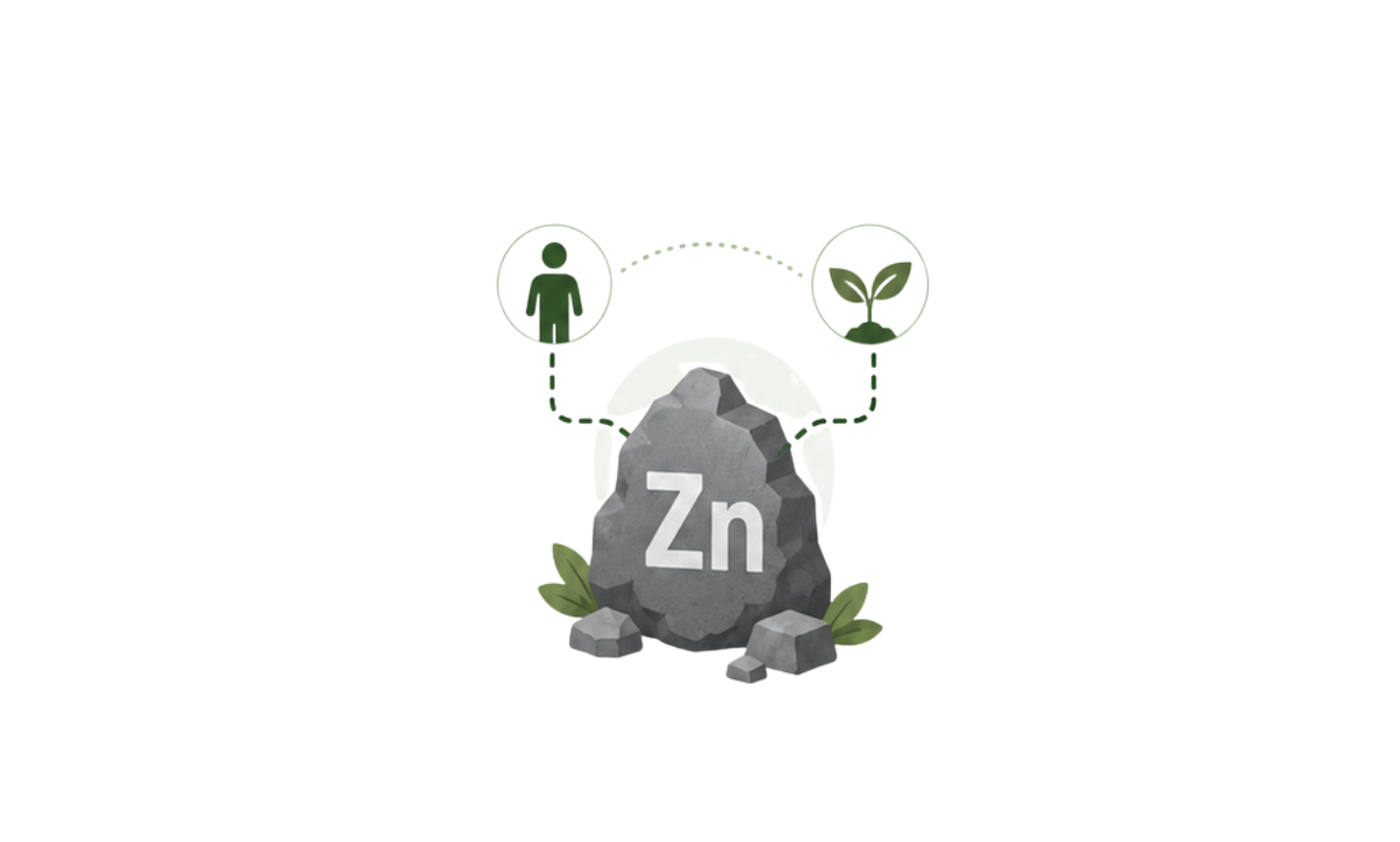
These less visible functions create a unique link between mineral resources, human health and agriculture. In soils, zinc availability affects plant nutrition and can influence how much zinc ends up in crops. In humans, diet is the main source of zinc, but the amount actually absorbed depends on its bioavailability. This article explores these distinctive roles of zinc, along with the farming practices that help manage its availability more effectively.
Key Takeaways
Zinc is a component of more than 300 enzymes involved in the metabolism of carbohydrates, lipids, proteins and nucleic acids [1].
An analysis published in 2024 estimates that about 15% of the world's population, or 1.13 billion people, has inadequate dietary zinc intake when existing fortification programmes are taken into account [9].
Zinc is an essential micronutrient for plants. When it is scarce in soils, crop growth, productivity and the zinc content of edible parts may decline [2].
According to an International Zinc Association fact sheet citing FAO data, nearly 50% of the world's agricultural soils are thought to be zinc deficient [2].
According to ILZSG forecasts, global refined zinc production was expected to reach 13.8 million tonnes in 2025, compared with estimated consumption of 13.7 million tonnes [8].
The role of Zinc in the Human Body
The role of zinc in the human body extends far beyond its familiar use in certain cold products. This micronutrient is involved in many biological processes related to metabolism, growth, gene expression and immune function.
Zinc's Enzymatic and Cellular Functions
An enzyme is a biological catalyst, meaning a molecule that speeds up chemical reactions in the body without being used up in the process. Zinc is a component of more than 300 enzymes and takes part in the metabolism of carbohydrates, lipids, proteins and nucleic acids [1].
At the cellular level, its main functions include:
Cellular metabolism, through its role in many enzymes involved in building and breaking down essential molecules [1].
Cell stability, since it helps maintain the structure of certain cellular components and membranes [1].
Gene expression, particularly through its role in transcribing genetic information [1].
Tissue renewal, which is especially important in systems where cells turn over rapidly, such as the immune system and the gastrointestinal tract [3].
An inadequate intake can therefore disrupt several physiological functions, including growth, protein synthesis and certain immune responses.
The Role of Zinc in Immune Function
Zinc also plays an important part in immunity. It is involved in the development, maintenance and activation of cells associated with both innate and adaptive immune responses [4]. It further helps preserve epithelial barriers, such as the skin and mucous membranes, which form a first line of defence against pathogens [4].
Research highlights several mechanisms linked to zinc:
Support for immune cells, thanks to its role in their development and activity [4].
Maintenance of physical barriers, particularly in epithelial tissues [4].
Antiviral effects observed experimentally, as higher intracellular zinc levels can inhibit the replication of some RNA viruses and interfere with certain stages of their replication cycle [4].
From a clinical standpoint, studies have also assessed the use of zinc lozenges against the common cold. A review published in 2020 reports that some studies observed reductions of up to 54% in the duration or severity of certain symptoms, depending on the parameters examined [4].
What Is Zinc Deficiency?
Zinc deficiency refers to an intake or zinc status that falls short of meeting the body's needs. Because this micronutrient contributes to growth, immune function, protein synthesis and numerous cellular processes, a shortfall can affect several physiological functions [3].
Globally, the risk remains significant. An analysis published in 2024 estimates that roughly 15% of the world's population, or 1.13 billion people, may have inadequate dietary zinc intake, based on modelling that accounts for existing food fortification programmes [9]. This risk varies depending on diet composition and zinc bioavailability, that is, the proportion the body actually absorbs [1].
This nutritional dimension ties directly into agriculture: when zinc is scarce in soils, some crops may show reduced growth and lower zinc content in their edible parts [2]. The issue of zinc deficiency therefore sits at the crossroads of nutrition, food and agricultural soil quality.
The Role of Zinc in Agriculture
Zinc in agriculture plays an important role in plant growth, crop yields and nutritional quality. When this micronutrient is in short supply in soils, the effects can touch both agricultural output and the zinc content of the edible parts of plants [2].
Why Plants Need Zinc
Zinc is an essential micronutrient for plants, required in small amounts but vital to several functions tied to their growth and development [2]. In plant tissues, a concentration between 25 and 150 mg/kg is generally considered normal, while levels below 20 mg/kg may point to a deficiency [5].
A lack of available zinc can have several consequences:
reduced crop growth and productivity [2];
lower zinc content in edible parts, particularly cereal grains [2];
diminished nutritional quality of harvests in regions where these crops make up a large share of the diet [2].
Soil zinc availability can thus help connect agriculture and nutrition. On its own, however, it does not determine the zinc status of populations, which also hinges on dietary composition and the micronutrient's bioavailability.
Zinc and Crop Biofortification
While fertilization can improve zinc availability in soils, other strategies aim to raise its concentration within the crops themselves. One such approach is varietal biofortification, which involves developing varieties of wheat, rice, maize and other crops capable of accumulating more zinc in their edible parts [6]. The goal is to enhance the nutritional quality of food, especially in regions where these staples account for a substantial portion of the diet.
Its rollout has now moved well past the experimental stage. As early as 2016, biofortified crops, including zinc-enriched rice and wheat, were being grown in 30 countries [7]. Biofortification thus complements fertilization practices, showing that zinc's role in agriculture covers both plant growth and harvest quality.
Conclusion
Zinc holds a special place among mineral resources because of the variety of its functions. Essential to the human body, it also plays a key role in plant growth and crop quality. Alongside these biological and agricultural uses comes a far larger industrial demand, notably for steel galvanization and corrosion protection.
In the farming sector, fertilization and biofortification illustrate different ways of better managing the availability of this micronutrient in soils and crops. These applications show that the properties of a mineral resource can carry implications reaching well beyond its traditional industrial uses.
Gaining a clearer understanding of zinc's role, uses and availability therefore sheds light on the value of this resource in sectors as diverse as industry, agriculture and nutrition.
Follow Squatex on LinkedIn to stay up to date on topics related to natural resources and the energy transition.
References
[1] World Health Organization, and Food and Agriculture Organization of the United Nations. “Chapter 16. Zinc.” Vitamin and Mineral Requirements in Human Nutrition, 2nd ed., World Health Organization and Food and Agriculture Organization of the United Nations, 2004. https://www.fao.org/4/y2809e/y2809e0m.htm
[2] Zinc Nutrient Initiative. Zinc Fact Sheet: Zinc Fertilizer Overview. International Zinc Association, 2015. https://crops.zinc.org/wp-content/uploads/sites/11/2016/12/Zinc-Fertilizer-Overview-General-Pop-June-2015.pdf
[3] World Health Organization, and Food and Agriculture Organization of the United Nations. “Evaluating the Public Health Significance of Micronutrient Malnutrition.” Guidelines on Food Fortification with Micronutrients, edited by Lindsay Allen et al., World Health Organization and Food and Agriculture Organization of the United Nations, 2006. https://www.who.int/docs/default-source/micronutrients/gff-part-2-en.pdf
[4] Name, José João, et al. “Zinc, Vitamin D and Vitamin C: Perspectives for COVID-19 With a Focus on Physical Tissue Barrier Integrity.” Frontiers in Nutrition, vol. 7, 2020, article 606398. https://doi.org/10.3389/fnut.2020.606398
[5] Keshari, Pankaj Kumar, Ranjan Laik, Abhinandan Singh, and Sudip Sarkar. “Effect of Zinc on Growth, Yield and Zinc Use Efficiency of Rice in Rice–Wheat Cropping System.” International Journal of Plant & Soil Science, vol. 29, no. 1, 2019, pp. 1–8. https://doi.org/10.9734/IJPSS/2019/v29i130134
[6] Hotz, Christine. “The Potential to Improve Zinc Status through Biofortification of Staple Food Crops with Zinc.” Food and Nutrition Bulletin, vol. 30, no. 1 suppl., 2009, pp. S172–S178. https://doi.org/10.1177/15648265090301S109
[7] HarvestPlus. Biofortification: The Evidence. HarvestPlus, 2016. https://assets.publishing.service.gov.uk/media/57a08961ed915d3cfd0001f8/HarvestPlus-Biofortification-Evidence-Brief.pdf
[8] U.S. Geological Survey. “Zinc.” Mineral Commodity Summaries 2026, U.S. Geological Survey, 2026. https://pubs.usgs.gov/periodicals/mcs2026/mcs2026-zinc.pdf
[9] Wessells, K. Ryan, et al. “Mandatory Large-Scale Food Fortification Programmes Can Reduce the Estimated Prevalence of Inadequate Zinc Intake by up to 50% Globally.” Nature Food, vol. 5, 2024, pp. 625–637. https://doi.org/10.1038/s43016-024-00997-w
