

SMR, MSR and Thorium: Understanding Next-Generation Nuclear Power
In a context of global energy transition, the production of low-carbon, reliable and dispatchable electricity is emerging as a central challenge. Nuclear energy, as a low-emission energy source, plays a key role in this balance.
Small modular reactors (SMR), including molten salt reactors (MSR) compatible with thorium, represent a new generation of nuclear design built to be more flexible, safer and suited to the needs of small grids or isolated sites. Their small size makes them easier to finance, and their modular manufacturing promises shorter deployment timelines [1]. Meanwhile, interest in thorium MSRs is growing in several countries, notably China, as they rely on a fuel cycle distinct from conventional uranium.
Thorium: An Emerging Nuclear Fuel
Thorium (Th-232) is a naturally occurring element found in the Earth's crust, with an average concentration of approximately 6 parts per million (ppm). It is generally dispersed across a wide variety of rocks, particularly igneous rocks, but can also concentrate in certain specific minerals. This relative abundance makes it approximately three times more prevalent in nature than uranium [4].
A fundamental distinction sets thorium apart from uranium: it is described as "fertile" rather than "fissile". In other words, thorium cannot directly trigger a nuclear chain reaction on its own. It must first absorb a neutron to transform into uranium-233 (U-233), a fissile isotope capable of fuelling a nuclear reactor [4]. This conversion mechanism is at the heart of the interest shown by next-generation reactor designers.
Geologically, thorium is primarily extracted from monazite, a phosphate mineral associated with rare earth elements, in which it is present in variable proportions (averaging between 6 and 7%) [4]. At the global scale, estimated thorium resources reach 6,355,000 tonnes [4], an abundance that contributes to the growing strategic interest in this resource in the context of the energy transition.
SMRs: Definition, Technologies and Development Status
Small modular reactors (SMR) represent a significant evolution in nuclear power plant design. Unlike conventional large-scale reactors, they are designed to be factory-built, transported to site, and deployed according to need.
What is an SMR?
An SMR is an advanced nuclear reactor with a capacity of up to 300 MWe per unit, approximately one third of the generating capacity of conventional nuclear reactors [3]. This reduction in scale is not simply a matter of size: it fundamentally transforms the logistics of construction and deployment. These reactors are designed to be assembled in a factory, then delivered to operators as needed, and can be installed on sites where large power plants would not be feasible.
According to the IAEA, SMRs span several distinct technology lines: water-cooled reactors, gas-cooled high-temperature reactors, liquid-metal-cooled fast neutron reactors, and molten salt reactors (MSR), alongside floating plant and microreactor categories [1].
Why Are SMRs Attracting Growing Interest?
Several factors explain the growing enthusiasm for this technology. According to the IAEA, SMRs simultaneously address several needs: more flexible electricity generation, replacement of ageing fossil fuel units, improved safety performance, and greater economic accessibility [2]. Their modular design promises shorter construction timelines and series production economies [1].
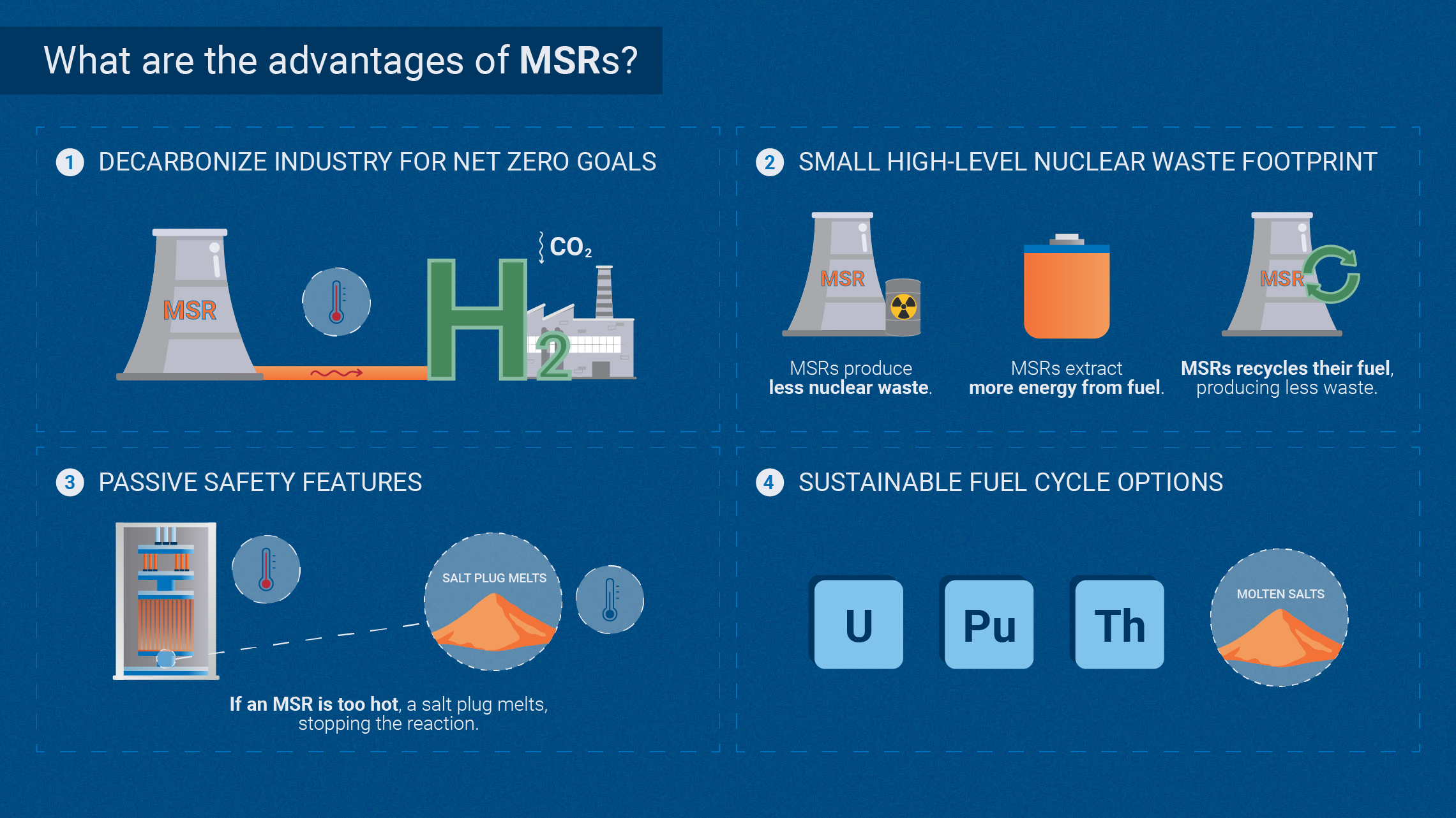
Beyond electricity generation, SMRs are also distinguished by their application versatility. Their format is particularly well suited to non-electrical uses: heat supply for industrial processes, hydrogen production, or seawater desalination. Cogeneration significantly improves thermal efficiency and return on investment [6]. This is a characteristic that clearly sets them apart from large conventional power plants, whose purpose remains almost exclusively electricity generation.
Table 1 — SMR vs Conventional Nuclear Reactor
| Characteristic | Conventional Reactor | SMR |
|---|---|---|
| Typical capacity | ~1,000 MWe | Up to 300 MWe |
| Manufacturing mode | On-site construction | Modular, factory-built |
| Grid adaptability | Large grids | Small grids, isolated sites |
| Applications | Electricity | Electricity + heat + hydrogen + desalination |
SMRs for Remote Regions and Isolated Industrial Sites
The IAEA highlights that SMRs are ideal for niche markets where large reactors are not viable, particularly in areas where electricity grids are small or in geographically isolated sectors [2]. This characteristic is especially relevant in northern or mining contexts, where access to reliable energy infrastructure is often a central challenge.
Marine-based SMRs illustrate this potential well: they can be factory-built, assembled at a shipyard, then delivered to remote sites or exported to other countries [7]. They have the potential to play an important role in the cogeneration of electricity and heat for remote and off-grid communities, where large land-based power plants are simply not feasible [7]. This deployment flexibility opens the way to applications in sectors such as northern mining, where the need for clean, stable energy combines with the absence of connection to large grids.
Molten Salt Reactors (MSR): The Technology Opening the Path to Thorium
Among the various SMR technology lines, molten salt reactors (MSR) occupy a special place: they are the technology most naturally compatible with thorium as a fuel and have been the subject of renewed global interest since the 2010s.
What is a Molten Salt Reactor?
A molten salt reactor (MSR) is a type of nuclear reactor in which the fuel is dissolved in a liquid fluoride salt, rather than being encapsulated in a solid. This molten salt plays a dual role: it serves both as a heat transfer fluid (transferring heat to the heat exchanger) and as a matrix for the fissile fuel [5]. This is a radically different approach from the pressurised water reactors we know today.
The reference mixture used in these reactors is lithium-beryllium fluoride (FLiBe). Thorium, uranium and plutonium form compatible fluoride salts that dissolve readily in this mixture, and thorium can be easily separated from uranium in fluoride form [5]. MSRs are not a radical novelty: the first such reactors were operated in the 1960s. They are today regarded as a promising technology, primarily for the thorium fuel cycle or for valorising spent fuel from light water reactors [5]. Global MSR research is currently led by China [5].
Why is the MSR Well Suited to Thorium?
The link between MSRs and thorium stems from a natural chemical and physical compatibility. MSRs are particularly well suited to thorium fuel, as they allow conventional solid fuel fabrication to be avoided. The liquid fuel can directly incorporate thorium and uranium fluorides (U-233 and/or U-235) [4]. This mixture operates in a temperature range of 400 to 700 °C, providing both heat transfer and support for the fuel in fission [4].
Furthermore, MSRs can accommodate multiple nuclear fuel cycles, including the Uranium-Plutonium cycle and the Thorium-Uranium cycle, which allows for an expanded range of available fuel resources for electricity production [2]. One of the most advanced variants, the Molten Salt Fast Neutron Reactor (MSFR), incorporates the thorium fuel cycle, actinide recycling and a closed Th/U cycle without uranium enrichment, with enhanced safety and minimal waste [10].
Source: iaea
The Status of MSR in International Research
The molten salt reactor is one of the six reactor technologies selected by the Generation IV International Forum for research and development [4]. This selection reflects the institutional recognition of its potential on a global scale.
According to the IAEA and the World Nuclear Association, MSRs are expected to offer advantages over current light water reactors in several respects: safety, environment, economics and proliferation resistance. High operating temperatures improve electricity generation efficiency, while passive decay heat removal and flexible fuel cycles constitute further distinctive assets [4]. The technology is also suited to the SMR format, further broadening its deployment potential [4].
Advantages of SMR/MSR with Thorium: Safety, Waste and Energy Transition
Beyond their deployment flexibility, next-generation SMRs, particularly thorium MSRs, are distinguished by technical characteristics that address several of the concerns historically associated with nuclear energy: waste management, safety and carbon footprint.
Reduction of Radioactive Waste and Radiotoxicity
The question of radioactive waste is often at the heart of debates surrounding nuclear energy. In this context, the thorium fuel cycle presents distinctive characteristics. It constitutes an attractive pathway to produce nuclear energy over the long term with low-radiotoxicity waste [8].
In an MSR specifically, at thorium fuel cycle equilibrium, the expected radiotoxicity is reduced compared to conventional uranium cycles. Fission products constitute the majority of residues, while the formation of transuranium actinides is strongly limited through fuel management and online reprocessing [4].
To quantify this advantage, a feasibility study on thorium molten salt microreactors indicates that the use of thorium rather than uranium could reduce minor actinide production by approximately 100-fold, while also enhancing proliferation resistance characteristics [9].
Passive Safety of Modern SMRs
Modern SMRs are designed according to a so-called "passive" safety philosophy, which relies more on natural forces than on active mechanical systems. Concretely, these reactors harness pressure, gravity, natural circulation and convection to ensure their safety, thereby reducing dependence on active equipment such as pumps, fans or diesel generators [1].
As an example, the AP300 design — one of the models documented in the IAEA 2024 catalogue — includes safety systems capable of operating without alternating current power supply for at least 72 hours [1].
The Role of SMR/MSR in the Energy Transition
In a global context where decarbonisation of energy systems is emerging as a priority, SMRs and thorium MSRs fit into a coherent technological trajectory. The International Atomic Energy Agency (IAEA) emphasises that achieving the goals of the Paris Agreement — notably limiting climate warming to well below 2 °C — will require mobilising all sources of low-carbon energy. In this framework, nuclear power is experiencing renewed interest as a low-emission electricity source contributing to the reduction of greenhouse gases.
SMRs in particular address growing needs for flexible electricity generation adaptable to a diversity of uses. They offer solutions to replace ageing fossil fuel infrastructure, while improving safety standards and facilitating access to financing through their modular design [6]. The IAEA also recognises their potential as a viable solution for energy supply security, both in countries embarking on nuclear energy and in those seeking to expand it [6].
Conclusion
SMRs and thorium MSRs are not simply variants of existing nuclear reactors. They represent a rethought approach to nuclear energy, designed to meet the constraints of the contemporary world.
In a context where the energy transition demands both reliability, flexibility and a low carbon footprint, these technologies offer a technical response worthy of attention — particularly for industrial and mining sectors operating in remote regions or outside major grids. Thorium, as an abundant geological resource, opens the way to a sustainable nuclear fuel cycle, with distinctive safety and waste management characteristics compared to conventional approaches.
Squatex is following with interest the progress in the field of low carbon footprint energies, including thorium, as well as their potential in certain emerging energy technologies.
References
[1] International Atomic Energy Agency. Small Modular Reactor Technology Catalogue 2024. IAEA, 2024, https://aris.iaea.org/Publications/SMR_catalogue_2024.pdf.
[2] International Atomic Energy Agency. "Small Modular Reactors." IAEA Topics, IAEA, https://www.iaea.org/topics/small-modular-reactors.
[3] World Nuclear Association. "Small Modular Reactors." World Nuclear Association Information Library, WNA, https://world-nuclear.org/information-library/nuclear-power-reactors/small-modular-reactors/small-modular-reactors.
[4] World Nuclear Association. "Thorium." World Nuclear Association Information Library, WNA, 2024, https://world-nuclear.org/information-library/current-and-future-generation/thorium.
[5] World Nuclear Association. "Molten Salt Reactors." World Nuclear Association Information Library, WNA, https://world-nuclear.org/information-library/nuclear-power-reactors/other/molten-salt-reactors.
[6] International Atomic Energy Agency. Small Modular Reactors and Their Applications: Advances in SMR Developments 2024. IAEA, https://aris.iaea.org/publications/smr_book_2020.pdf.
[7] International Atomic Energy Agency. Small Modular Reactors for Marine-Based Nuclear Power Plants. IAEA, https://aris.iaea.org/publications/Marine-Based%20SMR_V8_A4%20format.pdf.
[8] International Atomic Energy Agency. Thorium Fuel Cycle — Potential Benefits and Challenges. IAEA-TECDOC-1450, IAEA, 2005, https://www-pub.iaea.org/MTCD/Publications/PDF/TE_1450_web.pdf.
[9] Rummana, A., R. Barlow, G. Myneni, and S. M. Saad. "A Feasibility Study of a Thorium Fueled Molten Salt Micro Modular Subcritical Reactor Using an Electron Accelerator." arXiv, 26 Mar. 2024, doi:10.48550/arXiv.2401.12056.
[10] World Nuclear Association. "Generation IV Nuclear Reactors." World Nuclear Association Information Library, WNA, https://world-nuclear.org/information-library/nuclear-power-reactors/other/generation-iv-nuclear-reactors.
