

Deep Geothermal Energy (EGS): How Does Enhanced Geothermal Work?
The global energy transition rests on a central challenge: producing clean electricity that is continuously available and deployable at scale. Among emerging solutions, enhanced deep geothermal energy (EGS) is attracting growing attention. According to an analysis by the Center on Global Energy Policy at Columbia University, its technical potential could represent 60 times the world's currently installed electricity capacity [6]. A figure that contrasts sharply with the still modest diffusion of conventional geothermal energy, long confined to very specific geographic zones.
Unlike conventional geothermal energy, historically limited to volcanic or hydrothermal regions, this system aims to harness subsurface heat in hot but low-permeability rocks. By modifying the characteristics of the geological reservoir, this technology considerably expands the global map of exploitable resources [3].
Developed since the 1970s and now being tested at larger scales in the United States and Europe, EGS is positioning itself as a credible candidate to provide firm energy, complementary to intermittent renewables.
Conventional Geothermal Energy: Principles and Limitations
What Geothermal Energy is
Geothermal energy consists of harnessing the heat naturally present in the Earth's crust, either to produce electricity or to provide heat directly to buildings or industrial processes. It is recognized as a clean, renewable, and stable energy source.
A particularly valuable aspect of geothermal energy is that it constitutes firm energy — that is, energy produced in a constant and predictable manner, independent of weather conditions. Unlike solar or wind, whose production fluctuates with sunshine or wind, a geothermal power plant has the potential to operate 24 hours a day.
In its conventional form, however, geothermal energy only works when three conditions are naturally met in the subsurface: heat, water (the geothermal fluid), and rock that is permeable enough for this fluid to circulate. As the U.S. Department of Energy specifies, conventional geothermal resources require that "natural heat, water, and rock permeability be sufficient to allow energy extraction" [2]. The Geysers installation in California is a well-known example meeting all three criteria: it constitutes one of the largest conventional geothermal power plants in the world [7].
The Geographic Limitations of Conventional Geothermal Energy
The main constraint of conventional geothermal energy lies in the scarcity of geological settings that simultaneously combine high heat, the presence of a fluid, and sufficient permeability. As such, it is "limited to regions endowed with naturally superheated reservoirs" [7].
What this means in practice is that the majority of accessible geothermal resources are found in dry and impermeable rocks, making them unworkable with conventional techniques [2].
It is precisely to address this limitation that enhanced geothermal energy was developed.
Enhanced Deep Geothermal Energy (EGS): Definition
Enhanced geothermal energy was precisely designed to break free from the geological constraints that limit conventional geothermal energy. By intervening on subsurface properties rather than relying solely on naturally favorable conditions, it considerably expands exploitable zones.
Definition of EGS
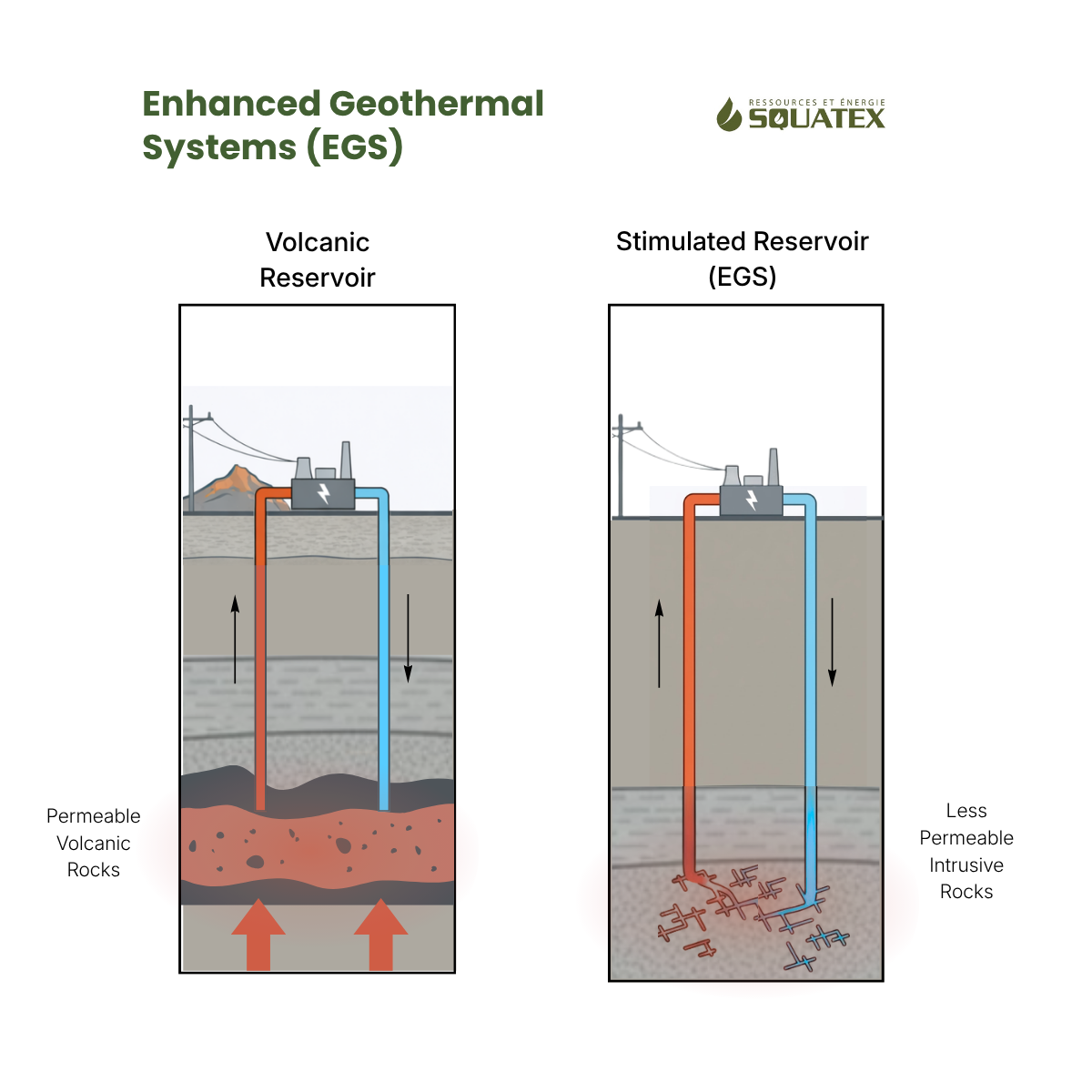
EGS (Enhanced Geothermal System) refers to a technology aimed at exploiting subsurface heat in hot but naturally dry or low-permeability rock formations, where conventional geothermal energy cannot be used.
Two broad categories of geothermal systems are generally distinguished: conventional (hydrothermal) systems and enhanced (EGS) systems, formerly called Hot Dry Rock (HDR) [4]. Unlike hydrothermal systems, which rely on the natural presence of a hot, permeable, fluid-saturated reservoir, EGS involves stimulating the subsurface to increase its permeability and enable the circulation of a fluid capable of absorbing heat and then bringing it back to the surface to produce electricity or heat.
The majority of recent geothermal power plants — both hydrothermal and EGS — now use binary cycle systems, suited to moderate-temperature resources, while dry steam and flash steam technologies remain associated with higher-temperature resources [4].
How Does It Work?
The operation of an EGS system relies on three main steps that transform heat buried in the ground into usable electricity.
Deep drilling: Wells are drilled to great depths, through hard, hot, and impermeable rocks, to form an artificial underground reservoir [7].
Hydraulic stimulation and fracture creation: Fluid is injected under pressure into these rocks, under carefully controlled conditions, in order to create new fractures or reopen existing natural ones. It is worth clarifying here what is meant by permeability: it refers to the property of a rock to allow a fluid to circulate through its pores or fractures. By increasing this permeability, the fluid can now flow freely through the hot rock, heat up in contact with it, and then be recovered [1].
Extraction and electricity production: The hot fluid, which has absorbed heat from the rock at depth, is brought back to the surface through a second well. This heat is then used to drive a turbine and produce electricity [7].
Just like conventional geothermal energy, EGS power plants are baseload resources: they produce electricity at a constant rate, without interruption due to weather conditions or the time of day [2].
The Distinct Advantages of EGS
Beyond its technical operation, EGS is distinguished by considerable global energy potential and a rapidly improving cost trajectory. These two dimensions make it one of the most closely watched geothermal technologies in discussions about the energy transition.
Several characteristics distinguish EGS from other renewable electricity sources:
Clean and firm energy: EGS presents "the potential to provide clean, firm energy in the form of electricity and/or direct heat." Its production is constant, independent of seasons and climate conditions, making it a natural complement to intermittent energy sources.
Unprecedented geographic flexibility: Compared to conventional geothermal energy, EGS can "be deployed anywhere there are rocks that are hot enough close enough to the Earth's surface" [7]. This characteristic represents a fundamental shift away from dependence on volcanic or hydrothermal zones.
Broad energy base resource: The internal heat of the Earth is continually produced by natural geophysical processes, making it conceivable to exploit it sustainably on a human timescale.
Small surface footprint: EGS installations require a significantly more limited physical surface area than a solar or wind farm, a considerable advantage in contexts where space is constrained.
Concrete Projects: Two Examples from Around the World
Enhanced geothermal energy is not just a theoretical concept. Several projects have already demonstrated its technical feasibility at very different stages of maturity, ranging from demonstration to the beginnings of commercialization.
Soultz-sous-Forêts, France
The Alsatian site of Soultz-sous-Forêts is one of the most emblematic EGS projects in Europe. It has demonstrated that a system based on three wells drilled to 5,000 meters depth, combining enhanced drilling methods, hydraulic stimulation, and subsurface diagnostics, can successfully access geothermal energy at depth [8]. Its governance by an industrial consortium — rather than academic laboratories alone — illustrates the transition toward reproducible and potentially investable economic models.
The study from this project also concludes that this EGS technology "can be applied in large areas of Europe, beneath which naturally fractured hot rock masses exist" [8]. This confirms that the geographic replicability of EGS extends well beyond zones of high volcanic activity.
Utah FORGE, United States
Across the Atlantic, Utah FORGE (Frontier Observatory for Research in Geothermal Energy) is the flagship demonstration site for the U.S. Department of Energy's geothermal program, operated by the University of Utah. Its "ultimate goal is to demonstrate the viability of EGS development" in a controlled environment allowing technologies to be developed, tested, and optimized [9]. In 2023, the Utah FORGE R&D portfolio comprised 17 projects covering five thematic areas, with a total value of $53.03 million [9].
It is at this site that the most spectacular cost reductions have been recorded: drilling speeds have improved by more than 500% and per-well costs have dropped from $13 million to $5 million [5]. With a view to commercialization by 2030, a national-scale EGS deployment in the United States would require a presence in 4 to 6 states to validate the technology under different geological conditions, with a production target of 2 to 5 GW and an estimated investment of $20–25 billion [6].
Also read: "Concrete Applications of Geothermal Energy"
EGS and the Mining Sector: Converging Competencies
EGS offers an often overlooked advantage: its development relies largely on know-how already present in the drilling and underground exploration sectors. According to Columbia University's analysis, "most of the skills and expertise needed to develop geothermal capacity are already available in the oil and gas industry" [6]. For every dollar invested in geothermal energy, between 65 and 80% represents a direct overlap with the competencies of this industry [6].
In practical terms, this means that deep directional drilling techniques, well management, reservoir characterization, and subsurface fluid management — well known in the mining and petroleum sectors — are directly transferable to EGS development. Furthermore, in Canada, Natural Resources Canada confirms that geothermal potential exists at the national scale, but that "more data are needed for much of the Canadian territory" [10]. This observation points to the importance of exploration and geological characterization in the future growth of the technology.
Conclusion
EGS has moved, in just a few years, from the stage of fundamental research to that of a technology on the cusp of commercialization. In a context where the global energy transition demands electricity sources capable of complementing intermittent energies, deep geothermal energy represents an increasingly serious option. Its ability to produce firm energy, wherever the subsurface is sufficiently hot, makes it a potentially valuable tool for the stability of tomorrow's electrical grids.
The Earth's subsurface holds resources that are still largely underexplored. Deep geothermal energy illustrates how exploration and advanced drilling technologies can contribute to building more resilient and decarbonized energy systems. This is a field that Squatex follows with great interest, in keeping with its commitment to subsurface resources and the energies of tomorrow.
Follow Squatex on LinkedIn to stay informed of advances in the field of renewable energies and subsurface resources, or consult other articles on the blog about geothermal energy to explore the subject further.
References
[1] U.S. Department of Energy. "Enhanced Geothermal Systems (EGS)." Office of Energy Efficiency & Renewable Energy, U.S. DOE, https://www.energy.gov/hgeo/geothermal/enhanced-geothermal-systems.
[2] "Enhanced Geothermal System." Wikipedia, Wikimedia Foundation, https://en.wikipedia.org/wiki/Enhanced_geothermal_system.
[3] "Enhanced Geothermal Systems for Clean Firm Energy Generation." Nature Reviews Earth & Environment, 2025. Springer Nature, https://www.nature.com/articles/s44359-024-00019-9.
[4] S. et al. "From Hot Rock to Useful Energy: A Global Estimate of Enhanced Geothermal Systems Potential." Applied Energy, vol. 261, 2020. Elsevier, https://www.sciencedirect.com/science/article/abs/pii/S0306261920312551.
[5] ThinkGeoEnergy. "US DOE Publishes Report on Commercial Liftoff of Next-Generation Geothermal." ThinkGeoEnergy, 2023–2024. https://www.thinkgeoenergy.com/us-doe-publishes-report-on-commercial-liftoff-of-next-generation-geothermal/.
[6] Columbia University, Center on Global Energy Policy. "The Potential Contribution of Enhanced Geothermal Systems to Future Power Supply: Roundtable Summary." Columbia SIPA, 2025. https://www.energypolicy.columbia.edu/publications/the-potential-contribution-of-enhanced-geothermal-systems-to-future-power-supply-roundtable-summary/.
[7] Princeton University School of Engineering. "Enhanced Geothermal Systems: An Underground Tech Surfaces as a Serious Clean Energy Contender." Princeton Engineering News, July 7, 2025. https://engineering.princeton.edu/news/2025/07/07/enhanced-geothermal-systems-underground-tech-surfaces-serious-clean-energy-contender.
[8] European Commission. "European Geothermal Project for the Construction of a Scientific Pilot Plant Based on an Enhanced Geothermal System (EGS PILOT PLANT)." CORDIS, project no. 502706. https://cordis.europa.eu/project/id/502706/fr.
[9] University of Utah. "Utah FORGE — 2023 Annual Report Phase 3B." Geothermal Data Repository, project DE-EE0007080, 2023. U.S. DOE, https://gdr.openei.org/files/1523/2023%20Annual%20Report%20Phase%203B%20and%20Appendices%20for%20GDR.pdf.
[10] Natural Resources Canada. "Geothermal Energy." Government of Canada, https://natural-resources.canada.ca/energy-sources/renewable-energy/geothermal-energy.
