

Introduction
Thorium is currently drawing renewed interest in the field of nuclear energy, particularly with the development of advanced reactors in China and India. This resource, roughly three times more abundant than uranium in the Earth's crust, has global reserves estimated at 6,355,000 tonnes [1]. Yet despite this potential and several conclusive technical demonstrations, thorium remains far less widespread than uranium in commercial nuclear applications today.
This contrast is partly explained by historical choices. From the earliest days of nuclear power, thorium was the subject of serious research. However, the uranium-plutonium pathway prevailed, driven by strategic and military considerations tied to the Cold War context, which durably shaped the development of civilian technologies [2].
Two fuels, two destinies
From the dawn of the nuclear era, thorium and uranium were both considered credible options for powering reactors. Their coexistence was not merely theoretical: it reflected two distinct approaches to the fuel cycle, each with its own technical constraints and development prospects.
Fertile thorium, fissile uranium: a structuring distinction
The distinction between fissile and fertile materials lies at the heart of this divergence. A fissile material, such as uranium-235, can directly sustain a chain reaction after absorbing a neutron. By contrast, a fertile material cannot fission immediately: it must first be transformed into a fissile isotope through neutron irradiation.
This is the case for thorium-232, which converts into uranium-233. This additional step has concrete implications for reactor design and for fuel management.
In practice, this translates into several key differences:
Thorium is a fertile, not a fissile element. It requires the initial addition of a fissile material, such as enriched uranium or plutonium, to initiate the nuclear reaction [1].
Thorium-232 has a thermal neutron absorption cross-section of about 7.4 barns, compared to 2.7 barns for uranium-238. It therefore converts more efficiently into uranium-233 than uranium-238 transforms into plutonium-239 [2].
The uranium-233 produced by this cycle has a high neutron yield. The number of neutrons emitted per neutron absorbed exceeds 2.0 across a wide range of conditions, which offers greater flexibility for designing reactors and even for considering breeder cycles [2].
These characteristics show that thorium is not merely a marginal alternative, but rather a different approach to the nuclear cycle. They explain why this pathway generated real interest from the earliest decades of atomic development.
An abundance that was not enough
Geologically, thorium has a clear advantage. It is present in the Earth's crust at an average concentration of about 6 parts per million (ppm), a level higher than that of uranium [1].
On a global scale, assured and inferred recoverable resources (at a cost less than or equal to $80/kg) reach 6,355,000 tonnes, with three countries leading the way [1]:
Iran (1,700,000 tonnes)
India (846,000 tonnes)
Brazil (632,000 tonnes)
From the 1950s through the 1970s, interest in this resource was real, motivated by the desire to supplement uranium reserves that were considered limited at the time. But these reserves ultimately proved sufficient, which reduced the urgency of developing an alternative pathway [2]. As a result, the competition between the two cycles came to be shaped by far more than geological criteria alone.
Also read: "Thorium vs uraniu: a direct comparison"
The Cold War as a structuring factor
The choice of uranium as the dominant fuel is not explained solely by technical considerations. It is set within a particular historical context, marked by the Cold War, in which military and strategic priorities strongly influenced the direction of civilian nuclear programs.
Plutonium, a central strategic stake
Plutonium is an artificial element produced when a uranium-238 nucleus captures a neutron within a reactor. From the earliest days of the nuclear era, it was identified as a key material for manufacturing nuclear weapons, which gave it major strategic importance.
In this context, the development of nuclear reactors did not respond solely to electricity production goals. It was also part of a logic of support for military programs.
Several factors thus favored the uranium-plutonium pathway:
From the mid-1950s, the development of civilian reactors in the United States was closely tied to military programs and to naval propulsion. Light-water reactors, fueled with uranium, were favored for their ability to provide compact cores with high power density, suited to naval uses [2].
At the same time, the production of plutonium in certain types of reactors was a strategic asset for nuclear weapons programs, which helped steer choices toward the uranium-plutonium cycle [2].
Conversely, thorium-based pathways required different fuel processing chains that were less aligned with the nuclear infrastructure developed for military purposes, which limited their integration into existing programs [2].
Finally, the thorium-uranium-233 cycle has proliferation-resistance characteristics. The presence of uranium-232 generates intense gamma radiation, making the material more complex to handle and more easily detectable, unlike plutonium, which can be chemically separated for military use [2].
In other words, what now constitutes an advantage of thorium in terms of non-proliferation was precisely what made it unattractive for the military needs of the time.
Hyman Rickover and the emergence of an industrial standard
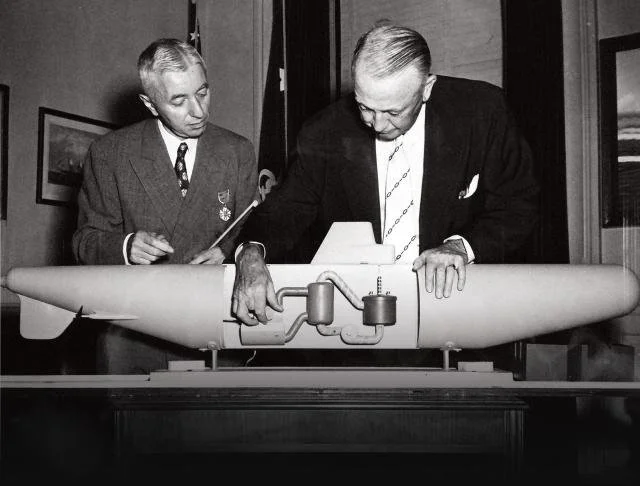
Beyond general considerations, certain individual decisions played a decisive role in shaping the nuclear industry. This is notably the case for those made by Admiral Hyman Rickover, a central figure in the American naval nuclear program.
As director of the Naval Reactors office, Rickover oversaw the development of the first reactors intended for the propulsion of nuclear submarines. The technical choices made in this framework had lasting consequences.
In the early 1950s, the reactor of the submarine USS Nautilus was designed as a light-water reactor using enriched uranium (uranium-235). This configuration made it possible to obtain a compact, reliable system suited to the operational constraints of submarines [4].
This type of reactor then served as the basis for the development of civilian nuclear power plants. The light-water reactor gradually established itself as the dominant model worldwide, owing to its technological maturity and the accumulated experience.
This initial choice created a form of technological inertia. Industrial infrastructure, regulatory frameworks, technical skills, and supply chains were structured around the uranium pathway, making the introduction of alternatives such as thorium more complex and more costly over time.
Documentary photo of the USS Nautilus (SSN-571), the world's first nuclear-powered submarine, commissioned in 1954. Source: U.S. Navy / Naval History and Heritage Command
Molten salt reactors: an old technology revived
Molten salt reactors (MSR) are not a recent innovation. As early as the 1960s, Oak Ridge National Laboratory (ORNL) developed the Molten Salt Reactor Experiment (MSRE), operated between 1965 and 1969. This program demonstrated the feasibility of the concept, notably with the use of uranium-235 and then uranium-233 derived from thorium, before being abandoned in favor of pressurized water reactors.
The technology then remained little used until China actively revived this work starting in 2011. The current program follows in the continuity of the American research, part of which had been made public, and aims to adapt these concepts to contemporary technologies [3].
Distinct technical characteristics
Molten salt reactors using thorium have several characteristics that distinguish them from conventional nuclear reactors [3]:
The fuel is dissolved in a molten salt, which acts both as a coolant and as a reaction medium, allowing operation at high temperatures (above 700 °C) without requiring high pressure.
The thorium cycle relies on the conversion of thorium-232 into uranium-233, which introduces a different fuel-cycle logic, with potential for reducing long-lived radioactive waste and a lower proliferation risk.
The production of plutonium-239 is markedly lower than in conventional pathways, and uranium-233 is more complex to isolate and to use for military purposes, which constitutes an advantage from a non-proliferation standpoint.
Some concepts incorporate passive safety systems, such as a "frozen salt plug" that melts automatically in the event of overheating, allowing the liquid fuel to flow toward a containment zone without external intervention.
A gradual ramp-up in China
Within this dynamic, China is not limiting itself to experimental research. A demonstration reactor of about 10 MWe is currently under development near Wuwei, in Gansu province. This project aims to produce both electricity and hydrogen, with a thermal capacity of about 60 MW and commissioning envisioned around 2030. It is part of a broader strategy to develop a low-carbon energy hub in desert areas [3]. In parallel, India is pursuing its own work on the thorium cycle, in connection with its substantial domestic resources.
Follow Squatex on LinkedIn to stay informed about the latest news in the field of renewable and low-carbon energy.
References
[1] World Nuclear Association. "Thorium." World Nuclear Association Information Library, updated 1 May 2024. World Nuclear Association, https://world-nuclear.org/information-library/current-and-future-generation/thorium.
[2] International Atomic Energy Agency (IAEA). Thorium Fuel Cycle — Potential Benefits and Challenges. IAEA-TECDOC-1450. IAEA, 2005. https://www-pub.iaea.org/MTCD/Publications/PDF/TE_1450_web.pdf.
[3] Nuclear Engineering International. "China refuels thorium reactor without shutdown." Nuclear Engineering International, 2024, https://www.neimagazine.com/news/china-refuels-thorium-reactor-without-shutdown/.
[4] Nuclear Regulatory Commission. "History." Nuclear Regulatory Commission – NRC, https://www.nr-ha.org/history.
