

The energy transition aims to reduce greenhouse gas emissions while ensuring a reliable energy supply. Yet each year, the combustion of fossil fuels leads to the emission of approximately 34 billion tonnes of CO₂, distributed between coal (45%), oil (35%) and natural gas (20%) [1]. Within this total, electricity generation plays a key role, since it is responsible for more than 40% of energy-related emissions, while accounting for only about 20% of final energy consumption.
In this context, the choice of energy technologies becomes decisive. Energy sources describeda as low-carbon do not all present equivalent environmental impacts when their entire life cycle is considered. Among these options, nuclear energy occupies a singular place in energy debates, owing to its low level of operational emissions and the challenges associated with its life cycle.
Life cycle analysis
Contrary to popular belief, nuclear energy ranks among the cleanest energy sources when its entire life cycle is analyzed, from fuel extraction to the decommissioning of facilities.
International organizations agree on the exceptional environmental performance of nuclear power. According to the United Nations, through the Intergovernmental Panel on Climate Change, nuclear energy emits a median of 12 grams of CO₂ equivalent per kilowatt-hour, a result similar to wind power and lower than all forms of solar [1]. More recently, in March 2022, the United Nations Economic Commission for Europe estimated an even lower range, namely 5.1 to 6.4 grams of CO₂ equivalent per kilowatt-hour for nuclear, the lowest level among all low-carbon technologies [1].
These estimates are confirmed by recent research work. A parametric study published in 2023 in Environmental Science & Technology demonstrates that the average greenhouse gas emissions of global nuclear power in 2020 stand at 6.1 grams of CO₂ equivalent per kilowatt-hour [2].
A revealing comparison with national emissions
To better grasp the significance of these figures, let us examine the actual emissions of various European countries. In 2020, the emissions of France, Denmark, Spain, the Netherlands and Germany were respectively 45, 102, 144, 290 and 300 grams of CO₂ equivalent per kilowatt-hour [4]. France, with 69% of its electricity produced by nuclear power in 2021, maintains one of the lowest electricity carbon footprints in the world. This concrete result illustrates the positive impact of a large nuclear fleet on national emissions.
The secret of a minimal carbon footprint
Nuclear fission presents a unique characteristic: it produces no CO₂ during operation [1]. As with renewable energies, nuclear emissions are produced indirectly, notably during the construction of the plant, the extraction and processing of fuel, and the decommissioning of facilities. Over its entire life cycle, nuclear produces approximately the same quantity of CO₂ equivalent emissions per unit of electricity as wind power, and about one third of that of solar [1].
Several factors influence these emissions. The main ones include the grade of the uranium ore, the extraction technique (conventional versus in situ leaching), the enrichment technique and the construction requirements of the plant [1]. The global sensitivity analysis identifies the enrichment method, the proportion of in situ leaching in the uranium extraction mix, as well as the grade of the uranium ore, as the three main parameters influencing overall emissions [3].
A concrete impact on the reduction of global emissions
Beyond theoretical figures, nuclear energy already contributes massively to the fight against climate change. It currently avoids approximately 2.2 to 2.6 gigatonnes of CO₂ per year, the equivalent of the emissions that would be generated if this same energy were produced from coal. Over the last 50 years, nuclear power has thus avoided approximately 70 gigatonnes of greenhouse gas emissions, a volume comparable to nearly two full years of global energy-related emissions. In advanced economies, the absence of nuclear generation would have led to an increase of approximately 60 gigatonnes in electricity sector emissions over this period [1].
Comparative table of average life cycle emissions by energy source
| Energy source | Average life cycle emissions (g CO₂eq/kWh) |
|---|---|
| Nuclear | 5.1 – 6.4 g (UNECE) / 12 g (IPCC median) |
| Wind | ~11 g |
| Hydroelectric | ~24 g |
| Solar photovoltaic | ~41 g |
| Natural gas | ~490 g |
| Coal | ~820 g |
(in g CO₂eq / kWh – UNECE and IPCC data)
Nuclear and renewables – A strategic complementarity
Far from being in opposition, nuclear energy and renewable energies form an essential complementary pair for reaching carbon neutrality objectives while ensuring the stability of electricity grids.
A central role in energy transition scenarios
The IEA (International Energy Agency) recognizes that nuclear energy can play a major role in helping countries carry out secure transitions toward energy systems dominated by renewable energies [7]. In the Agency's Net Zero Emissions scenario, this sector doubles between 2020 and 2050, with the construction of new plants required in all countries open to this technology [6]. This projection comes as more than 70 countries, representing three quarters of energy-related greenhouse gas emissions, have committed to reducing their emissions to net zero.
The high cost of the absence of nuclear
The IEA's forward-looking scenarios quantify the consequences of an energy strategy that would neglect nuclear power. The so-called "Low Nuclear" case of the Net Zero Emissions scenario considers the impact of failing to accelerate nuclear construction and to extend the lifetimes of existing plants. In this case, the share of nuclear in total generation would decline from 10% in 2020 to only 3% in 2050 [6].
The economic consequences would be considerable. This scenario would require 500 billion US dollars of additional investment and would increase consumers' electricity bills on average by 20 billion US dollars per year through 2050 [6]. The Agency's conclusion is unequivocal: building sustainable and clean energy systems will be more difficult, more risky and more costly without nuclear power.
Inspiring success stories
Several countries already demonstrate the effectiveness of an approach combining nuclear and renewables. France, Sweden and Finland have used nuclear energy combined with hydroelectricity and renewable energies to largely decarbonize their electricity production. France maintains an extremely low level of CO₂ emissions from electricity generation, since more than 90% of its electricity comes from low-carbon sources, including 70% from nuclear. For its part, 94% of Sweden's electricity comes from low-carbon sources, with more than a third coming from nuclear.
Sustainable mining extraction – A responsible life cycle
The reduced carbon footprint of nuclear energy is also explained by the considerable advances in uranium extraction and processing techniques, with increasingly environmentally friendly methods.
Modern and less invasive extraction methods
The current distribution of uranium extraction methods reflects an evolution toward more sustainable practices. Currently, approximately 44% of uranium comes from conventional mines (open-pit and underground), approximately 52% from in situ leaching, and 4% is recovered as a by-product of other mineral extraction.
In situ leaching deserves particular attention because of its environmental advantages. This method means that the removal of uranium minerals is accomplished without any major disturbance of the soil. When appropriate, it is certainly the mining method with the least environmental impact.
Responsible management of mining residues
Residue management practices have evolved considerably to minimize long-term environmental impact. At the end of the mining operation, the residue basin is normally covered with approximately two meters of clay and topsoil with enough rock to resist erosion. This approach makes it possible to reduce gamma radiation levels and radon emanation rates to levels close to those normally observed in the deposit region, and allows the establishment of vegetation cover.
An international framework for sustainable development
The World Nuclear Association has developed a framework for standardized international reporting on the sustainable development performance of uranium extraction and processing sites. This framework has been accepted by the main mining companies and developed in close collaboration with utilities so that they are able to report to their stakeholders.
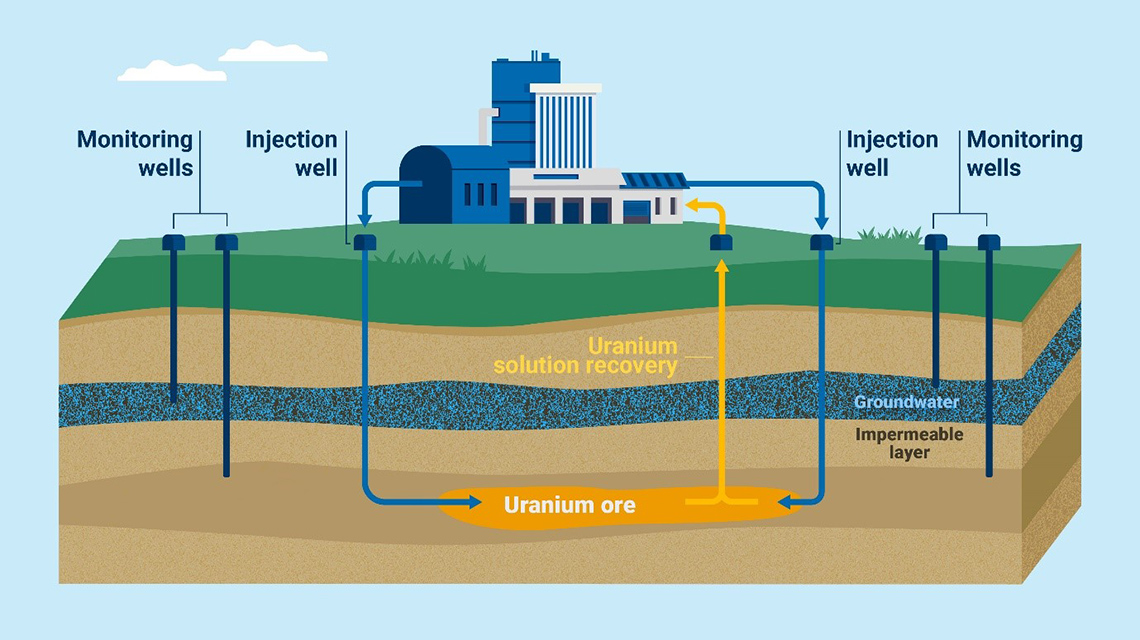
Image: In situ leaching process, Source: IAEA
Thorium – a promising technological path for the future of nuclear energy
Thorium, three times more abundant than uranium in the Earth's crust, represents a promising avenue for making nuclear energy even more sustainable and accessible, with major developments under way in China and India.
An interesting aspect for the mining industry is that thorium is primarily a by-product of rare earth extraction, which could create synergies with other mining activities.
Notable technical and environmental advantages
Thorium presents several characteristics that distinguish it from conventional uranium. It can generate more fissile material (uranium-233) than it consumes while powering a pressurized water reactor or a molten salt reactor, and it generates fewer long-lived minor actinides than plutonium fuels [8].
Historic technological advances
China is currently leading the most advanced developments in thorium reactors. In June 2023, the country issued an operating permit to the Shanghai Institute of Applied Physics of the Chinese Academy of Sciences to operate the TMSR-LF1, a reactor of 2 megawatts thermal. In October 2023, the reactor became critical; in June 2024, it reached full power; in October 2024, fresh thorium was introduced into the molten salt fuel of the reactor, a world first.
The Chinese Academy of Sciences announced in January 2011 its research and development program on the thorium molten salt reactor, claiming to have the largest national effort in the world on this technology, in the hope of obtaining full intellectual property rights [5]. This determination reflects China's ambition to position itself as a global leader in this technological sector.
India's ambitious program
For India, thorium represents far more than a simple technological option. As Anil Kakodkar, chancellor of the Homi Bhabha National Institute in Mumbai, explains, thorium has been at the center of research and development since the creation of India's nuclear energy program [8]. With immense and easily accessible thorium resources and relatively little uranium, India has made the use of thorium for large-scale energy production a major objective of its nuclear energy program, using a three-stage concept [5].
The 500 megawatt electric Prototype Fast Breeder Reactor at Kalpakkam began core loading in 2024 and is expected to be commissioned by 2026. India has designed an advanced heavy water reactor specifically as a means of valorizing thorium, which will constitute the final phase of its three-stage nuclear energy infrastructure plan [5].
Conclusion
The rigorous life cycle analysis demonstrates that nuclear energy ranks among the cleanest energy sources available, with emissions of only 5.1 to 6.4 grams of CO₂ equivalent per kilowatt-hour according to the latest assessments of the United Nations Economic Commission for Europe. This exceptional performance places nuclear at the same level as wind power and clearly below solar photovoltaic.
Beyond the figures, the concrete impact is considerable: over the last 50 years, nuclear energy has avoided the emission of 70 gigatonnes of CO₂, the equivalent of two full years of global energy-related emissions. This massive contribution to global decarbonization underscores the indispensable role of nuclear power in the energy transition.
However, the success of this transition does not rest on a single technology. The IEA emphasizes that nuclear and renewables form an essential complementary pair: while wind and solar bring variable production at low cost, nuclear provides the grid stability and dispatchable electricity needed to guarantee energy security. The examples of France, Sweden and Finland demonstrate the success of this integrated approach.
The emergence of thorium as a next-generation nuclear fuel opens up even more encouraging prospects. Three times more abundant than uranium, producing fewer long-lived wastes and offering improved safety characteristics, thorium represents a promising avenue for the future of nuclear energy. The recent advances in China and India, with the first experimental thorium reactors in operation, mark the beginning of a new era.
Furthermore, the extraction of thorium, often obtained as a by-product of rare earths, could integrate naturally into a value chain of critical minerals for the energy transition.
To follow our explorations in the field of renewable energies and critical mineral resources, visit squatex.com and follow us on LinkedIn .
References
[1] "Carbon Dioxide Emissions From Electricity." World Nuclear Association, world-nuclear.org/information-library/energy-and-the-environment/carbon-dioxide-emissions-from-electricity.
[2] Meunier, Loïc, et al. "Parametric Life Cycle Assessment of Nuclear Power for Simplified Models." Environmental Science & Technology, vol. 57, no. 39, 2023, pp. 14562-14574. ACS Publications, pubs.acs.org/doi/10.1021/acs.est.3c03190.
[3] Meunier, Loïc, et al. "Parametric Life Cycle Assessment of Nuclear Power for Simplified Models." PMC, PubMed Central, pmc.ncbi.nlm.nih.gov/articles/PMC10537461/.
[4] Poinssot, Christophe. "Carbon Footprint of Nuclear Reactors in France." Polytechnique Insights, www.polytechnique-insights.com/en/columns/energy/carbon-footprint-of-nuclear-reactors-in-france/.
[5] "Thorium." World Nuclear Association, world-nuclear.org/information-library/current-and-future-generation/thorium.
[6] Nuclear Power and Secure Energy Transitions – Executive Summary. International Energy Agency, 2022, www.iea.org/reports/nuclear-power-and-secure-energy-transitions/executive-summary.
[7] "Nuclear Power Can Play a Major Role in Enabling Secure Transitions to Low Emissions Energy Systems." International Energy Agency, 7 sept. 2022, www.iea.org/news/nuclear-power-can-play-a-major-role-in-enabling-secure-transitions-to-low-emissions-energy-systems.
[8] "Thorium's Long-Term Potential in Nuclear Energy." International Atomic Energy Agency, www.iaea.org/bulletin/thoriums-long-term-potential-in-nuclear-energy.
[9] Sharma, Sakshi. "Why India's Nuclear Programme is Lagging Despite Vast Reserves of Thorium While China's Making History." ThePrint, 15 nov. 2025, theprint.in/science/why-indias-nuclear-programme-is-lagging-despite-vast-reserves-of-thorium-while-chinas-making-history/2779334/.
