

Salt caverns: why is salt a strategic material for energy storage?
Salt caverns are playing a growing role in the development of underground energy storage. In 2026, the IEA reported that large-scale salt caverns intended for hydrogen storage are under construction in several countries, including the United States, Germany and China [7]. Their appeal lies largely in their operational flexibility, marked by high injection and withdrawal rates.
As low-carbon technologies expand, so does the need for solutions capable of storing large amounts of energy over long periods. In its net zero emissions scenario, the IEA estimates that hydrogen storage needs could reach 410 billion m³ by 2050, a volume comparable to today's natural gas storage infrastructure [6].
To understand this potential, we need to look at the properties of rock salt, how the caverns are built and the different forms of energy they can hold.
What makes rock salt geologically unique
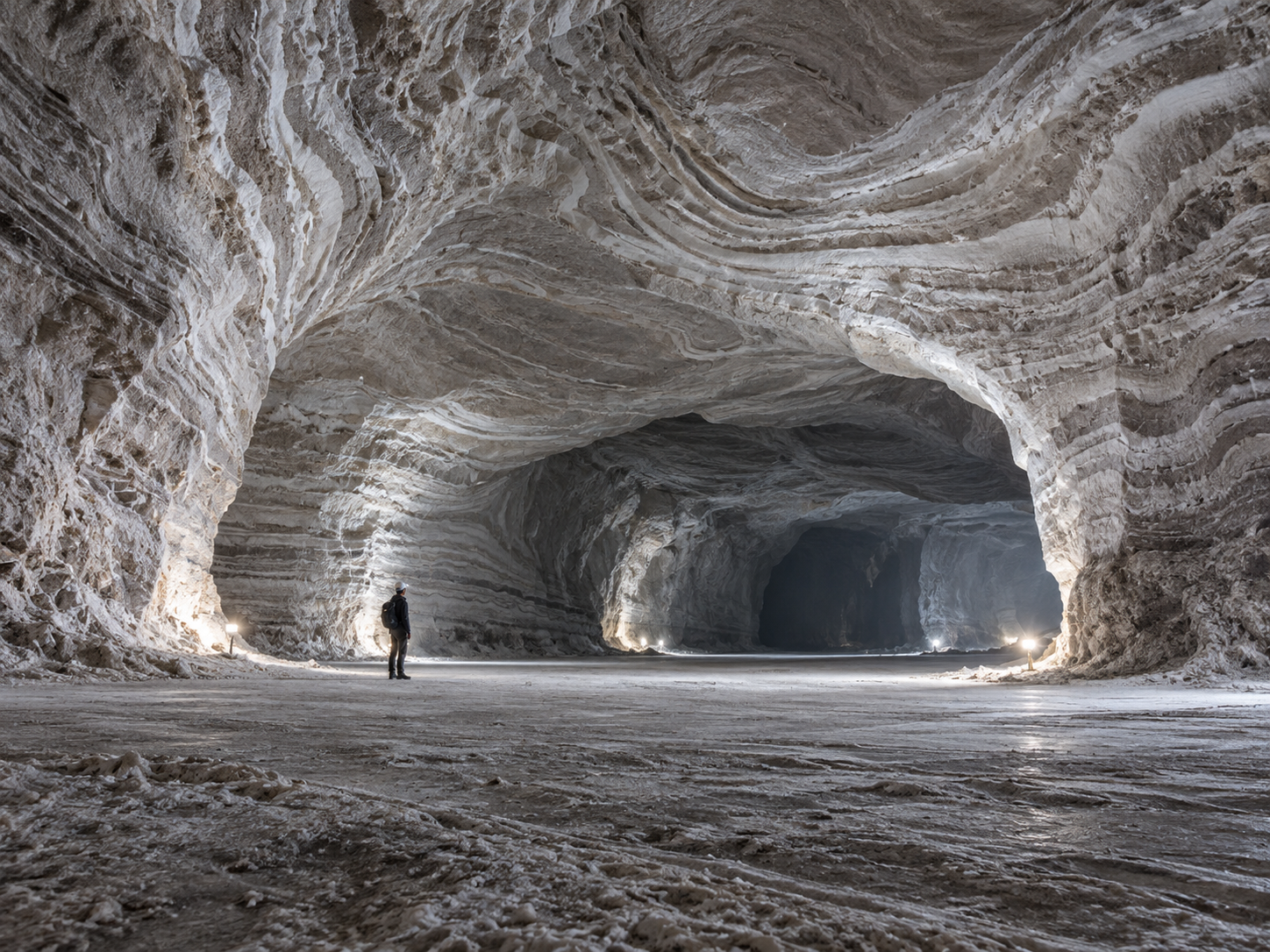
A salt cavern is an underground cavity developed within a rock salt formation. It is usually created by leaching, a process in which water is injected into the rock to dissolve part of the salt before the resulting brine is extracted. Once completed, the cavity can be used for underground storage of natural gas, compressed air or hydrogen.
The reliability of this type of facility depends largely on the characteristics of the rock forming its walls. Also known as halite, rock salt is the naturally occurring mineral form of sodium chloride (NaCl). It is found mainly as sedimentary layers or domes, left behind by the evaporation of ancient bodies of salt water.
A rock with very low permeability
Rock salt stands out first for its ability to restrict the movement of fluids. When a cavern and its well are properly designed and operated, this low permeability helps effectively contain the stored gas or liquid.
Salt rock generally shows low porosity and very low permeability, two properties that matter greatly in limiting fluid migration through the formation [1]. Measurements taken on rock salt samples show that pore sizes can range from 0.01 to 300 µm, with most below 1 µm [2].
The connections between these pores are even smaller. Depending on the analytical method used, the characteristic pore structures fall within a few tens of nanometres: the study reports a main range of roughly 15 to 50 nm and, using nitrogen adsorption, characteristic sizes mostly between 10 and 30 nm [2]. This network of microscopic passages plays a decisive part in the rock's actual permeability.
Taken together, a dense structure, limited fluid flow and distinctive mechanical properties make rock salt a favourable medium for geological energy storage [3].
Plasticity and creep: a rock that can deform
Rock salt does not behave like an ordinary rigid rock. Under sustained stress, it can slowly deform without breaking right away. This phenomenon, known as creep, refers to the gradual movement of material over time.
This capacity for plastic deformation sets salt apart from many stiffer surrounding rocks [1]. Under the pressure exerted by adjacent geological formations, it gradually tends to conform to the shape of the cavity and to close up certain voids or fractures. This slow deformation can therefore support containment, while also shaping how the cavern behaves over the years [3].
Self-healing of microcracks
Rock salt is able to partially recover after damage. This phenomenon, often referred to as self-healing, does not rely on a single mechanism. It can result, among other things, from:
the mechanical closure of cracks under pressure;
gradual deformation linked to creep;
certain recrystallization processes, promoted by pressure and temperature.
Laboratory experiments show that some properties of damaged salt can gradually be restored in this way. In a study based on wave velocity measurements, recovery was rapid at first, then slowed and levelled off after about 600 hours [1]. These results are consistent with partial closure or healing of microcracks, without implying that the rock fully returns to its original state.
At depth, geological pressure can also help close some of the fractures around a cavern [4]. This ability supports containment, but it does not on its own guarantee that the storage is sealed. Tightness also depends on several other factors, including well integrity, cavern geometry, operating pressure and injection and withdrawal cycles.
Underground conditions also change under the combined influence of temperature, fluids and mechanical stress. Research conducted under coupled thermo-hydro-mechanical conditions shows that these interactions can alter the permeability and pore structure of salt [3].
How is a salt cavern formed?
A salt cavern is not excavated mechanically like a traditional mine. It is created through the controlled dissolution of rock salt using water. This process, called leaching or solution mining, gradually shapes an underground cavity intended for storage.
Before work begins, geological studies confirm that the salt formation has a suitable thickness and appropriate mechanical properties. Caverns can be developed in:
a bedded salt deposit, which forms an extensive sedimentary layer;
a salt dome, a more vertical structure that can extend to considerable depth.
Once the site is chosen, a well is drilled down to the salt formation. Pipes are then installed to circulate water and brine between the surface and the subsurface.
Salt leaching
The formation of a salt cavern then proceeds in several steps:
Drilling the well: a well is drilled down to the salt formation and fitted with tubing to control the flow of water and brine.
Injecting water: water is pumped under pressure into the salt to gradually dissolve part of it [4].
Extracting the brine: the salt-saturated water is brought back to the surface to be treated, used or disposed of, depending on the project.
Controlling the cavity shape: the position of the tubing and the circulation of fluids are adjusted to give the cavity the desired dimensions.
Preparing for storage: once the intended shape is reached, leaching is stopped and the cavern is readied for the injection and withdrawal of the product it will hold [4].
Once completed, the cavity benefits from the natural properties of rock salt, notably its very low permeability and its ability to deform slowly under stress. These characteristics help keep the fluid confined within the formation.
The strategic role of salt caverns in the energy transition
Beyond their geological features, salt caverns could play an important part in developing large-scale energy storage. Their ability to hold large volumes of hydrogen and to support injection and withdrawal cycles makes them an option being studied to help energy systems evolve.
Growing needs for underground hydrogen storage
Long-term needs could be considerable. In its Net Zero Emissions scenario, the IEA estimates that more than 230 TWh of hydrogen storage would be required as early as 2035. By 2050, these requirements could reach 410 billion m³ [6].
Storage makes it possible to decouple hydrogen production from its use over time. When it is produced during periods of abundant renewable electricity, hydrogen can be kept for later consumption. IRENA highlights its potential to provide flexibility across different timescales, including seasonal ones [5].
At scale, this infrastructure could help to:
absorb some surpluses of renewable generation;
shift energy between different times of the year;
provide flexibility over several weeks or months;
secure supply for certain industrial and energy uses.
These functions complement those of batteries: while batteries mainly address short-duration needs, hydrogen can support storage over several weeks or months [5].
Salt caverns, a lever for energy storage
Salt caverns hold a special place among underground energy storage solutions. Their low permeability, their capacity to deform and the partial healing of certain fractures allow large storage volumes to be developed, particularly for compressed air and hydrogen.
In energy systems that rely on a growing share of variable renewable generation, salt formations can contribute to long-duration, large-scale storage. They are therefore a geological resource worth considering alongside other storage solutions.
It is with this in mind that Squatex is exploring the various roles the subsurface can play in the energy transition, from large-scale storage to the exploration of resources such as natural hydrogen.
To stay up to date on the latest developments in energy storage and natural resources, follow Squatex on LinkedIn.
References
[1]: Chen, Jie, et al. "Self-Healing Characteristics of Damaged Rock Salt under Different Healing Conditions." Materials, vol. 6, no. 8, 2013, pp. 3438–3450. MDPI, https://pmc.ncbi.nlm.nih.gov/articles/PMC5521314/.
[2]: Chen, Jianwen, Erbing Li, and Jin Luo. "Characterization of Microscopic Pore Structures of Rock Salt through Mercury Injection and Nitrogen Absorption Tests." Geofluids, vol. 2018, Article ID 9427361. Hindawi, https://onlinelibrary.wiley.com/doi/10.1155/2018/9427361.
[3]: Liang, Xufeng, et al. "Evolution of Permeability and Pore Structure of Salt Rock and Its Self-Healing Mechanism under Coupled Thermo-Hydro-Mechanical Environment." Journal of Energy Storage, vol. 66, 2023, Article 107476. Elsevier, https://www.sciencedirect.com/science/article/pii/S2352152X23008733.
[4]: U.S. Energy Information Administration. "Salt Caverns Account for 23% of U.S. Underground Natural Gas Storage Daily Deliverability." Today in Energy, 22 Sept. 2011, https://www.eia.gov/todayinenergy/detail.php?id=3190.
[5]: International Renewable Energy Agency. Innovation Landscape for Smart Electrification: Decarbonising End-Use Sectors with Renewable Power. IRENA, 2023, https://www.irena.org/Publications/2023/Jun/Innovation-landscape-for-smart-electrification.
[6]: International Energy Agency. Global Hydrogen Review 2024, IEA, 2024, section "Trade and infrastructure", https://www.iea.org/reports/global-hydrogen-review-2024
[7]: International Energy Agency. Global Hydrogen Review 2026. "Trade and Infrastructure." IEA, 2026, https://www.iea.org/reports/global-hydrogen-review-2026/trade-and-infrastructure.
