

What Are the Main Types of Hydrogen and How Can You Tell Them Apart?
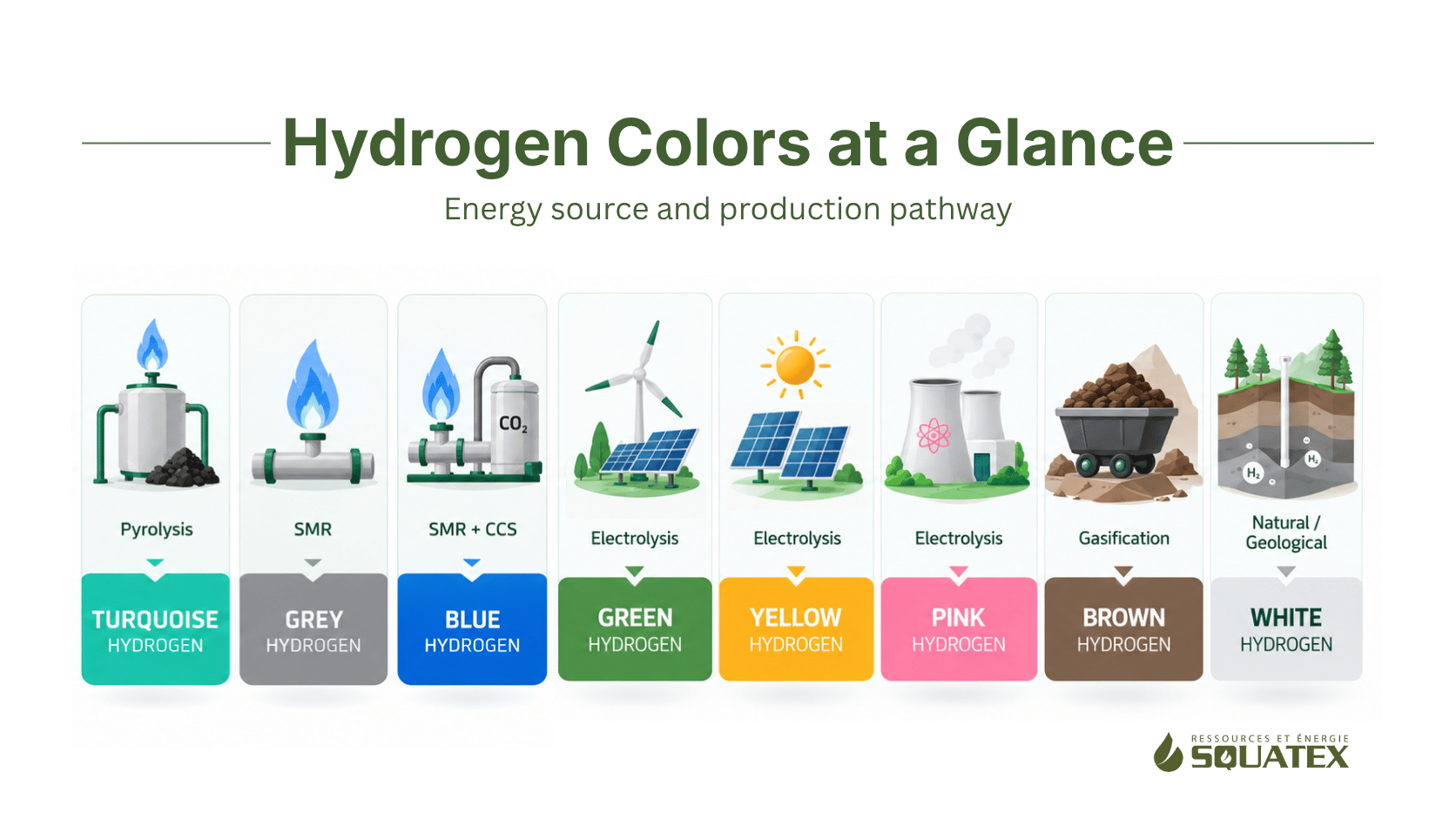
Hydrogen is playing an increasingly prominent role in energy strategies, yet not every pathway relies on the same resources or processes. To distinguish between these different pathways, hydrogen is often labelled by colour, reflecting its source, production method and, to some extent, its environmental profile.
These colour labels do not refer to any visible characteristic of the gas. They are conventions used by the energy sector and are not universal: their meaning can vary between countries, organizations and applications.
Understanding these hydrogen colours makes it easier to compare technologies, their carbon intensity, their maturity and their outlook, from well-established fossil-based routes to natural hydrogen, a geological resource that is still being explored.
The Colour Code System: A Convention for Distinguishing Pathways
Before comparing the different types of hydrogen, it helps to understand what their colours actually represent. This classification is mainly used to tell apart the key production methods, the energy sources involved and, to some extent, their environmental footprint.
Why Do We Use Colours to Describe Hydrogen Gas?
In its natural state, hydrogen is a colourless, odourless gas. Names like grey, blue or green hydrogen therefore say nothing about its physical properties. Instead, they serve as shorthand within the energy sector to identify different pathways based on their source and production method [2].
While this nomenclature is widely used across industry and energy policy, it does not rest on any universal agreement. The same colour can sometimes carry different meanings depending on the country or organization, and definitions may shift over time [2]. The most common categories include grey, blue, green, yellow, pink or purple, turquoise and white hydrogen, occasionally joined by other labels such as brown or black hydrogen.
Carbon Intensity: A Key Indicator for Comparing Pathways
A colour mostly tells us about the energy source and the production process. To compare climate impact, though, one of the most useful metrics is carbon intensity. It refers to the amount of greenhouse gases generated to produce one kilogram of hydrogen and is usually expressed in kilograms of CO₂ equivalent per kilogram of hydrogen produced, or kg CO₂e/kg H₂.
Results can vary considerably depending on the technology and on the assumptions built into life cycle assessments. As a rough guide:
Grey hydrogen: some configurations exceed 12 kg CO₂e/kg H₂, particularly when the entire natural gas supply chain is taken into account [4].
Green hydrogen: when produced through electrolysis powered by renewables, its carbon intensity can be far lower, although it depends on where the electricity comes from.
Natural or white hydrogen: since it is formed by geological processes and does not need to be synthesized industrially, a low carbon footprint is expected. Its full balance, however, hinges on drilling, processing, compression, transport and any leaks tied to its extraction.
These gaps show that the colour of hydrogen offers a helpful hint about the pathway but cannot, on its own, determine its environmental footprint. Analysis boundaries, the origin of the energy, upstream emissions and, for blue hydrogen, the carbon capture rate can all heavily influence the final result [1][4].
Table 1: Overview of the main types of hydrogen by source, production method and carbon intensity
| Colour | Energy source or resource | Production method | Indicative carbon intensity | Maturity |
|---|---|---|---|---|
| Grey | Natural gas | Steam methane reforming (SMR) | Roughly 9 to 14 kg CO₂e/kg H₂ depending on the supply chain | Commercial |
| Blue | Natural gas + carbon capture | SMR with carbon capture and storage (CCS) | Highly variable depending on capture rate and upstream emissions | Emerging/commercial |
| Green | Renewable electricity | Water electrolysis | Generally low, depending on the electricity source | Growing/commercial |
| Yellow | Solar under some definitions, the power grid under others | Electrolysis | Variable depending on the definition and electricity source | Commercial |
| Pink/purple | Nuclear electricity | Electrolysis | Low, depending on the life cycle of nuclear power | Niche/emerging |
| Turquoise | Methane | Methane pyrolysis | Variable depending on the energy used, leaks and solid carbon management | R&D |
| White/gold | Natural geological resource | Extraction, processing and conditioning | Low footprint expected | Exploration |
Grey and Blue Hydrogen: Two Pathways Derived from Natural Gas
A significant share of the hydrogen produced worldwide still relies on fossil fuels. Among these routes, grey hydrogen is mainly obtained from natural gas, while blue hydrogen follows a similar path but adds the capture and storage of part of the CO₂ released. What sets them apart, then, is less the feedstock itself than how the associated emissions are handled.
Grey Hydrogen: Production Based on Natural Gas
Grey hydrogen is typically produced through steam methane reforming, or SMR. At high temperatures, the methane in natural gas reacts with steam to form hydrogen. The process also generates carbon dioxide, which is released into the atmosphere when no capture system is in place.
Historical data cited in reference [3] highlight how much global hydrogen output depends on fossil resources:
around 76% came from natural gas reforming;
around 23% came from coal gasification [3].
Both routes are fossil-based, but they fall under different colours in the usual nomenclature. Hydrogen made from natural gas without capture is generally described as grey, whereas hydrogen made from coal is often referred to as brown or black [2].
The footprint of grey hydrogen also depends on how the natural gas is supplied. One life cycle assessment puts its intensity at approximately:
12.3 kg CO₂e/kg H₂ when the gas is delivered by pipeline;
13.9 kg CO₂e/kg H₂ when it is supplied as liquefied natural gas (LNG) shipped by sea [4].
Emissions therefore do not stem solely from the reforming reaction. In one of the analyses reviewed by Roy et al., roughly 77.75% were attributed to the production process and 22.13% to the natural gas supply [3]. These proportions vary, however, with the origin of the gas, the infrastructure in place and the boundaries chosen for the analysis.
Blue Hydrogen: Cutting Emissions Through Carbon Capture
Blue hydrogen also relies on natural gas and, in most cases, on steam methane reforming. The main difference is the addition of carbon capture and storage (CCS), which captures part of the CO₂ generated before it reaches the atmosphere and transports it to a geological storage site.
The climate performance of this route depends heavily on the CO₂ capture rate, as well as on emissions elsewhere along the supply chain. Among the studies reviewed by Roy et al. [3]:
a capture rate of 56% is associated with roughly 6.87 kg CO₂e/kg H₂;
a capture rate of 90% is associated with roughly 3.97 kg CO₂e/kg H₂.
Other assessments produce different results. One life cycle study estimated blue hydrogen emissions at 7.6 kg CO₂e/kg H₂ with pipeline-supplied natural gas and 9.3 kg CO₂e/kg H₂ with an LNG-based supply chain. In that study, emissions were reduced by about 25 to 38% compared with grey hydrogen [4]. Other configurations reviewed in the literature show more modest reductions of around 18 to 25% [3].
One advantage of this pathway is that some existing SMR facilities can be retrofitted to incorporate carbon capture. For this reason, blue hydrogen is often viewed as an intermediate decarbonization option, especially in sectors where natural gas-based production infrastructure is already established.
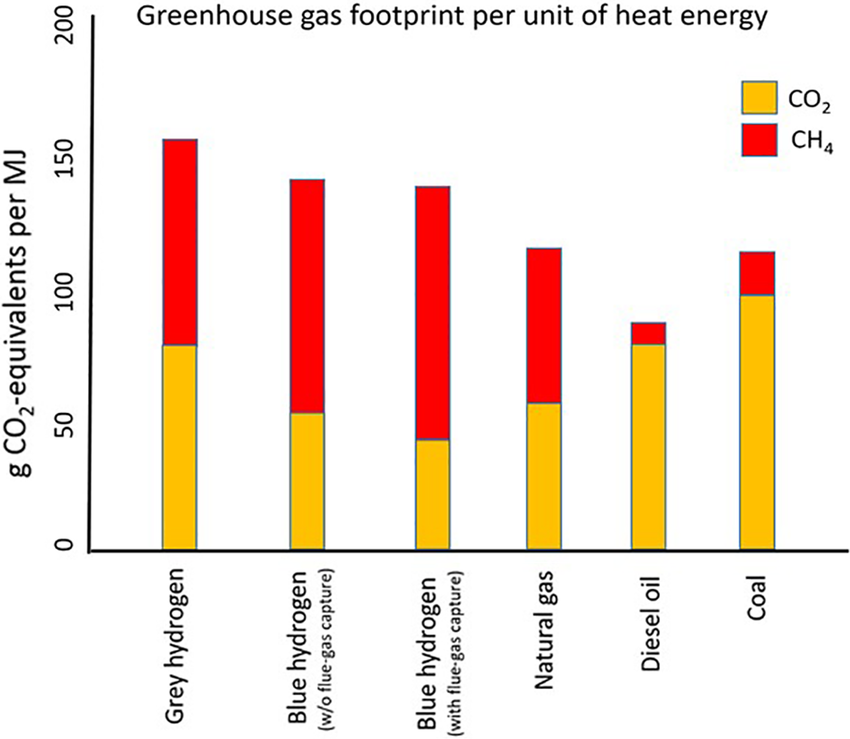
Comparison of CO2 equivalent emissions. Source: R. Howarth, Mark Jacobson. How green is blue hydrogen, 2021
Green Hydrogen: Producing Hydrogen with Renewable Electricity
Green hydrogen stands apart from fossil-based pathways because of the way it is made. It is obtained through water electrolysis powered by renewable electricity, including solar, wind or hydropower. This combination sharply reduces the emissions tied to hydrogen production, provided the electricity used genuinely comes from low-carbon sources.
Production of low-emission hydrogen keeps rising worldwide. According to the IEA, it reached nearly 1 million tonnes in 2025, up from less than 0.6 million tonnes in 2020 [5]. Growth is expected to continue in 2026, the year in which these pathways could, for the first time, account for more than 1% of global hydrogen output [5].
How Is Green Hydrogen Produced?
Water electrolysis is an electrochemical process that uses electricity to split a water molecule (H₂O) into hydrogen and oxygen. The reaction takes place inside an electrolyzer. When the power comes from renewable sources, the resulting hydrogen is generally labelled green.
The carbon footprint of this route depends mainly on how that electricity is generated. A life cycle assessment cited in reference [4], for example, estimates the carbon intensity of green hydrogen at approximately:
0.6 kg CO₂e/kg H₂ with wind power;
2.5 kg CO₂e/kg H₂ with solar power;
1.5 kg CO₂e/kg H₂ with a combined solar-wind supply [4].
In the configurations studied, these values translate into an emissions reduction of about 80 to 95% compared with grey hydrogen [4]. Outcomes may nonetheless differ depending on the electrolysis technology, equipment manufacturing, the electricity source and the boundaries set for the life cycle assessment.
Natural Hydrogen: An Emerging Pathway
Beyond grey, blue and green routes, several forms of hydrogen draw on different sources or processes. Among them, natural hydrogen, also called white hydrogen, holds a special place. Unlike the other categories, it does not need to be synthesized from another energy source, since it is generated directly by geological processes underground.
Natural Hydrogen: A Primary Geological Resource
Natural hydrogen differs from grey, blue or green hydrogen, which are manufactured industrially from natural gas, electricity or other resources. It is instead a primary energy resource capable of migrating through geological formations and, under favourable conditions, accumulating in underground reservoirs [6].
Also known as geological, geogenic or native hydrogen, and sometimes gold hydrogen, it can form through several natural mechanisms. The main processes under study include:
serpentinization, a reaction between water and certain iron-rich rocks, notably ultramafic rocks. The oxidation of iron during this transformation can release hydrogen;
water radiolysis, in which radiation from the natural decay of radioactive elements within rocks can break apart water molecules and generate hydrogen;
This geological origin gives it several distinctive traits. The gas does not have to be produced through electrolysis or by reforming a fossil fuel, which avoids some of the energy-intensive steps found in other pathways. Its extraction nonetheless requires drilling, processing, compression and transport. Its complete environmental footprint will therefore depend on the characteristics of the deposit and the technologies deployed.
The IEA Hydrogen TCP regards natural hydrogen as a potentially low-carbon source and notes that its costs could be lower than those of several conventional production routes if commercially viable accumulations are identified [6].
Other Hydrogen Colours: Turquoise, Pink and Yellow
In addition to grey, blue, green and natural hydrogen, other labels are used to describe more specific pathways. The most common include turquoise hydrogen, pink hydrogen and yellow hydrogen. Their definitions rest primarily on the energy source and the production process involved.
Turquoise Hydrogen
Turquoise hydrogen is produced through methane pyrolysis, a thermal process that breaks methane down into hydrogen and solid carbon. Unlike steam reforming, this reaction does not directly yield gaseous CO₂ as its main by-product. The resulting carbon can then be stored or put to use in certain industrial applications.
Its carbon footprint, however, depends on where the methane comes from, the energy used to heat the process and how the solid carbon is managed. In the life cycle assessment presented in reference [4], emissions reach approximately:
6.1 kg CO₂e/kg H₂ with pipeline gas supply;
8.3 kg CO₂e/kg H₂ with an LNG-based chain.
These configurations represent a reduction of roughly 35 to 54% compared with grey hydrogen [4]. The low-emission potential of this route is thus closely linked to the use of low-carbon energy and to sustainable management of the solid carbon [2]. Its development remains largely at the research and demonstration stage [1].
Pink, Purple or Red Hydrogen
Pink hydrogen is obtained through water electrolysis powered by nuclear electricity [2]. Depending on the source, the terms purple or red may also be used to describe this same production family.
As with green hydrogen, the electrolysis reaction itself produces no direct CO₂ emissions. Overall carbon intensity, however, depends on the life cycle of nuclear power, equipment manufacturing and the required infrastructure [1]. This pathway remains fairly specialized today, and its level of deployment varies across markets and energy policies.
Yellow Hydrogen
Yellow hydrogen commonly refers to hydrogen produced by water electrolysis powered by solar electricity. In this pathway, electricity generated by solar panels is used to split water into hydrogen and oxygen [2].
However, the definition is not universal. While sources such as National Grid associate yellow hydrogen with solar-powered electrolysis, other publications use the term for hydrogen produced by electrolysis using electricity from the power grid [1]. In that case, its carbon intensity depends directly on the electricity generation mix.
This variation highlights one of the limits of the hydrogen colour system: the same label can refer to different production pathways depending on the country, organization or publication. Assessing a pathway therefore requires looking at the actual electricity source and production process, rather than the colour alone.
A Wide Range of Solutions for the Hydrogen Sector
The hydrogen landscape is more nuanced than it might first appear. The colour code system, while imperfect and not universally standardized, provides a useful framework for grasping the diversity of pathways. As technologies evolve, costs shift and new resources are explored, some production routes may gain ground while others take on a more limited role.
This variety reflects the complexity of the energy transition: depending on available resources, infrastructure, industrial needs and the economic context, different types of hydrogen may offer distinct advantages. Squatex closely follows developments in this field, particularly those related to natural resources, low-carbon pathways and the potential of natural hydrogen.
Follow Squatex on LinkedIn to stay up to date on progress in renewable energy, the exploration of new resources and the development of natural hydrogen.
References
[1] Kundu, Debajyoti, et al. "Green hydrogen pathways for a net-zero future: technologies, circular economy integration, life-cycle performance and safety dimensions." RSC Adv. 2026, pp 13471–13514. https://doi.org/10.1039/d5ra09599a
[2] National Grid. "The Hydrogen Colour Spectrum." National Grid, 23 Feb. 2023, https://www.nationalgrid.com/stories/energy-explained/hydrogen-colour-spectrum.
[3] Roy, Riya, et al. "Comparative Techno-Environmental Analysis of Grey, Blue, Green/Yellow and Pale-Blue Hydrogen Production." International Journal of Hydrogen Energy, vol. 116, 2025, pp. 200–210. Elsevier, http://catalysis.eprints.iitm.ac.in/4396/1/Comparative_techno_environmental_analysi.pdf.
[4] Patel, Gulam Husain, et al. "Climate Change Performance of Hydrogen Production Based on Life Cycle Assessment." Green Chemistry, vol. 26, 2024, pp. 992–1006. Royal Society of Chemistry, https://pubs.rsc.org/en/content/articlehtml/2024/gc/d3gc02410e.
[5] International Energy Agency (IEA). Global Hydrogen Review 2026. IEA, 18 June 2026. https://www.iea.org/reports/global-hydrogen-review-2026
[6] Natural Hydrogen (Task 49 Workplan). IEA Hydrogen Technology Collaboration Programme, version 2024/03/14, https://www.ieahydrogen.org/wp-content/uploads/2025/08/2024_Workplan_Task-49_Natural-Hydrogen_H2TCP.pdf
