

Helium-3: Why Is This Rare Isotope Different From Helium-4?
In 2025, roughly 81 million cubic meters of Grade-A and gaseous helium were sold or used in the United States, for an estimated value of $970 million [1], reflecting the growing importance of this resource across numerous strategic sectors. Helium plays a critical role in essential industrial applications, including magnetic resonance imaging (MRI), semiconductor manufacturing, aerospace, and optical fiber production [1].
Behind this widespread use, however, lies a lesser-known reality. Helium isn't a single substance but a family of isotopes with distinct properties. Among them, helium-4 dominates current industrial applications, while helium-3, far scarcer, is tied to high-tech uses and growing strategic stakes.
To understand why helium is considered a strategic resource, it's essential to distinguish between these two forms and examine their fundamental characteristics.
What Is an Isotope?
An isotope is a variant of a chemical element whose atoms share the same number of protons but differ in their number of neutrons. This difference gives them very similar chemical properties, though it can lead to significant variations in certain physical and nuclear characteristics.
Helium exists as two stable isotopes. Helium-4 (He-4) consists of two protons and two neutrons, while helium-3 (He-3) contains two protons and just one neutron [2]. Although this variation appears minimal, it significantly shapes their behavior, particularly under extreme conditions such as very low temperatures.
Helium-4, Nature's Dominant Isotope
Helium-4 makes up the overwhelming majority of Earth's natural helium: in the atmosphere, helium-3 accounts for only a tiny fraction of the total. Much of the helium-4 found in the Earth's crust comes from the natural alpha decay of uranium, thorium, and their radioactive byproducts [2]. Over millions of years, this radiogenic helium can migrate and accumulate in underground geological reservoirs, particularly in certain natural gas formations. It is primarily this isotope that gets extracted from these deposits, and it makes up the vast majority of helium traded worldwide.
Helium-3, the Rare Isotope
Helium-3, by contrast, is a stable but extremely rare isotope in nature on Earth [2]. Its terrestrial presence comes mainly from the radioactive decay of tritium (hydrogen-3), a byproduct generated at certain nuclear facilities [1]. In 2025, U.S. helium-3 production took place at only a single site, in South Carolina, through tritium decay, and production figures remain confidential [1]. This structural scarcity largely explains the strategic value that many countries place on it.
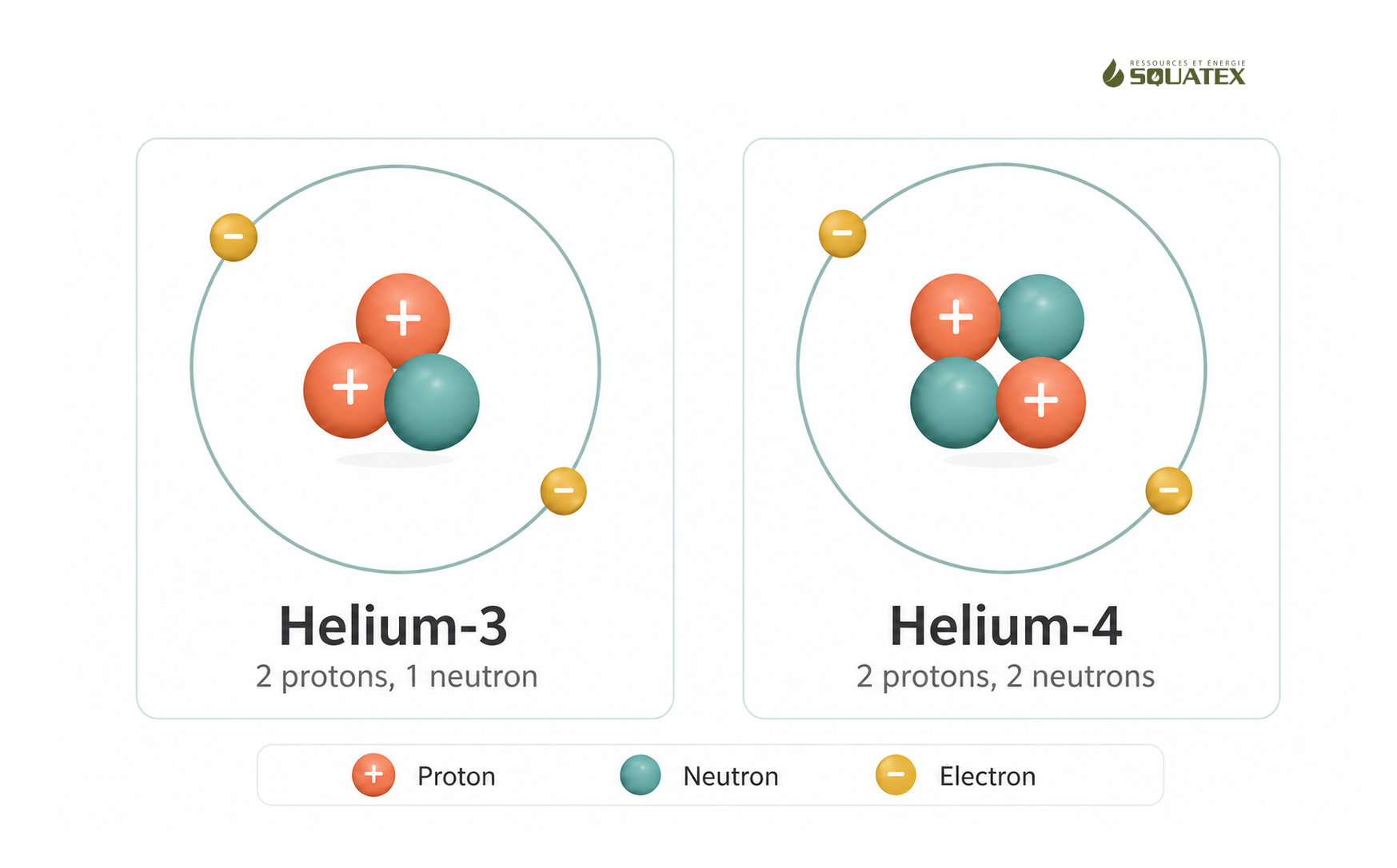
Image: Schematic infographic showing the He-3 (2p + 1n) and He-4 (2p + 2n) nuclei side by side
Physical Properties: What Truly Sets Them Apart
Beyond their nuclear composition, helium-3 and helium-4 display markedly different physical behaviors, particularly at temperatures close to absolute zero. These differences directly shape their respective fields of application.
Boiling Points and Density
The boiling point is the temperature at which a liquid turns into a gas, or, conversely, at which a gas liquefies. In cryogenics, the science and techniques of very low temperatures (generally below −150°C), this property determines how far a fluid can lower the temperature of other materials.
On this front, the two isotopes differ in measurable ways:
Helium-3 has a boiling point of 3.19 K, compared with 4.23 K for helium-4, allowing it to stay liquid at lower temperatures [2].
Its critical point is also lower, at 3.35 K, versus 5.2 K for helium-4 [2].
Its density at the boiling point is about 59 g/L, notably lower than helium-4's roughly 125 g/L under similar conditions [2].
Comparative Cryogenic Performance
These differences translate into distinct cooling capabilities. Helium-3 is notably used in cryogenic refrigerators capable of reaching around 0.2 K. Dilution refrigerators, which rely on a mixture of helium-3 and helium-4, can reach temperatures on the order of a few millikelvins.
This ability to reach extreme temperatures explains why helium-3 is used in scientific equipment requiring particularly demanding thermal conditions.
Quantum Behavior: A Fundamental Distinction
At very low temperatures, the quantum properties of these isotopes become decisive. Particles fall into two main categories, bosons and fermions, which follow different statistical rules.
Helium-4 is a boson. It can enter a superfluid state, marked by a complete absence of viscosity, at a temperature of about 2.17 K.
Helium-3 is a fermion. Its transition to a superfluid state only occurs at extremely low temperatures, around 2.5 millikelvins [2].
This fundamental difference explains why helium-3 is used primarily in advanced scientific research, particularly in low-temperature physics and quantum technologies.
Table 1: Comparison of Physical Properties, He-3 vs. He-4
| Property | Helium-3 (He-3) | Helium-4 (He-4) |
|---|---|---|
| Nuclear structure | 2 protons, 1 neutron | 2 protons, 2 neutrons |
| Boiling point | 3.19 K | 4.23 K |
| Critical point | 3.35 K | 5.2 K |
| Density at boiling point | 59 g/L | 125 g/L |
| Minimum cryogenic temperature | Lower than He-4 | Higher than He-3 |
| Particle type | Fermion | Boson |
| Superfluid transition | ~2.5 mK | ~2.17 K |
Industrial Uses: Markets Shaped by Physical Properties
The distinct physical properties of each isotope translate directly into separate markets and supply chains. Helium-4 supplies a mature, diversified global industry, while helium-3 meets niche needs with very high added value.
Helium-4: An Industrial Pillar with Cross-Cutting Uses
Helium-4 accounts for nearly all the helium traded worldwide. Its market rests on steady demand from essential industrial and technological sectors. In 2025, sales of Grade-A and gaseous helium were estimated at around 81 million cubic meters, worth close to $970 million [1]. This works out to an implied average value of about $12 per cubic meter, though it doesn't reflect a single uniform market price, since figures vary with supply conditions and market dynamics [1].
This economic importance stems from the sheer variety of helium-4's uses, which come into play at different stages of numerous industrial processes. Rather than forming a single homogeneous market, it's really a collection of complementary applications, each drawing on specific properties of the gas, including its chemical inertness, low density, and cryogenic capabilities.
The main areas of use break down as follows [1]:
Helium-4 · Industrial demand
Where the world's helium-4 goes
Source: U.S. Geological Survey, Mineral Commodity Summaries 2026 [1]
Beyond this diversity, one central factor sets helium-4 apart from other industrial gases: its critical role in cryogenics. Thanks to its exceptionally low boiling point, helium is an essential cryogenic fluid for reaching temperatures where other common cryogens simply stop working. This property makes it hard to replace, despite ongoing efforts to develop technologies based on higher-temperature superconductors, particularly those using liquid nitrogen. So far, these alternatives remain confined to certain specific applications and don't fully match the performance helium delivers.
This structural reliance on helium-4 largely explains its strategic importance, particularly in sectors where continuous operations depend on extreme thermal conditions.
Helium-3: Rare Uses with High Strategic Value
Helium-3, meanwhile, occupies a very different niche. It's used mainly in neutron detectors, cutting-edge scientific research, and quantum computing [1]. Its scarcity and the complexity of its production, which depends entirely on tritium decay here on Earth, make it a resource of exceptionally high strategic value. Helium-3 detectors find particular use in neutron detection and nuclear material monitoring. Its high absorption cross-section for thermal neutrons makes it a particularly effective material.
Helium-3 and Nuclear Fusion: A Long-Term Outlook
Nuclear fusion is a reaction in which two light atomic nuclei combine to form a heavier one, releasing a considerable amount of energy in the process. Unlike fission, the principle behind today's nuclear power plants, fusion produces very little long-lived radioactive waste, making it a technology of great interest for the energy transition.
In this context, helium-3 is often mentioned as a potential fuel for next-generation fusion reactors. As early as 1988, a NASA report discussed helium-3's potential for fusion. Among the theoretical benefits studied are low-carbon energy production and a significant reduction in certain radioactive waste compared with conventional fission [3]. The presence of helium-3 on the Moon has been documented since the Apollo and Luna missions: estimates published by the University of Wisconsin's Fusion Technology Institute suggest that at least a million tons of helium-3 could exist in the lunar regolith [4]. That said, this remains a long-term prospect that hinges on progress in controlled fusion, which isn't yet commercially viable at this stage.
To go further: "Which sectors depend on helium?"
Supply, Scarcity, and Strategic Stakes
Understanding the properties and uses of both isotopes isn't complete without addressing the question of availability. Helium-4 and helium-3 face very different supply challenges, which directly shapes their position in the markets.
Global Reserves and Geographic Concentration of Helium-4
Helium-4 is extracted from geological reservoirs where it has built up over long periods, usually alongside certain natural gas deposits. Although found in several regions of the world, its extraction remains concentrated in a limited number of countries with both sufficient resources and the infrastructure to tap them.
In the United States, recoverable helium resources are estimated at around 8.49 billion cubic meters. Internationally, identified resources reach an additional 31.3 billion cubic meters or so [1]. This distribution, however, remains uneven and reflects a marked concentration in a handful of key countries:
Qatar: 10.1 billion m³, the largest holder of identified resources
Algeria: 8.2 billion m³, a major player in the international market
Russia: 6.8 billion m³
Canada: 2.0 billion m³, a significant supplier in North America
China: 1.1 billion m³
This concentration of resources shows up directly in trade flows. Between 2021 and 2024, the United States imported most of its helium from Canada (47%), Qatar (28%), Algeria (10%), and China (5%) [1]. Such reliance on a small number of suppliers highlights how exposed the market is to geopolitical, logistical, or technical disruptions.
Against this backdrop, supply security becomes a central concern for helium-dependent industries. Any disruption, even a temporary one, can have significant repercussions for critical sectors, including healthcare, electronics, and scientific research.
The Structural Scarcity of Helium-3
The situation for helium-3 is fundamentally different. Unlike helium-4, it doesn't naturally build up in exploitable quantities in Earth's geological reservoirs. Its presence in the environment is extremely limited, and its production relies almost entirely on controlled nuclear processes.
In practice, helium-3 is obtained mainly through the decay of tritium, a radioactive hydrogen isotope produced at certain nuclear facilities [1]. This production method imposes major constraints, both in terms of available volumes and the cost and management of the infrastructure involved. What's more, global output stays concentrated at a very small number of facilities, further limiting availability.
This structural scarcity results in a much narrower market, marked by low volumes but high value. Helium-3 is therefore regarded as a strategic resource in several countries, given its role in sensitive applications such as nuclear detection, advanced scientific research, and certain emerging technologies.
Ultimately, while helium-4 grapples with issues of geographic concentration and supply security, helium-3 faces a more fundamental constraint tied to its intrinsic availability. This distinction helps explain why these two isotopes, despite being chemically similar, occupy such different positions within global industrial and strategic dynamics.
Conclusion
The distinction between helium-3 and helium-4 comes down to a minimal atomic difference, just one neutron, yet its implications are substantial on an industrial and strategic scale. Helium-4, made up of two protons and two neutrons, forms the foundation of an established global market, and remains indispensable to numerous critical sectors such as healthcare, electronics, and aerospace [1]. Helium-3, on the other hand, with two protons and one neutron, stands out for its scarcity and unique properties, which make it a strategic resource for high-tech applications, particularly in nuclear detection, scientific research, and quantum technologies [2].
Amid the rise of advanced technologies, the ongoing energy transition, and emerging industrial needs, a nuanced grasp of these distinctions is becoming a strategic priority. As such, helium, in its various forms, remains a strategic resource for numerous scientific, industrial, and technological fields.
Follow Squatex on LinkedIn to stay updated on developments in the strategic resources sector.
References
[1] U.S. Geological Survey. "Helium and Rare Gases." Mineral Commodity Summaries 2026, U.S. Geological Survey, 2026. https://pubs.usgs.gov/periodicals/mcs2026/mcs2026-helium.pdf
[2] Wikipedia contributors. "Helium-3." Wikipedia, Wikimedia Foundation, 2025. https://en.wikipedia.org/wiki/Helium-3
[3] Polytechnique Insights. "Helium-3 from the Lunar Surface for Nuclear Fusion?" Polytechnique Insights, 2022. https://www.polytechnique-insights.com/en/braincamps/space/extraterrestrial-mining/helium-3-from-the-lunar-surface-for-nuclear-fusion/
[4] University of Wisconsin, Fusion Technology Institute. "Lunar Mining of Helium-3." FTI Research Projects, 1995. https://fti.neep.wisc.edu/fti.neep.wisc.edu/research/he3.html
