

Understanding Helium: A Strategic Resource
Introduction
Helium holds a strategic position in the global economy today. Often perceived as a light gas associated with recreational uses, it is in reality an essential resource for several critical sectors: medical imaging, quantum technologies, semiconductor manufacturing, aerospace, and advanced scientific research. Its chemical stability, extremely low boiling point, and inert nature make it a unique gas that is difficult to substitute and widely recognized as a critical resource.
Despite helium being the second most abundant element in the universe, it remains surprisingly rare on Earth, as its low weight causes it to naturally escape into the atmosphere. Its exploitable presence is therefore limited to certain specific geological environments, contributing to a high concentration of global production among just a few countries. In a context where demand is growing faster than supply, understanding what helium is, how it forms, and how it is extracted becomes essential for assessing its economic and scientific importance.
This article offers a clear and rigorous introduction to helium: its fundamental properties, its geological origin, production methods, and the global market dynamics that explain its strategic nature.
What Is Helium?
Beyond its lightness that makes balloons float, helium possesses unique physical properties that make it irreplaceable in modern industry.
Helium belongs to the noble gas family, characterized by their inert and non-reactive nature. With a density of only 0.1786 g/L at 0°C and 1 atm [1], it is the second lightest element after hydrogen. Its extremely low boiling point of −268.93°C (4.22 K) makes it an ideal candidate for the most demanding cryogenic applications.
Indeed, what truly distinguishes helium is its unique ability to remain liquid even at temperatures close to absolute zero. Helium is the only element that cannot be solidified by simple cooling at normal atmospheric pressure; it requires the application of approximately 25 atmospheres of pressure at 1 K [2]. This particular property opens the door to critical applications in the fields of medical MRI, superconductors, and quantum research.
Furthermore, when the temperature drops below 2.18 K, liquid helium transitions to the state of helium-II, a superfluid phase in which its thermal and mechanical properties change radically. Thermal conductivity reaches an exceptional level, exceeding that of copper by more than 1,000 times [2], allowing rapid dissipation of heat fluxes generated in controlled cryogenic environments. At the same time, viscosity becomes almost zero, enabling flow without resistance through very fine gaps — a phenomenon that clearly distinguishes helium-II from conventional fluids. These behaviors are essential for many research and engineering facilities that must maintain stable thermal conditions at extremely low temperatures, particularly in superconducting magnets and certain quantum physics experiments.
How Does Helium Form in Nature?
Although widely used in cutting-edge technologies, helium owes its origin to a surprisingly discreet natural process, deeply buried in the Earth's crust. Unlike hydrocarbons derived from organic matter, this noble gas is born from an essentially nuclear phenomenon: the progressive decay of radioactive elements present in rocks for hundreds of millions of years. It is this slow, invisible but constant geological work that gives rise to the helium atoms found today in certain underground reservoirs.
Indeed, the formation of terrestrial helium results primarily from the radioactive decay of uranium and thorium present in rocks [3]. This process, spanning millions of years, produces alpha particles that ultimately become helium atoms. Uranium-238, as it decays into lead-206, generates eight alpha particles along its decay chain. Similarly, uranium-235 produces seven alpha particles during its transformation into lead-207, and thorium-232 generates six as it transforms into lead-208.
The transition from alpha particle to helium atom constitutes a fundamental step in this natural process. Each alpha particle, composed of two protons and two neutrons, essentially represents a helium-4 nucleus. These particles rapidly capture electrons present in their environment to form complete gaseous helium atoms. Once formed, this gas begins a vertical migration through geological formations, gradually rising toward the Earth's surface [4, 5].
The accumulation of helium in economically exploitable underground reservoirs requires particular geological conditions. The gas must be trapped beneath impermeable layers, generally composed of salt or anhydrite, which prevent its escape into the atmosphere.
In these natural reservoirs, helium is frequently associated with hydrocarbon-poor gases, particularly nitrogen, which often dominates the composition of the mixture. For a reservoir to be considered economically viable, the industry generally considers that a helium content of at least 0.3% [4] makes extraction feasible.
Transport and Storage – A Complex Logistical Challenge
Beyond its extraction, the delivery of helium represents a major logistical challenge on an international scale. Due to its extremely low boiling point — the lowest of all elements — maintaining helium in its liquid state requires particularly strict cryogenic conditions.
Maintaining liquid helium at temperatures close to −269°C requires highly sophisticated infrastructure. By analogy with the transport of cryogenic hydrogen, double-walled vacuum-insulated pipes [5] are used to minimize heat transfer between the fluid and the environment.
The storage and transport of helium therefore require specialized equipment capable of limiting evaporation losses, a phenomenon that cannot be completely eliminated. These technical constraints contribute to making transport a significant component of the final cost of helium and explain why the geographical location of production facilities plays a determining role in the structure of the global market.
This logistical complexity directly influences supply dynamics: regions located near major consumption centers benefit from a notable competitive advantage, while long-distance trade routes impose higher costs.
Global Market – Geopolitics of a Strategic Resource
The distribution of global production in 2024 reveals a remarkable concentration among a few dominant countries. According to statistical data compiled for that year, the United States produced approximately 68 million cubic meters of helium, while Qatar produced nearly 64 million cubic meters [6]. This dependence on limited sources is also reflected in trade flows, where a few actors account for the bulk of international supply.
Global helium reserves present a complex picture of opportunities and geological constraints:
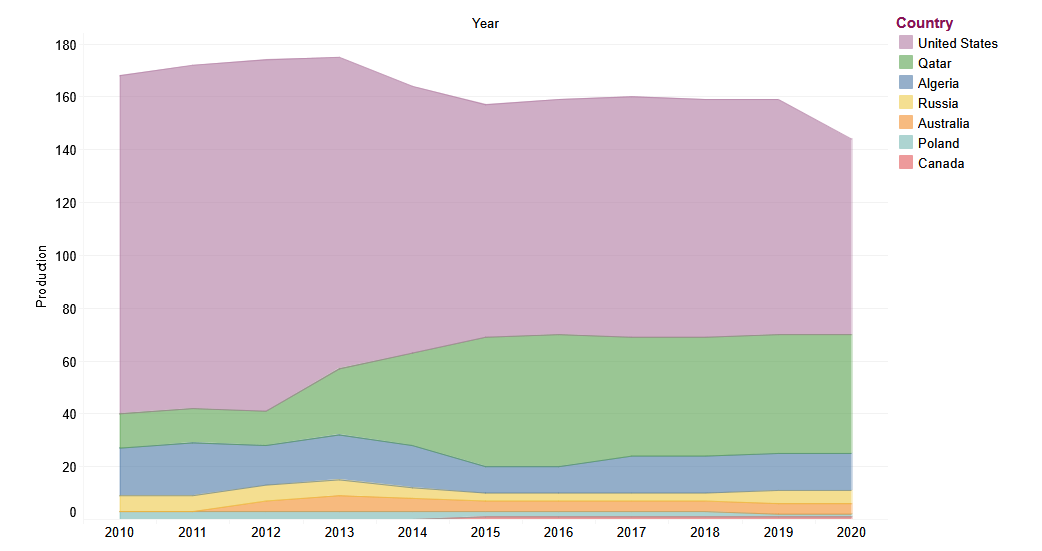
Source: CER (Canada Energy Regulator)
On the demand side, several market analyses estimate that the value of the global helium market reached approximately USD 4.4 billion in 2024 and could approach USD 8.6 billion by 2034 [8]. This growth is accompanied by recurring shortages (often referred to as "Helium Shortages") that marked the years 2011–2013, 2019, and 2022, creating tensions in global supply chains.
The recognition of helium as a critical resource or mineral by the European Union and Canada, notably due to its role in the energy transition and digital transformation, is also highlighted by IDTechEx analyses [9]. This classification reflects the growing importance of the gas in sectors where supply reliability constitutes a major strategic issue. In this context, the Canada Energy Regulator (CER) [10] highlights the potential of Canada, whose several regions feature some of the highest helium concentrations observed internationally. These deposits are distinguished by their association with hydrocarbon-poor gases, a factor that limits processing steps and favors the production of volumes with low carbon intensity.
The CER also notes that North American demand remains strong, driven by medical imaging, space technologies, advanced electronics, and the digital sector. These industries require continuous and stable supply, reinforcing the relevance of reliable regional sources. Thanks to its geographical proximity to the United States — the world's primary helium market — Canada occupies an advantageous position to contribute to this stability. The emergence of new exploration and production projects also testifies to the growing interest in this resource.
Helium, a Pillar of the Technological Transition
Next-generation semiconductors, artificial intelligence, and intensive computing infrastructures share a critical dependency: high-purity helium.
High-technology applications are experiencing sustained growth that is gradually transforming the structure of helium demand. The manufacture of advanced semiconductors, particularly for the finest technological nodes, relies on helium as a purge and cooling gas in many production steps. In data centers and infrastructure dedicated to artificial intelligence, helium is used in certain specialized cooling systems for high-performance computing equipment. In the electric vehicle sector, it also contributes to testing and processes where thermal management and component reliability are essential.
-> Also read: “Which Sectors Depend on Helium?”
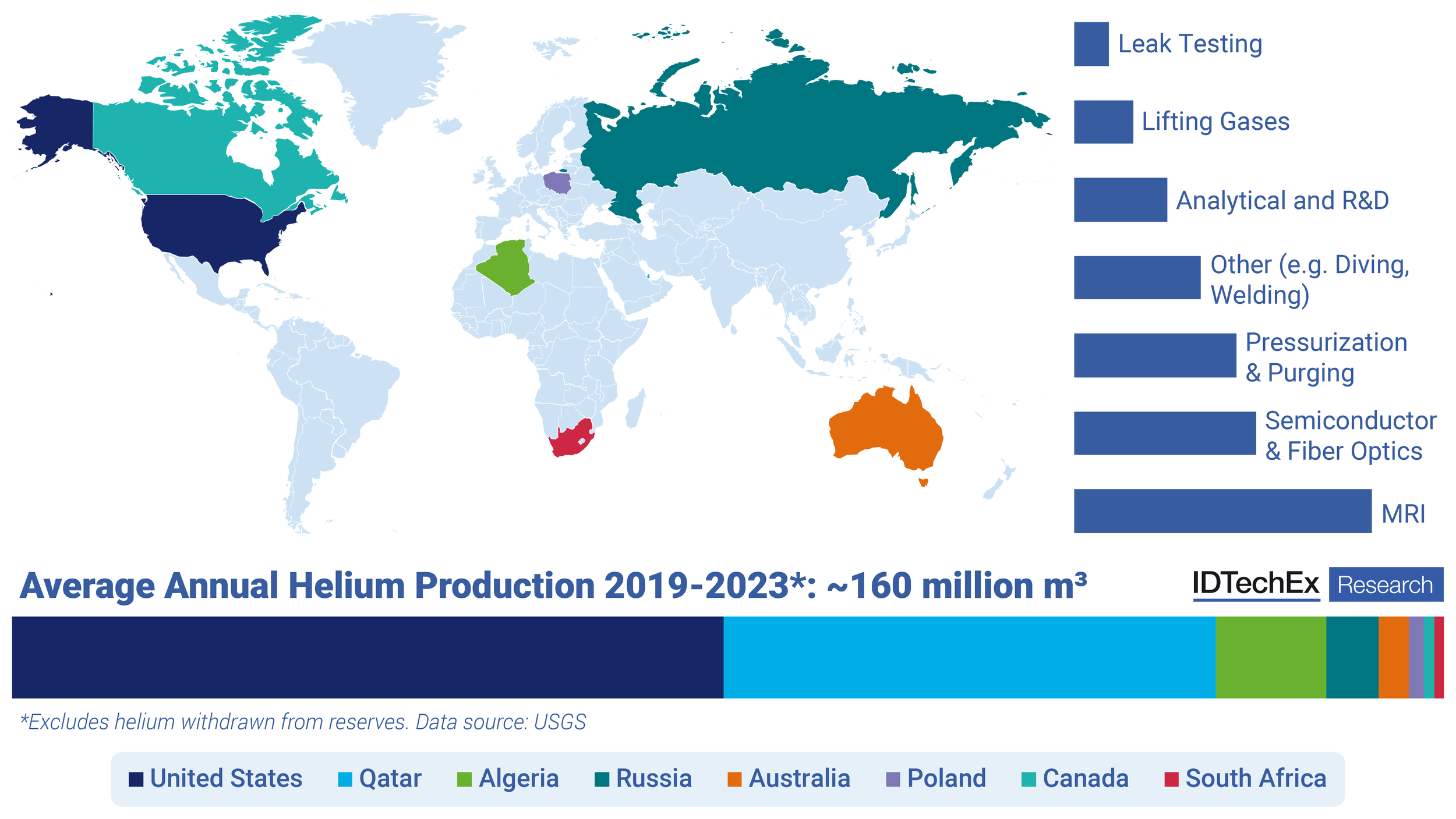
Image source: IDTechEX
The absence of fully equivalent alternatives for certain cryogenic applications represents a major challenge for the industry. Work by the USGS and IDTechEx confirms that nothing replaces helium when temperatures below approximately −429°F (~4 K) [7] are required, particularly for cooling certain superconducting magnets or experimental devices. Substitutes (such as argon or hydrogen) exist for other uses, but they do not replicate all of helium's properties in the most critical cases.
A strategic resource
Helium goes far beyond its image as a festive gas: it stands today as an indispensable resource for many key technologies, from medical imaging to quantum applications. Formed over very long geological timescales, it is among the critical resources whose understanding, management, and assessment have become priorities in supporting the development of cutting-edge industries.
The concentration of production among a few major geopolitical actors creates strategic vulnerabilities that are increasingly concerning to governments and industries alike. This dependence, combined with the absence of fully viable technological alternatives for the most demanding cryogenic uses, positions helium at the heart of economic and technological sovereignty challenges of the 21st century.
Faced with demand that could nearly double by 2035 [9] and global resources concentrated in a few regions, interest in new exploration areas, notably in Canada, is intensifying. The evolution of the global helium market fuels strategic thinking within the natural resources sector. In this regard, responsible exploration companies such as Squatex are closely following the emerging dynamics linked to critical minerals and gases.
References
[1] Stanford Advanced Materials. "Helium: Element Properties and Uses." Stanford Advanced Materials, 2025, https://www.samaterials.com/blog/helium-element-properties-and-uses.html.
[2] "Helium – Chemical Element." Encyclopædia Britannica, https://www.britannica.com/science/helium-chemical-element.
[3] CG Engineering Canada. "Helium Exploration & Drilling in Canada: A Comprehensive Guide." CG Engineering Canada, https://cgeng.ca/knowledge/helium-exploration-drilling-canada.
[4] "A Review of Helium Resources and Development." ScienceDirect, https://www.sciencedirect.com/science/article/pii/S2352854025000397.
[5] "Cryogenic Hydrogen Storage and Cryogenic Cooling." Hyfindr, https://hyfindr.com/en/hydrogen-knowledge/cryogenic-hydrogen-storage-cryogenic-cooling.
[6] "Helium." Wikipedia, 2025, https://en.wikipedia.org/wiki/Helium.
[7] U.S. Geological Survey. "Helium – Mineral Commodity Summaries 2024." Mineral Commodity Summaries, 2024, https://pubs.usgs.gov/periodicals/mcs2024/mcs2024-helium.pdf.
[8] "Global Helium Market Size." Market.us, https://market.us/report/global-helium-market/.
[9] IDTechEx. "The Industrial High on Helium: Demand for Helium to Double by 2035." IDTechEx, 2024, https://www.idtechex.com/en/research-article/the-industrial-high-on-helium-demand-for-helium-to-double-by-2035/31592.
[10] Canada Energy Regulator. "Market Snapshot: Helium – It's Not Just for Balloons." Canada Energy Regulator, 2022, https://www.cer-rec.gc.ca/en/data-analysis/energy-markets/market-snapshots/2022/market-snapshot-helium-its-not-just-for-balloons.html.
