
Thermal Storage: How Heat Becomes a Strategic Energy Resource
In energy systems, the challenge isn't just producing power, but also making it available at the right moment. This reality is becoming increasingly important as renewable energy sources, whose output fluctuates with weather conditions, seasons, and time of day, are integrated at a growing scale.
Thermal storage, commonly known by the acronym TES (Thermal Energy Storage), addresses this need by making it possible to store energy as heat or cold and release it later when demand calls for it. Depending on the technology used, this release can happen just a few hours afterward, or extend over several days, even weeks [1].
Interest in these solutions is rising sharply. According to the International Renewable Energy Agency, the global thermal storage market could more than triple by 2030 [3]. This growth reflects the increasingly recognized part thermal storage plays in managing grids, buildings, industrial processes, and, in some cases, underground geological formations.
What Is Thermal Storage?
In its broadest sense, TES refers to any system capable of storing surplus thermal energy for periods ranging from a few hours to several months, at scales that vary from a single building to an entire region [1]. Its applications are numerous: balancing demand between day and night, retaining heat produced in summer for use in winter, or even storing winter cold to power summer air conditioning [1].
This last example illustrates what's known as seasonal storage: a charge-and-discharge cycle spanning several months, unlike the more common daily storage cycle. This ability to operate over such long timeframes sets TES apart from most other energy storage technologies.
The Three Main Families of TES Technologies
TES isn't a single technology but three main categories, distinguished by how the energy is physically retained [2]:
Sensible heat storage relies on heating or cooling a medium (water, rock, or soil, for example) without changing its physical state. It's one of the most widespread and mature forms of thermal storage, seen especially in hot water tanks and molten salt systems [2][3].
Latent heat storage takes advantage of a material's phase changes, such as melting or solidifying. Phase change materials (PCMs) fall into this category, and their industrial development is currently underway [2].
Thermochemical storage uses reversible chemical reactions to absorb and release energy. It's the most promising path in terms of energy density, though also the least technologically advanced, still mostly confined to research and testing [2].
Storage media come in many forms: hot water or ice tanks, bodies of soil or bedrock connected to borehole exchangers, deep aquifers, gravel-filled pits, molten salts, phase change materials, or thermochemical compounds [1]. This diversity partly explains why TES shows up in sectors as different as construction, industry, and geothermal energy.
Table 1: Overview of the Three TES Families
| Storage Type | Purpose | Example Applications | Maturity Level |
|---|---|---|---|
| Sensible heat | Store large quantities of heat or cold in a simple medium, such as water, soil, or rock | Hot water tanks, underground storage, district heating networks, buildings | Most widespread and mature |
| Latent heat | Store more energy within a more compact volume through a material's phase change | Ice storage, phase change materials in buildings, certain industrial applications | Under development and deployment |
| Thermochemical | Store energy through a reversible chemical reaction, with potentially higher energy density | Long-duration storage, specialized industrial applications, still-experimental systems | Mostly in research and testing |
Thermal Storage in Service of the Energy Transition
Thermal storage isn't limited to heating and cooling needs in buildings. It also plays a part in the flexibility of energy systems, helping integrate larger shares of renewables. This contribution matters especially in addressing intermittency, meaning the mismatch between when energy is produced and when it's consumed.
A Tool for Integrating Renewables
IRENA finds that TES technologies can help integrate high shares of renewable energy into electricity generation, industry, and buildings, in line with the climate goals of the Paris Agreement [3]. In practice, TES is compatible with most renewable sources (wind, photovoltaic, and concentrated solar thermal) and can operate in four distinct modes: heat to heat, heat to electricity, electricity to heat, and electricity to electricity [4].
That flexibility is exactly what makes TES valuable: by decoupling heating and cooling demand from the immediate availability of electricity generation, it boosts the energy system's adaptability and lowers its reliance on variable sources [3]. In concrete terms, this translates into less need for costly grid reinforcement, better balancing of seasonal demand, and a possible acceleration toward a predominantly renewable system [3].
The Comparative Advantages of TES as Long-Duration Storage
Beyond its role in integrating renewables, TES stands out from other long-duration energy storage technologies (LDES) through several specific strengths. The U.S. Department of Energy lists them as follows [4]:
Comparatively low costs relative to other long-duration storage solutions.
A long operational lifespan, which supports its profitability over time.
High energy density, allowing large amounts of energy to be stored within manageable volumes.
A natural capacity to stabilize the electrical grid, thanks to the inherent inertia of thermal systems.
The ability to produce heat and electricity at the same time, setting it apart from purely electric storage solutions.
According to the IEA ES TCP, thermal storage, whether used over the short or long term, is an economical option for balancing variable renewable electricity output. It can also help bring the power and heating sectors closer together [1]. The program's executive committee notes, however, that TES potential still isn't fully recognized in several energy policy analyses, including some IEA reports, particularly regarding cross-sector synergies [9]. This observation doesn't call the technology itself into question; rather, it points to a gap in institutional recognition that is now being addressed.
To learn more: "What Are Renewable Energy Sources and Why Do They Matter?"
Real-World Applications: Buildings, District Heating, and Industry
Buildings and Urban District Heating Networks
In residential and commercial buildings, TES is already used for heating, cooling, and domestic hot water production [2]. At the urban scale, it can also be built into what are known as district heating networks, which distribute centrally produced heat across a group of buildings. In this context, TES acts as a buffer between supply and demand.
Two main storage families coexist within these networks [3]:
TTES (Tank Thermal Energy Storage) refers to tank-based storage, typically hot water tanks, already widely used around the world.
UTES (Underground Thermal Energy Storage) makes use of the ground itself as a storage medium. This approach is particularly well-suited to seasonal storage.
Ice storage and solid-state thermal battery technologies are also being developed for this application, though they remain at an early stage of deployment [3].
Thermal Storage and Geothermal Energy: An Underground Partnership
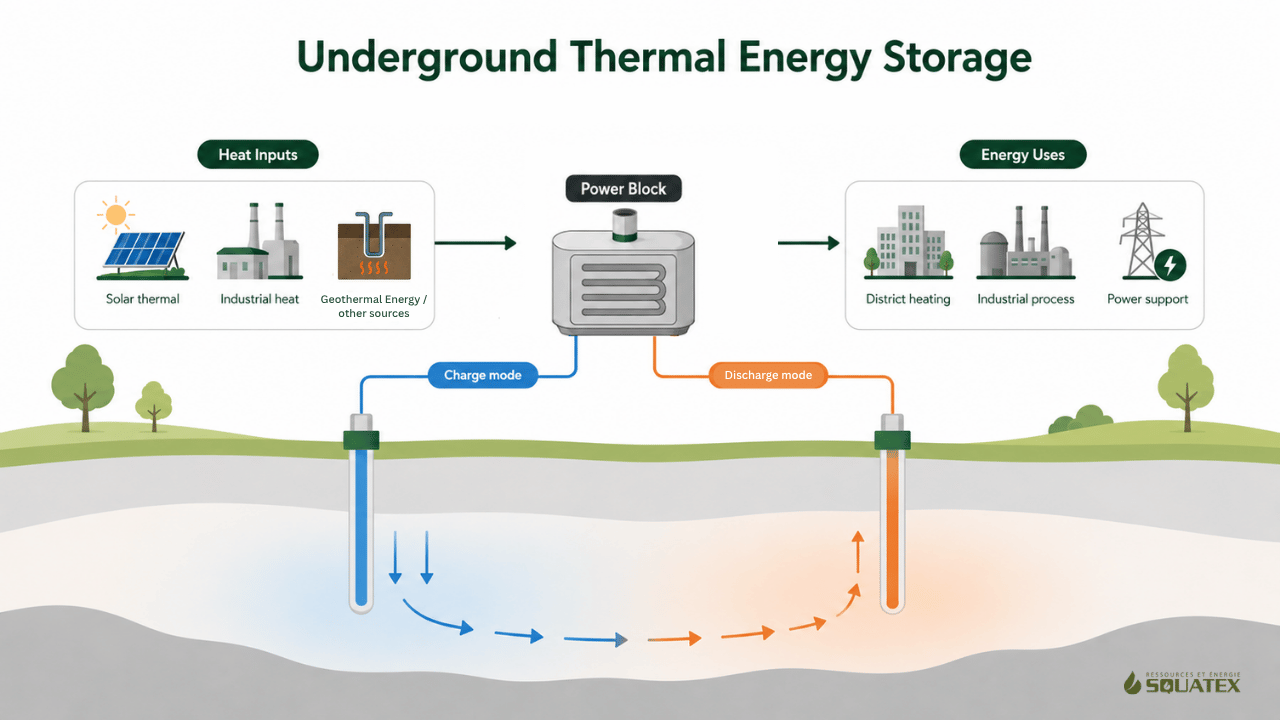
One of the lesser-known forms of thermal storage takes place directly underground. This is precisely where TES connects with geothermal energy: instead of extracting heat from the Earth, this approach uses geological formations as the storage medium itself. It opens up particularly promising prospects for large-scale seasonal storage.
Underground Thermal Storage: UTES, BTES, and RTES
The term UTES (Underground Thermal Energy Storage) covers several underground storage technologies, the main ones being [1]:
BTES (Borehole Thermal Energy Storage), which uses a large volume of natural ground crossed by boreholes to store thermal energy. This technique has been successfully deployed in several large seasonal solar systems.
ATES (Aquifer Thermal Energy Storage), which uses underground aquifers as a medium for thermal transfer and storage.
RTES (Reservoir Thermal Energy Storage), an approach that stores surplus energy (whether nuclear, renewable, or conventional in origin) as heated geothermal brine within deep geological formations [5].
This last type deserves particular attention. According to modeling carried out by Idaho National Laboratory on the Portland Basin, RTES could reach round-trip efficiencies of up to 93% [5]. It's also considered capable of offering some of the largest storage capacities and longest retention periods among TES technologies, with a potential comparable only to certain forms of hydrogen storage, but with expected higher efficiency [5].
Why This Connection Matters for Tomorrow's Energy
Through this synergy with geothermal energy, underground thermal storage shows how geology can serve as both an energy source and a natural reservoir, supporting renewable generation, surplus management, and grid flexibility all at once. This integrated vision of the subsurface as energy infrastructure lies at the heart of the most innovative approaches to the transition.
Given today's energy challenges, thermal storage is expected to keep gaining importance in the years ahead. Its maturity varies by technology, but its overall potential remains largely untapped, especially in long-duration underground applications.
Want to keep up with developments in underground energy technologies and the energy transition? Follow Squatex on LinkedIn so you don't miss a post.
References
[1] International Energy Agency Energy Storage Technology Collaboration Programme. "Thermal Energy Storage." IEA ES TCP, n.d. IEA, https://iea-es.org/thermal-energy-storage/.
[2] National Energy Technology Laboratory. "THERMAL Energy Storage." NETL Factsheet, U.S. Department of Energy, 2021. NETL, https://netl.doe.gov/sites/default/files/2021-02/Thermal_Energy_Storage_1Pager.pdf.
[3] International Renewable Energy Agency. Innovation Outlook: Thermal Energy Storage. IRENA, 2020. IRENA, https://quantumgraphite.com/wp-content/uploads/2021/11/IRENA_Innovation_Outlook_TES_2020.pdf.
[4] Balliet, W. Hill, et al. Technology Strategy Assessment: Thermal Energy Storage. U.S. Department of Energy, Office of Electricity, July 2023. DOE, https://www.energy.gov/sites/default/files/2023-07/Technology%20Strategy%20Assessment%20-%20Thermal%20Energy%20Storage.pdf.
[5] Atkinson, Trevor, et al. Reservoir Thermal Energy Storage Benchmarking. Idaho National Laboratory, August 2023. INL, https://inldigitallibrary.inl.gov/sites/sti/sti/Sort_67342.pdf.
[9] International Energy Agency Energy Storage Technology Collaboration Programme. ES TCP Annual Report 2022. IEA, 2023. IEA, https://iea-es.org/wp-content/uploads/public/ES_TCP_Annual_Report_2022.pdf.
