

What is the History of Geothermal Energy? Discover its 10,000-Year Journey
Introduction
Did you know that geothermal energy is one of the oldest forms of energy used by humanity, with traces of use dating back more than 10,000 years? Today, it represents only 0.5% of the global renewable electricity market [1], yet its potential remains immense.
In a context where the energy transition is becoming urgent, why does this clean and constant energy source remain underutilized? How has it evolved through the millennia? And above all, what role can it play in our energy future?
What is geothermal energy and where is it found?
Geothermal energy is the natural heat stored beneath the Earth's surface. This heat comes from two main sources: the radioactive decay of minerals present in the Earth's crust and mantle, as well as residual heat from the formation of our planet several billion years ago [2]. Contrary to what one might think, this resource is not reserved for a few privileged volcanic zones.
Indeed, geothermal energy has a major advantage: it exists everywhere beneath our feet, although its access depth and intensity vary according to local geological conditions. [2].
This energy manifests in several concrete applications. At the surface, it can be used directly to heat or cool buildings through geothermal pump systems that exploit shallow ground heat. It also allows, in certain regions, the production of electricity by harnessing underground reservoirs hot enough to drive turbines. Finally, various industrial sectors use this stable heat to power their processes or optimize their energy consumption.
-> Also read: Discover the vast practical applications of geothermal energy
High-temperature geothermal resources are found mainly in active tectonic zones, where plate movements bring internal heat closer to the surface. Conversely, lower-temperature uses — such as building heating via geothermal pumps — remain accessible in a large part of the world, even in less favorable geological contexts, with operating conditions that vary according to local subsurface characteristics [2].
This geographical universality is accompanied by major environmental advantages. Geothermal energy emits very low amounts of CO₂ compared to fossil fuels. Moreover, it has the ability to operate 24 hours a day, 7 days a week, which radically distinguishes it from solar and wind power, whose production fluctuates according to weather conditions.
Geothermal energy through the ages - A millennial history
The use of geothermal energy by humanity constitutes one of the longest histories of energy exploitation, testifying to its importance across civilizations.
Prehistoric period and Antiquity
~10,000 years ago – Paleo-Indians of North America exploit natural hot springs to cook their food, heat their shelters, and bathe. This early use makes geothermal energy one of the very first forms of energy mastered by human beings [3].
Antiquity – The Roman Empire develops sophisticated geothermal heating systems to power its famous baths and dwellings, notably in cities like Pompeii and throughout various provinces of the Empire [3].
Roman era – Construction of monumental thermal complexes such as the Baths of Caracalla in Rome, testifying to the Romans' remarkable technical mastery of geothermal exploitation [3].
14th century – In Chaudes-Aigues, France, a geothermal hot water distribution network is established to heat homes. Often presented as the world's first geothermal district heating network, it is still partly in use today [3].
Industrial era (19th century)
1818–1827 – In Tuscany, François-Jacques de Larderel develops and then perfects an industrial process that uses geothermal steam to extract boric acid from volcanic mud. This is one of the first documented industrial uses of geothermal energy [3].
1892 – The city of Boise, Idaho (United States), inaugurates the first documented modern geothermal district heating system, serving several buildings and laying the foundations for contemporary heat networks [3]. This network is often cited as a model for contemporary heat networks.
20th century: The era of electricity generation
1904 – Major historical moment: Prince Piero Ginori Conti succeeds in lighting five electric bulbs using geothermal energy in Larderello, Italy. This experiment proves for the very first time that it is possible to produce electricity from terrestrial steam [3]. This is the starting point of modern geothermal electricity generation.
1911-1913 – Construction of the world's first commercial geothermal power plant in Larderello, truly opening the era of industrial-scale geothermal electricity generation [3].
1958 – New Zealand inaugurates the Wairakei power plant, which introduces flash steam technology. This technical innovation allows more efficient exploitation of geothermal reservoirs and constitutes a major advancement for the entire sector [3].
1960 – The United States launches its first production facility with The Geysers power plant in California. This complex will become the world's largest geothermal site [3].
1974 – Creation of the International Energy Agency (IEA), which will play a crucial role in promoting renewable energies, including geothermal energy, at the global level [4].
1970s-1980s – Oil crises and rising energy and environmental concerns stimulate interest in alternative energies. Many countries then develop or extend their installed geothermal capacity to diversify their energy mix [1], [5].
Modern acceleration and institutional developments (1980-2015)
The last decades of the 20th century and the beginning of the 21st century saw the emergence of an international institutional framework and major technological advances that transformed geothermal energy into a mature industry.
1988 – The International Geothermal Association (IGA): The IGA is created as the first global organization dedicated exclusively to promoting geothermal energy as a vital component of the energy transition.
1997 – IEA Geothermal Technical Cooperation Programme (IEA GTCP): The Geothermal Energy Technology Collaboration Programme (GEA-TCP) is established within the framework of the International Energy Agency's Technology Collaboration Programme as a platform promoting international collaboration and networking for all aspects of geothermal energy.
2008 – The Geothermal Energy Association (GEA): This association is created to promote sustainable geothermal development worldwide and improve awareness of the unique advantages of this renewable resource.
2009 – The International Renewable Energy Agency (IRENA): Created on January 26, 2009, this intergovernmental agency sets itself the mission of facilitating global cooperation on renewable energies — including geothermal energy — and accelerating their adoption.
2015 – The Global Geothermal Alliance (GGA): The GGA is established by IRENA during COP21 in Paris, with the ambitious objective of multiplying global geothermal capacity by five by 2030. This initiative testifies to the international awareness of this energy's potential [4].
2015 – The Paris Agreement on climate: Adopted during COP21, this agreement explicitly recognizes the crucial role of renewable energies, including geothermal energy, in limiting global warming to 1.5°C, definitively placing geothermal energy at the heart of global climate strategies [4].
Key technological innovations
Alongside these institutional developments, major technological advances are transforming geothermal exploitation possibilities:
Enhanced Geothermal Systems (EGS): This revolutionary technology makes it possible to exploit geothermal heat in areas that do not naturally present exploitable reservoirs, considerably expanding the geographical potential of geothermal energy.
Binary systems: Progress in binary systems now allows the exploitation of lower-temperature resources, making geothermal production accessible in a growing number of regions previously considered non-viable.
Drilling techniques: Substantial improvements in drilling techniques, inspired by advances in the oil and gas industry, translate into reduced exploration and development costs, as well as increased capacity to reach greater depths.
Current state and future prospects (2020-2050)
Despite its 10,000-year history and considerable potential, where does geothermal energy really stand today in the global energy mix?
Current situation
Currently, geothermal energy represents approximately 0.5% of the global renewable electricity market. This proportion may seem modest at first glance, but it hides a potential that is still largely untapped [1]. Global installed capacity has progressed steadily over the decades, with notable concentration in geologically favorable regions, particularly the Pacific Ring of Fire and the African Rift [1].
Why geothermal energy is essential for the energy transition
According to projections from the International Energy Agency (IEA), achieving carbon neutrality by 2050 requires a significant multiplication of all renewable energy sources. In this context, global geothermal capacity will need to undergo major expansion to meet global climate objectives [5].
Geothermal energy has a decisive advantage that distinguishes it from its renewable counterparts: its stability. Unlike solar and wind power, whose production fluctuates according to weather conditions, geothermal energy provides constant and predictable electricity 24 hours a day, 365 days a year. Its capacity factor regularly exceeds 90%, making it one of the most consistently operating renewable sources [2][5].
This characteristic makes geothermal energy an ideal baseload energy, capable of compensating for the intermittency of solar and wind power. By providing a reliable production base, geothermal energy can help reduce reliance on backup fossil fuel plants and limit the size — and therefore the cost — of storage systems necessary for balancing electrical grids.
Beyond electricity generation, the potential for urban heating and cooling through geothermal energy deserves particular attention. Geothermal heat networks can significantly decarbonize the residential and commercial sector, responsible for a significant portion of greenhouse gas emissions in developed countries.
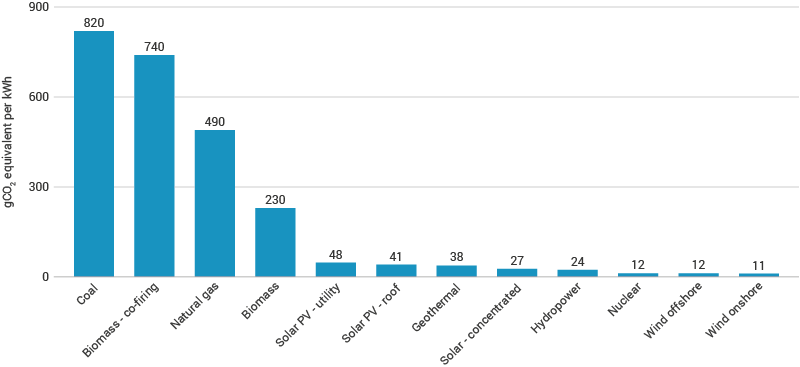
Figure 1: Average life-cycle CO2 equivalent emissions
The economic co-benefits are not negligible: the geothermal industry creates non-relocatable local jobs, strengthens the energy independence of territories, and develops technical skills transferable to other industrial sectors.
Challenges of geothermal energy
Despite these considerable assets, several barriers still slow the massive deployment of geothermal energy. Initial exploration and drilling costs remain high, representing a significant financial risk for project developers. Geological risks, notably the uncertainty regarding reservoir quality before drilling, also constitute a major obstacle. Finally, the absence of coherent support policies in certain regions limits investments in this sector.
At the same time, emerging technologies are opening new perspectives. Enhanced geothermal systems (EGS) and deep geothermal energy, as well as "super-hot rock" concepts, aim to access higher-temperature resources at greater depths, potentially almost anywhere on the planet. A particularly interesting opportunity lies in the extraction of lithium and other critical minerals from geothermal brines, creating a direct link with the transition to batteries and critical materials for low-carbon technologies [5].
This convergence between sectors opens fascinating synergy possibilities. Skills and technologies developed in mining extraction can be applied to geothermal energy, and vice versa. The valorization of abandoned oil and gas wells for geothermal production also represents a particularly relevant industrial reconversion opportunity for Quebec and other regions with a history of hydrocarbon exploitation.
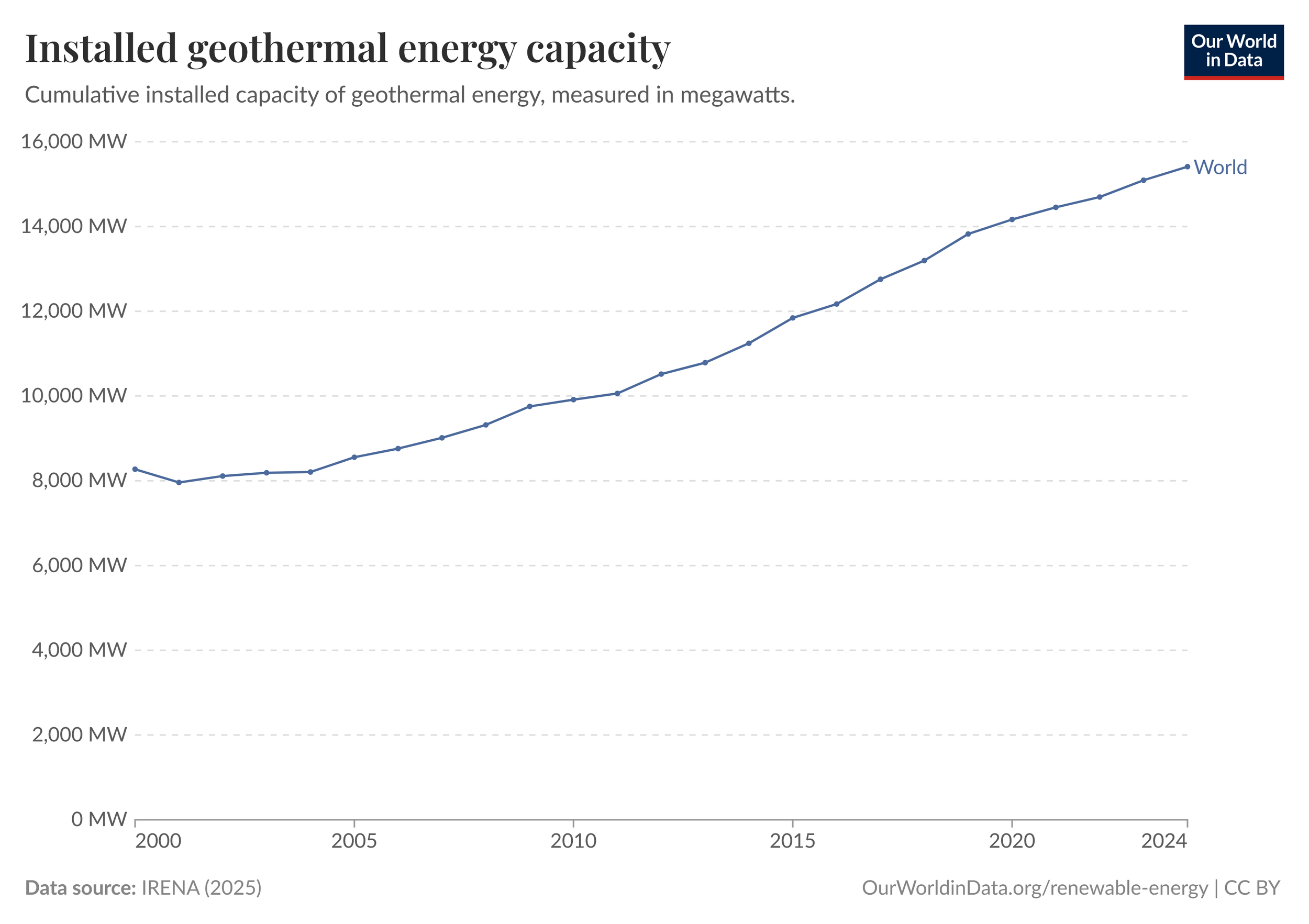
Graph: Evolution of global installed geothermal capacity
Conclusion
At a time when the world is resolutely committing to carbon neutrality by 2050, geothermal energy is not only a technology of the future, it is a bridge between our most ancient energy past and our decarbonized future. Its millennial history testifies to its reliability; its unique characteristics of stability and universality make it an essential pillar of tomorrow's energy mix. For companies like Squatex that are working toward the energy transition, geothermal energy represents an opportunity to combine technological innovation, environmental responsibility, and valorization of local resources.
-> Follow us on LinkedIn to stay informed about the latest developments in the renewable energy sector.
References
[1] Ritchie, Hannah, and Max Roser. "Installed Geothermal Capacity." Our World in Data, 2024, ourworldindata.org/grapher/installed-geothermal-capacity.
[2] U.S. Department of Energy. "Geothermal FAQs." Office of Energy Efficiency & Renewable Energy, energy.gov/eere/geothermal/geothermal-faqs.
[3] "Geothermal Energy Throughout the Ages." Alberta Energy Heritage, Government of Alberta, history.alberta.ca/energyheritage/energy/alternative-energy/geothermal-energy/geothermal-energy-throughout-the-ages.aspx.
[4] "About Us - Key Policy Developments." Global Geothermal Alliance, globalgeothermalalliance.org.
[5] International Energy Agency. "Geothermal Power." IEA Reports, 2024, iea.org/reports/geothermal-power.
