

Carbon-negative materials and CCUS: towards a complementary approach to CO₂ management
Introduction
The construction sector generates approximately 8% of global CO₂ emissions, mainly due to concrete production, which represents one of the most widely used materials in the world. Faced with this major environmental challenge, how can we transform this traditionally polluting sector into an ally in the fight against climate change?
Researchers at Worcester Polytechnic Institute have just unveiled an innovation that could provide part of the answer: an enzymatic building material capable not only of replacing concrete, but also of actively absorbing atmospheric CO₂. This emerging technology, still in the laboratory research stage, fits into the broader ecosystem of carbon capture, utilization and storage (CCUS) technologies.
For Squatex, a Quebec company specializing in subsurface sciences, this innovation represents a fascinating opportunity to observe how different sequestration approaches can complement each other to achieve climate goals.
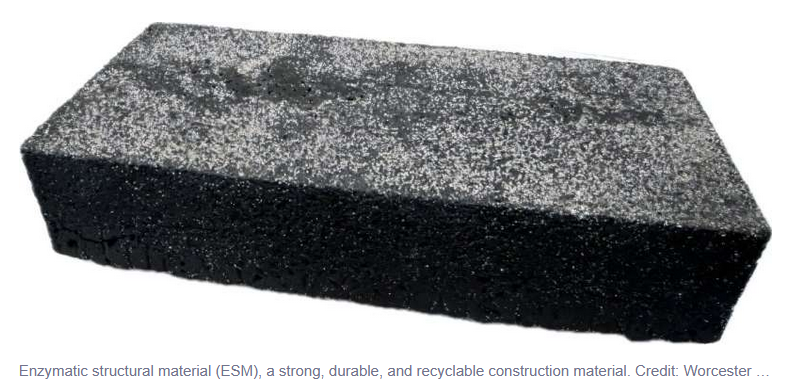
Source: Worcester Polytechnic Institute
A promising innovation: carbon-negative building materials
American researchers have just developed a revolutionary material that could transform the way we build while capturing atmospheric CO₂. This technology, called ESM (enzymatic structural material), is based on a catalyzed enzymatic process that directly converts CO₂ into solid mineral particles [1]. The material exhibits fast and adjustable hardening properties, allowing its adaptation to various construction applications.
The figures speak for themselves: while conventional concrete production emits approximately 330 kilograms of CO₂ per cubic meter, this new enzymatic material can sequester more than 6 kilograms of CO₂ per cubic meter [1]. This difference represents a complete paradigm shift, transforming an emitting process into a carbon-capturing process.
The potential applications identified by the researchers are vast and promising. The material could revolutionize modular construction and contribute to the development of affordable housing thanks to its ease of implementation. Temporary structures for humanitarian aid could also benefit from this technology, offering a rapid and ecological solution for emergency situations. Another considerable advantage lies in the recyclable and repairable nature of these materials, fitting perfectly into a circular economy.
Additional note: It is important to note that this research currently remains in the experimental phase. No commercial deployment is yet underway. However, in the current context of technological acceleration and climate urgency, several factors suggest promising development potential for this innovation. The convergence of market needs, available investments and scientific expertise could facilitate a faster transition to practical applications.
The CCUS context: understanding different carbon management strategies
To fully grasp the importance of this innovation, it must be placed in the broader ecosystem of carbon capture, utilization and storage (CCUS) technologies. This system rests on three fundamental pillars that work together to reduce atmospheric CO₂ concentration.
The first pillar, capture, involves various technologies for separating CO₂ directly from industrial emission sources or from the atmosphere [2]. These technologies include chemical absorption, physical adsorption and separation membranes, each adapted to different industrial contexts.
The second pillar, utilization, transforms captured CO₂ into value-added products. This conversion can produce synthetic fuels, chemicals, or as with ESM, innovative building materials. This approach creates economic value from CO₂, transforming a waste into a resource.
The third pillar, storage, consists of permanent sequestration of CO₂ in deep geological formations, including saline aquifers, depleted oil and gas reservoirs, and unmineable coal seams [3, 4]. This method offers a long-term storage solution for massive volumes of CO₂.
The scale of the climate challenge puts into perspective the importance of developing all these approaches simultaneously. Currently, only approximately 50 million metric tons of CO₂ are captured annually, representing barely 0.1% of global emissions [2]. To achieve our climate goals, many international organizations and public bodies agree on the need to aim for more than one billion tons by 2030 and several billion tons by 2050 [2]. These figures illustrate the monumental scale of the task ahead.
In this context, ESM technology positions itself as a utilization strategy with a co-benefit of capture. Unlike centralized geological storage which requires massive infrastructure, this approach offers a distributed solution where CO₂ is captured and used directly at construction sites. This decentralization could facilitate rapid deployment of the technology while significantly reducing the carbon footprint of the construction sector.
Complementarity of approaches: surface mineralization and geological storage
Carbon-negative materials like ESM illustrate an important evolution in how CO₂ capture can integrate directly into industrial value chains, particularly in the construction sector. By enabling CO₂ to be captured and mineralized at the very moment of material manufacturing, these approaches pave the way for so-called "surface" solutions, distributed and integrated into the final use.
Moreover, this technology offers other advantages to consider in the long term. Capturing CO₂ at the point of production limits the need for transportation and intermediate infrastructure, which can reduce logistical complexity and certain sources of indirect emissions [1]. Its potential for recyclability and circularity also aligns with a circular economy logic, while offering a direct reduction in the carbon footprint of a historically difficult sector to decarbonize.
However, as with any emerging technology, several parameters remain under evaluation, particularly regarding large-scale production conditions, associated costs and methods of integration into existing markets. Nevertheless, in a context where technological advances, particularly in materials engineering, are progressing rapidly, these constraints must be seen as development axes rather than structural limitations.
From this perspective, carbon-negative materials fully fit into an expanded CCUS approach, where CO₂ capture and valorization can be deployed both on the surface, through innovative industrial applications, and in depth, via long-term storage solutions. These approaches do not oppose each other, but respond to complementary needs depending on volumes, contexts and targeted time horizons.
The crucial importance of geological storage
Geological storage of CO₂ remains today a central pillar of carbon management strategies at the global scale. Deep saline aquifers and depleted hydrocarbon reservoirs offer considerable storage capacities, potentially reaching gigatons of CO₂ [3]. Geological trapping mechanisms — structural, residual, dissolution and mineralization — have been extensively studied and demonstrate effectiveness over periods exceeding several thousand years.
This capacity to ensure long-term confinement over very long periods responds to a fundamental constraint in the fight against climate change: the need to permanently remove large quantities of CO₂ from the atmosphere. Geological storage is particularly well suited to concentrated emissions from heavy industries and energy production, where the volumes involved far exceed what distributed solutions can absorb in the short term.
In a forward-looking vision, geological storage and surface mineralization technologies can be considered as two complementary components of the same climate infrastructure. As carbon-negative materials become technically and economically viable at large scale, they could reduce pressure on certain forms of deep storage by integrating CO₂ capture directly into products and buildings. At the same time, the subsurface will continue to play a strategic role in managing residual volumes and ensuring permanent long-term sequestration.
It is in this articulation between surface innovations and subsurface expertise that a robust and scalable CCUS approach is taking shape, capable of adapting to technological advances, economic constraints and future climate objectives.
A promising technology
Carbon-negative building materials like ESM represent a promising frontier in our arsenal against climate change. This enzymatic technology could radically transform the construction sector, converting a major source of emissions into an active carbon sink. However, the scale of the climate challenge requires a diversified approach where each solution plays a complementary role.
The rapid evolution of carbon capture, utilization and storage technologies relies on close collaboration between research, industry and territorial actors. While new solutions emerge on the surface, particularly in building materials, the CCUS sector continues to structure itself around rigorous evaluation of subsurface potential. In this context, Squatex takes part in the development of this emerging sector by contributing to analyses and understanding of geological issues related to CO₂ sequestration, with a view to long-term reflection on energy transition trajectories.
To follow the evolution of these technologies and understand their impact on the energy transition, we invite you to subscribe to the LinkedIn page to stay informed of the latest sector advances.
References
[1] "New Material Absorbs CO2 Quickly to Make Sustainable Concrete Alternative." Phys.org, Worcester Polytechnic Institute, December 2025. https://phys.org/news/2025-12-material-absorbs-quickly-sustainable.html
[2] World Resources Institute. "7 Things to Know About Carbon Capture, Utilization and Sequestration." WRI Insights, 2025. https://www.wri.org/insights/carbon-capture-technology
[3] Zhang, L. et al. "Research Status and Prospects of CO2 Geological Sequestration Technology from Onshore to Offshore." Earth-Science Reviews, vol. 245, 2024. https://www.sciencedirect.com/science/article/abs/pii/S0012825224002563
