

What are renewable energy sources and why are they essential?
Introduction
In 2023, renewable energies reached a historic milestone by representing 30% of global electricity production [1]. This progress demonstrates a profound shift in our global energy system.
Faced with the climate emergency and the progressive depletion of fossil resources, a fundamental question arises: how can we meet our growing energy needs while drastically reducing our carbon footprint? Do renewable energies offer a viable and sustainable solution for our energy future?
This article provides a clear and comprehensive overview: definition, functioning, major sources, the place of nuclear power, challenges to overcome, and the strategic role of critical resources.
What is renewable energy?
Renewable energy comes from natural sources that regenerate faster than they are consumed [2]. This fundamental characteristic radically distinguishes them from fossil energies, whose formation requires millions of years. Thus, on a human timescale, renewable resources appear inexhaustible.
Three key characteristics
Renewable energies are distinguished by:
A perpetual natural cycle (sun, wind, water, Earth's internal heat...).
A low carbon footprint during production.
Widespread geographical availability, promoting energy autonomy.
They rely notably on: solar radiation, air movements, the water cycle, terrestrial heat, biomass [2].
This diversity of sources offers considerable flexibility to adapt energy solutions to the geographical and climatic characteristics of each region, thereby strengthening the resilience and energy autonomy of territories.
Why are renewable energies crucial today?
The current global context places renewable energies at the heart of the solution to the unprecedented environmental and energy challenges facing humanity.
The climate emergency
The climate emergency constitutes the primary driver of this transition. The energy sector bears overwhelming responsibility: it generates more than 75% of global greenhouse gas emissions [3]. This reality makes its decarbonization an absolute priority to hope to limit the impacts of climate change. Every ton of CO2 avoided in energy production directly contributes to stabilizing our climate.
International objectives reflect this collective awareness. At COP28, nations committed to tripling global renewable energy capacity by 2030 [1]. This ambition aims to keep the goal of limiting global warming to 1.5°C within reach. Without this massive acceleration in renewable deployment, this objective would quickly become unattainable.
Energy security and reduced dependence
Beyond climate benefits, renewable energies offer considerable strategic advantages. They reduce dependence on fossil fuel imports, thereby creating increased energy security for the nations and regions that deploy them [2]. This local energy autonomy also protects economies against the volatility of international oil and gas prices.
How do renewable energies work?
All these energies are based on a simple principle: converting natural flows into heat or electricity.
The general principle
Solar: conversion of radiation into current via semiconductors.
Wind: transformation of the kinetic energy of wind into electricity.
Hydraulic: use of moving water to drive a turbine.
Geothermal: valorization of underground heat.
Biomass: combustion or chemical transformation of organic matter [2].
Unlike fossil energies, no single and definitive fossil combustion is necessary: natural cycles continually renew themselves.
The main renewable energy sources
Let's now explore in detail the most developed renewable energy sources and their respective contribution to our global energy mix.
Solar energy
Solar photovoltaic directly converts sunlight into electricity through semiconductor cells that generate an electric current when exposed to photons [2]. In parallel, solar thermal uses the heat from solar radiation to produce steam that drives electricity-generating turbines. These two complementary approaches exploit the immense energy potential of our star.
The advantages of solar are multiple. The technology is modular and can be applied at all scales, from individual residential installations to immense industrial solar farms [2]. This energy stands out for its reduced costs and maintenance time required regarding panel installation and maintenance. Moreover, no emissions are generated during operation.
Wind energy
Wind turbines capture the kinetic energy contained in the movement of air masses. Aerodynamic blades rotate under the effect of wind, driving a generator that produces electricity [2]. This proven technology now comes in terrestrial and marine versions, each optimized for its specific environment.
Offshore wind is experiencing particularly dynamic development. Offshore installations benefit from more consistent and powerful winds than on land, enabling superior electricity production.
On a global scale, wind represents the second source of renewable capacity added after solar [1]. Growth remains sustained, particularly in coastal regions and areas characterized by favorable wind regimes. Onshore wind continues to develop as well, benefiting from improved weather forecasting and site optimization.
Hydroelectric energy
Hydroelectricity exploits the potential and kinetic energy of moving water. Rivers, natural waterfalls, or artificial dams create a flow that turns electricity-generating turbines [2]. Reservoir plants additionally offer a valuable energy storage capacity, allowing production to be modulated according to demand.
Hydroelectricity constitutes the most mature and important renewable electricity source on a global scale [1]. Developed for over a century, this technology has proven itself in terms of reliability and longevity. Numerous hydroelectric installations have been operating for decades with consistent and predictable production.
Geothermal energy
Geothermal energy exploits the natural heat stored in the Earth's depths. This thermal energy can produce electricity via steam turbines or serve directly for building heating and industrial processes [2]. Drilling reaches hot zones in the subsurface, where heat-transfer fluids capture the heat before bringing it back to the surface.
A unique advantage distinguishes geothermal from other renewable sources: its capacity to provide constant production. Unlike solar which depends on sunshine or wind which is dependent on wind conditions, geothermal offers stable and predictable baseload energy, independent of weather conditions or day-night cycles. This reliability makes it a valuable complement to stabilize electrical grids.
-> Also read : How does geothermal energy stand out compared to other renewables?
Geothermal applications extend far beyond electricity production alone. In certain scenarios, it also serves for heating agricultural greenhouses, enabling year-round cultivation, and for various industrial processes requiring high temperatures. This versatility maximizes the use of this underground thermal resource.
-> Also read : The various practical applications of geothermal energy
Biomass and bioenergies
Biomass uses various organic materials to produce energy. Agricultural waste, forestry residues, and dedicated energy crops can be burned directly, fermented into biogas, or chemically transformed into liquid biofuels [2]. This flexibility allows energy recovery from a wide variety of organic materials.
The concept of relative carbon neutrality characterizes biomass. Although its combustion does release carbon dioxide, it was theoretically captured from the atmosphere during plant growth [2]. If resources are managed sustainably, with systematic replanting, a balanced cycle is created where the CO2 emitted is quickly reabsorbed by new crops. This circularity distinguishes biomass from fossil fuels whose carbon remains geologically stored.
Waste valorization represents a major additional benefit. Bioenergy allows organic residues that would otherwise be buried or left to decompose to be transformed into useful energy [2]. This dual function – energy production and waste volume reduction – significantly improves the overall efficiency of our residual materials management systems.
Nuclear energy: a controversial option toward decarbonization
Although it is not considered renewable, nuclear energy deserves particular attention in the current context of energy transition and decarbonization goals.
Nuclear energy cannot be classified as renewable for one fundamental reason: it uses uranium, a finite ore extracted from the ground [3]. This nuclear fuel does not regenerate naturally on a human timescale, unlike truly renewable sources. Despite its low operational emissions, this characteristic places nuclear in the category of non-renewable energies, in the same way as fossil fuels from the standpoint of resource availability.
However, nuclear presents an undeniable climate advantage. During its operation, this technology produces electricity with virtually zero carbon dioxide emissions [3]. On this crucial criterion, it compares favorably to renewable energies and stands out radically from coal or natural gas plants. This characteristic makes nuclear a potentially useful tool in the fight against climate change.
The challenges of transitioning to renewable energies
Production intermittency represents the most fundamental challenge. Solar and wind directly depend on weather conditions and do not produce energy continuously [2]. Solar panels stop producing at night and their efficiency decreases in cloudy weather. Wind turbines only turn when the wind blows sufficiently. This natural variability creates considerable challenges in maintaining the constant balance between production and electrical consumption, essential to grid stability.
The need for storage stems directly from this intermittency. To guarantee a constant electricity supply despite production fluctuations, energy storage solutions become essential [2]. Lithium-ion batteries, hydrogen storage, and pumped hydroelectric stations constitute the main options being explored. However, these technologies remain in active development and remain costly at large scale. The massive deployment of storage capacity represents a considerable investment necessary for the successful integration of renewables.
The modernization of electrical grids constitutes another major imperative. The massive integration of decentralized renewable sources requires smart grids capable of managing bidirectional and variable flows [3]. Unlike conventional power plants that inject electricity at a central point, solar and wind installations are geographically dispersed and their production constantly fluctuates. Grids must therefore become more flexible, interconnected, and digitalized to optimize energy routing and prevent local overloads.
Dependence on critical minerals emerges as a crucial strategic issue. Green technologies require significant quantities of specific minerals for their manufacture [3]. Solar panels require silicon, silver, and sometimes rare earths. Batteries depend on lithium, cobalt, and nickel. Wind turbines use neodymium and dysprosium for their permanent magnets. This increased consumption of critical minerals creates new supply issues that could limit the pace of clean technology deployment if not anticipated.
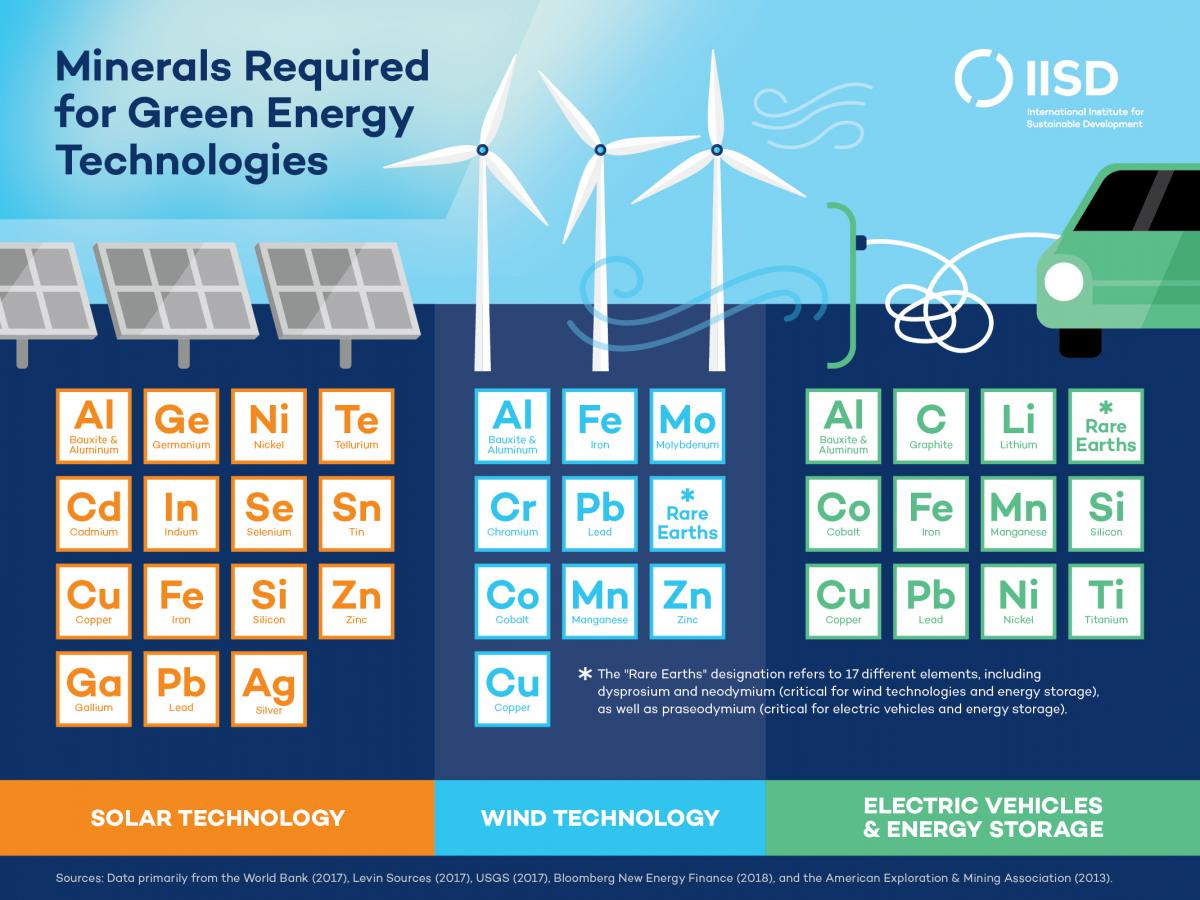
Source: International Institute for Sustainable Development (IISD)
Towards a Sustainable Energy Future
Renewable energies represent much more than a simple alternative to fossil fuels: they constitute the indispensable cornerstone of our energy transition toward a decarbonized and sustainable future. With remarkable 50% growth in installed capacity in 2023 and the ambitious goal of tripling this capacity by 2030 [1].
In this context, Squatex’s interest in geothermal energy and critical minerals highlights the interdependence between energy production and resource availability. By examining these complementary dimensions, the company contributes to a broader reflection on how energy systems can evolve in a way that is both responsible and resilient.
The energy transition is a long-term process shaped by innovation, collaboration, and informed decision-making. Understanding its challenges and opportunities today is essential to building the sustainable energy systems of tomorrow.
Discover how Squatex contributes to the energy future by following our news on LinkedIn to stay informed of the latest advances in the renewable energy sector.
References
[1] International Energy Agency (IEA). "Renewables - Energy System." IEA, 2024, https://www.iea.org/energy-system/renewables.
[2] IBM. "What Is Renewable Energy?" IBM Think Topics, https://www.ibm.com/think/topics/renewable-energy.
[3] IBM. "What Is Decarbonization?" IBM Think Topics, https://www.ibm.com/think/topics/decarbonization.
[4] International Energy Agency (IEA). "Renewable Energy Progress Tracker." IEA Data & Statistics, https://www.iea.org/data-and-statistics/data-tools/renewable-energy-progress-tracker.