

BECCS: Bioenergy and Carbon Capture Explained
Reaching carbon neutrality is no longer just about cutting emissions; it also means offsetting the residual emissions that are hard to eliminate. Heavy industry, aviation, agriculture: some sectors will keep emitting CO₂ despite technological progress. It is against this backdrop that carbon removal technologies are taking on growing importance in international climate scenarios.
According to the IEA, the combined atmospheric removals from direct air capture with storage (DACS) and bioenergy with carbon capture and storage (BECCS) are expected to reach roughly 0.6 Gt of CO₂ in 2035 and 1.7 Gt of CO₂ in 2050 under the Net Zero scenario [4]. These volumes show the scale of the challenge: the task is no longer simply about limiting emission flows, but about organizing massive and durable removals of atmospheric carbon.
Among these solutions, BECCS — Bioenergy with Carbon Capture and Storage — holds a distinctive place. By pairing renewable energy production from biomass with permanent geological storage of CO₂, it can in theory deliver net-negative emissions [1]. Built into the majority of scenarios compatible with warming limited to 1.5–2 °C, BECCS is steadily emerging as a lever that complements renewables, energy efficiency, and electrification.
CCUS: A Technology at the Heart of Decarbonization
Before defining BECCS specifically, it helps to briefly recall what CCUS — Carbon Capture, Utilization and Storage — is, since BECCS represents a particularly promising variant of it.
The General Principle of CCUS
CCUS brings together the technologies for capturing CO₂ at the source — whether from industrial facilities or power plants — along with its compression, transport, and injection into deep geological reservoirs, accompanied by long-term monitoring. In practical terms, this approach makes it possible to intercept CO₂ before it reaches the atmosphere, diverting it toward permanent underground storage.
BECCS pushes this logic even further by adding a biological dimension that allows not only the avoidance of emissions, but their active removal from the atmosphere.
BECCS: Definition and the Mechanism of Negative Emissions
BECCS rests on an elegant idea: harnessing the natural carbon cycle — namely the ability of plants to absorb atmospheric CO₂ through photosynthesis — and grafting an industrial capture technology onto it so that this carbon never returns to the air.
What Is BECCS?
To understand what makes BECCS distinct, it is worth first separating two notions. Emissions reduction means avoiding the release of CO₂, for instance by replacing a coal-fired plant with a wind turbine. Negative emissions, by contrast, refer to something different: the active removal of CO₂ already present in the atmosphere and its durable storage, resulting in a net balance below zero. It is this second category that BECCS belongs to.
Technically, BECCS combines the processes that convert biomass into usable forms of energy — electricity, heat, biofuels, or hydrogen — with technologies for capturing and permanently storing the CO₂ released during that conversion [8]. As biomass grows, it absorbs atmospheric CO₂ through photosynthesis. During combustion or conversion into energy, this CO₂ is recaptured and stored geologically rather than re-emitted, thereby creating a net-negative carbon balance [1]. Put another way, as the Clean Air Task Force (CATF) summarizes it, BECCS transfers carbon atoms captured through photosynthesis into geological storage while supplying zero- or low-carbon energy [8].
The BECCS Cycle Diagram
How BECCS works can be boiled down to five main steps that form a near-closed loop for carbon [8] [1]:
Biomass growth: plants absorb atmospheric CO₂ through photosynthesis as they grow (wood, energy crops, agricultural residues, and so on).
Harvest and transport: the biomass is collected and carried to an energy conversion facility.
Conversion into energy: through combustion, fermentation, or gasification, the biomass is turned into electricity, heat, biofuels, or hydrogen.
CO₂ capture: at the facility's stack, the released CO₂ is intercepted by chemical absorption or another capture technology.
Transport and geological injection: the compressed CO₂ is injected into deep geological reservoirs, such as saline aquifers or depleted oil and gas fields.
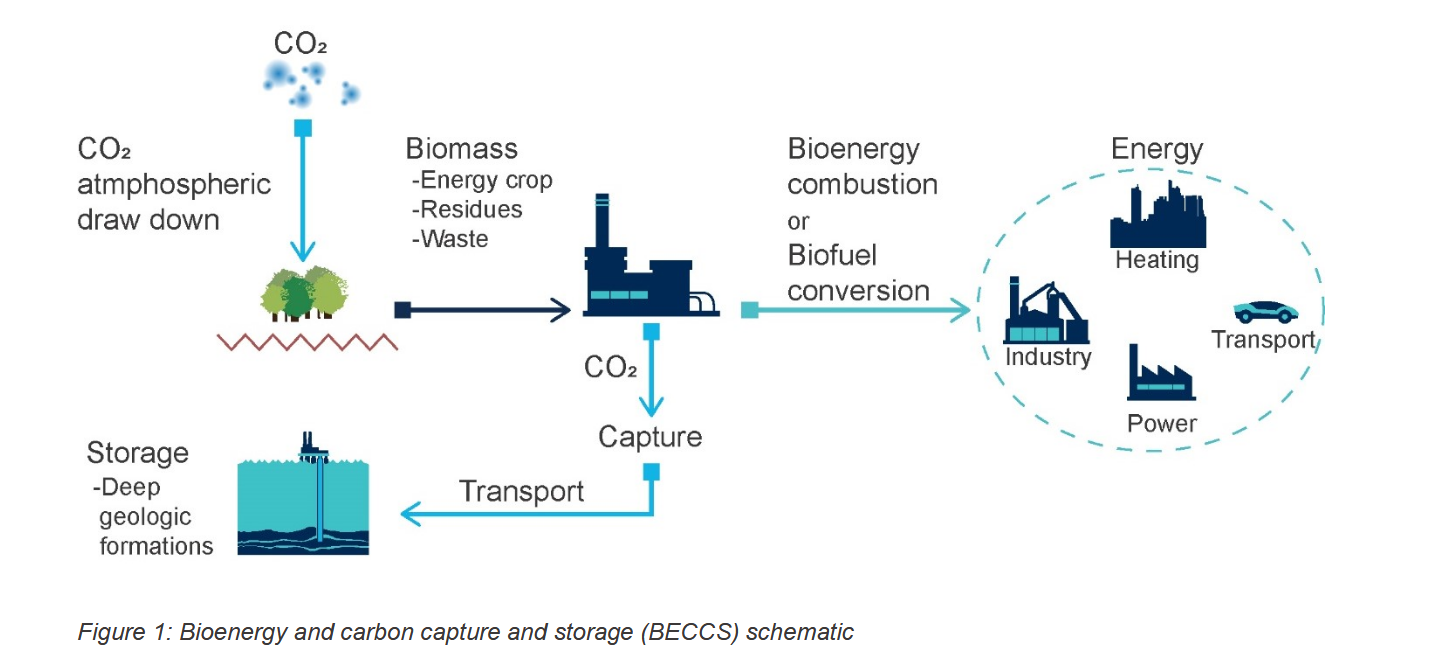
"The carbon cycle in a BECCS system" Source: The Global CCS Institute
Real-World Efficiency
It is worth noting that BECCS is not perfectly neutral across its entire chain: some emissions remain during biomass transport, the associated logistics, and certain processing stages. In practice, the expected CO₂ removal efficiencies for BECCS fall between 65% and 85% [5], depending on the capture rate at the source, the supply chain, and its logistics. That figure remains particularly high for a large-scale industrial technology, which goes a long way toward explaining the interest it draws from global climate scenarios.
The Potential of BECCS in Global Energy Transition Scenarios
BECCS is not merely a promising idea on paper: it holds a central place in the most rigorous climate models, from the International Energy Agency (IEA) to the Intergovernmental Panel on Climate Change (IPCC).
The Place of BECCS in IEA Scenarios
The IEA regularly publishes trajectories that model the path toward carbon neutrality for the global energy sector. In its Net Zero scenario (NZE), updated in 2023 and aiming for carbon neutrality by 2050, the combined atmospheric removals via BECCS and direct air capture (DACS) are set to reach roughly 0.6 Gt of CO₂ in 2035, then 1.7 Gt in 2050 [4]. These removals are meant to offset the residual emissions of the sectors that are hardest to decarbonize fully, notably aviation, heavy industry, and agriculture [4].
In a delayed-action scenario, the requirements grow considerably larger. To bring the rise in temperatures below 1.5 °C, atmospheric removal via BECCS and DACS would need to exceed 5 Gt of CO₂ per year in the second half of the century, of which 2 Gt/year through BECCS alone, which would tie up about 135 million hectares of land [4]. These orders of magnitude underline how important it is to act early so as to avoid having to lean heavily on these technologies later on.
The Role of BECCS in IPCC Scenarios
In its Sixth Assessment Report (AR6), the IPCC modeled several thousand trajectories compatible with the goals of the Paris Agreement. In the scenarios that limit warming to 2 °C or less with a probability greater than 67%, the IPCC estimates that the cumulative removal volumes from BECCS reach a median value of 328 GtCO₂ over 2020–2100, within a range of 168 to 763 GtCO₂. The corresponding median values are 252 GtCO₂ for AFOLU and 29 GtCO₂ for DACCS [2]. In the trajectories aiming for 1.5 °C with low overshoot, roughly 334 Gt of biogenic CO₂ would be stored through BECCS by 2100, according to the median of the scenarios [3]. These projections confirm that BECCS is identified as one of the indispensable pillars of any credible carbon-neutrality strategy on a global scale.
BECCS Worldwide: Projects, Policies, and Innovations
BECCS is moving from the stage of theoretical modeling toward concrete deployment, with quantified policy commitments, sizeable investments, and a growing body of academic work on its sector-specific applications.
The British Example: An Ambitious National Policy
The United Kingdom offers one of the most structured examples of national policy in favor of BECCS. The country has set itself the goal of deploying at least 5 Mt of CO₂ removed per year by 2030 through its greenhouse gas removal (GGR) technologies, with a ramp-up that could reach 23 Mt CO₂/year in 2035. This program rests on a commitment of £20 billion for the early deployment of CCUS through four industrial clusters, the first two of which were expected by the mid-2020s [5].
This example reveals a broader trend: BECCS fits naturally into existing industrial hubs by drawing on skills in drilling, reservoir geology, and CO₂ transport infrastructure, all of which are directly transferable from the mining and energy sectors.
The Most Promising Application Sectors
Several industrial sectors are especially well positioned to host the deployment of BECCS [8]:
Electricity generation from biomass: biomass power plants are a natural point of application, with concentrated CO₂ streams that make capture technically easier.
The bioethanol industry: the fermentation process generates a near-pure stream of CO₂, which makes it an ideal candidate for low-marginal-cost capture — an economically attractive feature.
The pulp and paper industry: the processes that valorize lignocellulosic biomass also represent potential vehicles for applying BECCS at scale.
Low-carbon hydrogen production: the gasification of biomass coupled with capture makes it possible to produce hydrogen with a strongly negative carbon balance, an angle of particular interest for national clean-hydrogen strategies.
Also read: "Carbon-Negative Materials and CCUS: Toward a Complementary Approach"
Recent Academic Research
A literature review published in 2024 presents BECCS as an emerging approach to climate mitigation, examining its technological synergies, its deployment challenges, its environmental impacts, and its future prospects [7]. Other sources point out that BECCS processes can be tied to the production of electricity, heat, biofuels, or hydrogen [1] [5] [8].
The authors also raise an often-overlooked issue: roughly 37% (24 EJ) of the bioenergy consumed worldwide is still used in a traditional way for cooking and heating by 2.4 billion people, making this unmodernized bioenergy the leading source of black carbon emissions, a climate agent with strong warming potential despite its short lifespan in the atmosphere [6]. This highlights the need to modernize bioenergy practices, since the traditional methods are not only inefficient from a climate standpoint, but also responsible for 3.6 million deaths per year linked to the deterioration of indoor air quality [6].
On the economic side, BECCS is increasingly recognized in the market for durable carbon-removal credits: according to Carbonfuture, BECCS projects accounted in 2024 for the largest volume of carbon-removal credits sold among the durable CDR methods [9]. In concrete terms, this means BECCS projects can generate additional revenue through the sale of carbon credits, thereby improving their economic viability.
Conclusion
BECCS also illustrates a reality that comes up more and more in discussions about the energy transition: the most effective solutions often cut across several disciplines at once. In this particular case, plant biology, energy engineering, reservoir geology, and subsurface monitoring come together into a single coherent system. This means that the skills built up in the fields of drilling, CO₂ burial, and geological characterization prove directly relevant to the BECCS projects that will come online in the decades ahead.
As governments and companies look to broaden their decarbonization toolkit, BECCS is establishing itself as a lever that complements renewable energy, hydrogen, and advanced nuclear — a space where subsurface-resource expertise and climate ambition meet quite naturally.
Want to follow how these technologies evolve and what they mean for the energy sector? Follow Squatex on LinkedIn so you never miss a publication.
References
[1] National Academies of Sciences, Engineering, and Medicine. "Bioenergy with Carbon Capture and Sequestration." Negative Emissions Technologies and Reliable Sequestration: A Research Agenda. National Academies Press, 2019. https://www.ncbi.nlm.nih.gov/books/NBK541444/
[2] IPCC. "Chapter 12: Cross-Sectoral Perspectives." Sixth Assessment Report, Working Group III: Mitigation of Climate Change. IPCC, 2022. https://www.ipcc.ch/report/ar6/wg3/chapter/chapter-12/
[3] Clean Air Task Force. "What Does the Latest IPCC Report Say About Carbon Capture?" CATF, 2022. https://www.catf.us/2022/04/what-does-latest-ipcc-report-say-about-carbon-capture/
[4] IEAGHG. "IEA Net Zero Roadmap Update 2023 — IP13." IEAGHG Insights, 2023. https://ieaghg.org/insights/iea-net-zero-roadmap-update-2023-ip13/
[5] UK Government, Chief Scientific Advisor's Task and Finish Group. "The Ability of Bioenergy with Carbon Capture and Storage (BECCS) to Generate Negative Emissions." HM Government, 2023. https://assets.publishing.service.gov.uk/media/64d4b25a5cac65000dc2dd1f/task-finish-group-report-ability-beccs-to-generate-negative-emissions.pdf
[6] Ganeshan, Prabakaran, et al. "Bioenergy with Carbon Capture, Storage and Utilization: Potential Technologies to Mitigate Climate Change." Biomass and Bioenergy, vol. 177, Oct. 2023, article 106941, doi:10.1016/j.biombioe.2023.106941.
[7] Kwakye, J. M., Ekechukwu, D. E., and Ogundipe, O. B. "Reviewing the Role of Bioenergy with Carbon Capture and Storage (BECCS) in Climate Mitigation." Engineering Science & Technology Journal, vol. 5, no. 7, 2024, pp. 2323–2333. https://fepbl.com/index.php/estj/article/download/1346/1578
[8] Clean Air Task Force. "Bioenergy with Carbon Capture and Storage as a Tool for Climate Change Mitigation." CATF, 2025. https://www.catf.us/resource/bioenergy-carbon-capture-storage-tool-climate-change-mitigation/
[9] Carbon Future. "Bioenergy with Carbon Capture and Storage." CarbonFuture, 2024. https://www.carbonfuture.earth/cdr-technology/bioenergy-with-carbon-capture-and-storage
