
Zinc: Uses, Properties and Its Role in the Energy Transition
With global production reaching 12.0 million tonnes in 2024 [1], zinc ranks among the most widely used base metals internationally.
While zinc is best known for galvanizing, a process that accounts for 60% of its worldwide applications [1], its place in renewable energy infrastructure (wind, solar, energy storage) also makes it a strategic material for global decarbonization.
The rise of clean technologies is now prompting a reassessment of the role played by so-called "base" metals, and zinc stands out as a striking example. For perspective, a single 10 MW offshore wind turbine requires 4 tonnes of zinc [4], a figure that captures just how firmly this discreet metal has become an essential cog in the energy transition. From the properties that give it its strength, to the global markets that set its value, to the distinctive position Canada and Quebec hold in its value chain, here is a complete portrait of zinc.
What Are the Properties of Zinc?
Zinc is a transition metal with atomic number 30. Found in more than 50 countries, it has been mined for centuries for its physical and chemical properties, particularly its ability to resist corrosion.
A Corrosion-Resistant Metal
This metal is valued for its ability to shield steel from corrosion [1]. Its main industrial use rests on galvanizing, a process that involves coating a metal surface with a thin protective layer to prevent rust and oxidation.
Beyond its technical definition, the process plays a decisive part in the durability of infrastructure. By significantly extending the lifespan of metal structures, it helps cut down on maintenance, replacement, and, as a result, the associated material footprint. That is why it appears in critical elements such as bridges, buildings, power grids, and even wind turbine structures [5]. This resistance makes it a particularly well-suited solution for environments exposed to moisture, salt, or harsh climate conditions.
Versatile Alloys
Beyond its protective function, this element stands apart for its capacity to form alloys with varied properties. Combined with copper, it yields brass, while pairing it with copper and tin produces bronze [1].
These alloys hold an important place across numerous industrial and household applications. They are used in particular for plumbing systems, thermal equipment, and various mechanical components, where their strength, malleability, and durability are sought after. This ability to blend into different materials considerably broadens the metal's reach within the modern economy.
Zinc in Modern Industrial Sectors
This material turns up in fields as diverse as construction, automotive, agriculture, and industrial chemistry. Through the breadth of its uses, it establishes itself as one of the most cross-cutting metals in the global economy. Examining how it is distributed across sectors offers a clearer picture of the roles it fills within industrial value chains.
Construction and Infrastructure
Anti-corrosion protection remains by far the leading application, accounting for roughly 60% of global consumption [1]. This dominance reflects the importance of metal infrastructure in modern economies, along with the need to ensure such structures last.
In this respect, the metal contributes directly to the resilience of public and industrial infrastructure. Without this protective coating, many structures would be far more vulnerable to deterioration, which would lead to higher economic and environmental costs over the long run.
Alloys destined for die casting make up around 15% of global use and serve to produce complex parts found in construction and industry [1]. Brass and bronze, for their part, represent 9% of applications and remain essential in plumbing systems and thermal uses [1].
Agriculture, Chemistry, and Consumer Products
Derived compounds account for roughly 11% of worldwide use and span a wide range of applications [1]. Among them, zinc oxide appears in pharmaceuticals and skincare products, while other compounds feature in rubber manufacturing, notably for tires.
In the agricultural sector, this element also serves as an additive in fertilizers to correct certain soil deficiencies and improve yields. Semi-finished products, such as rolled sheets, wire, and tubing, round out this picture by providing the basis for many industrial transformations.
Zinc and Batteries
One emerging category of use deserves special attention: energy storage. Among the technologies under development, zinc-based batteries, particularly zinc-ion and zinc-air systems, rely on this metal as the active material for storing and releasing energy. These solutions are the focus of sustained research, especially for large-scale stationary storage applications.
Concretely, this element plays a growing part in the development of rechargeable batteries intended for stationary energy storage. Such technologies are especially suited to uses like telecommunications infrastructure or decentralized energy grids, where a reliable and durable power supply is essential [4]. This foothold in energy storage makes it an emerging application with strong potential, one likely to support global demand in the years ahead.
Table I: Main Uses of Zinc in Modern Industrial Sectors (2024)
| Sector / Use | Global Share (%) | Example Application |
|---|---|---|
| Galvanizing | 60% | Steel protection, bridges, infrastructure |
| Die-casting alloys | 15% | Industrial parts, handles, components |
| Zinc compounds | 11% | Zinc oxide, pharmaceuticals, tires |
| Brass and bronze | 9% | Plumbing, heat exchangers |
| Semi-finished products | 4% | Wire, tubing, rolled sheets |
| Other (including batteries) | 1% | Energy storage, emerging applications |
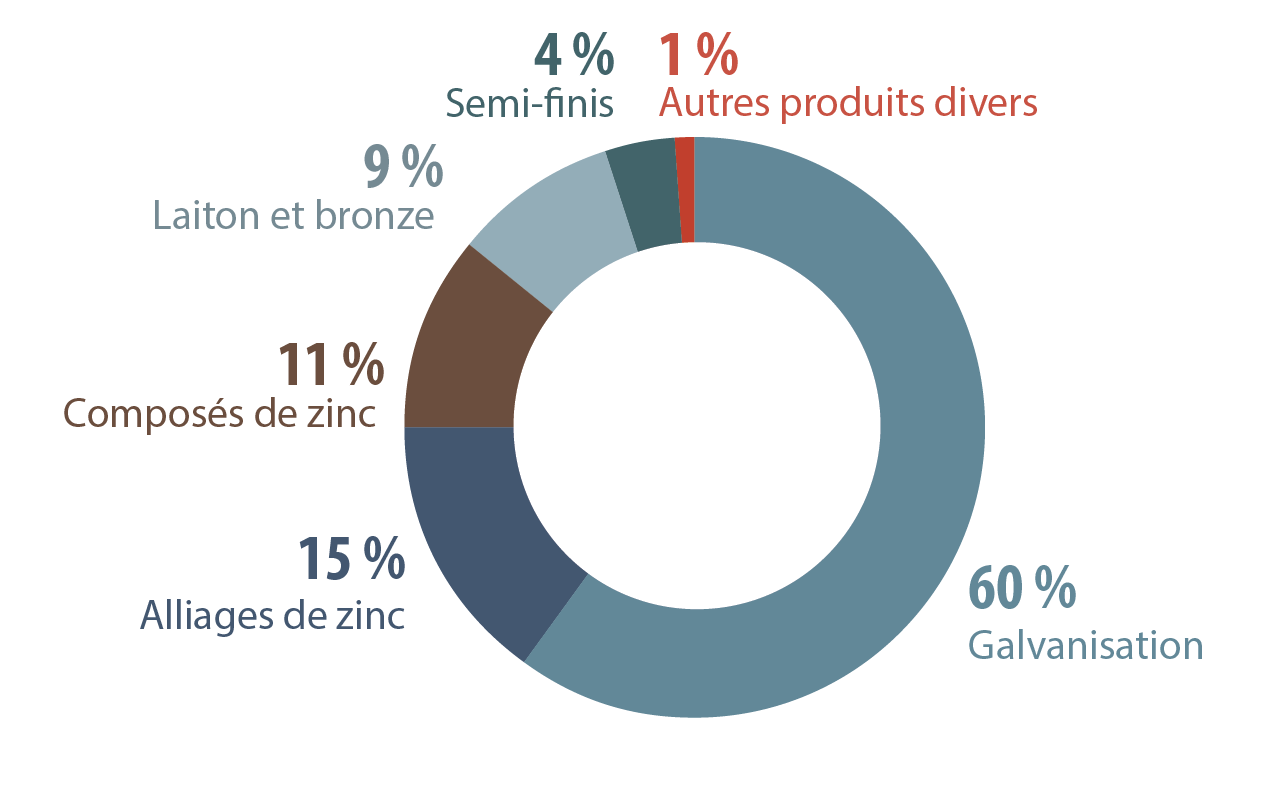
Main uses of zinc in modern industrial sectors (2024), Source: Natural Resources Canada
Global Production
The Leading Producing Countries
In 2024, the global production of mined zinc reached 12.0 million tonnes [1], spread across more than 50 countries around the world. In 2023, the top seven producers (China, Australia, Peru, the United States, Mexico, India, and Bolivia) accounted for roughly 71% of global output [3].
Table II: Global Zinc Mine Production by Country, 2024
| Rank | Country | Production (thousands of tonnes) | % of Global Total |
|---|---|---|---|
| 1 | China | 4,000 | 33.3% |
| 2 | Peru | 1,300 | 10.8% |
| 3 | Australia | 1,100 | 9.2% |
| 4 | India | 860 | 7.2% |
| 5 | United States | 750 | 6.3% |
| 6 | Mexico | 700 | 5.8% |
| 7 | Bolivia | 510 | 4.3% |
| 8 | Kazakhstan | 370 | 3.1% |
| 9 | Russia | 310 | 2.5% |
| 10 | Sweden | 240 | 2.0% |
| — | Other countries | 1,700 | 14.2% |
Source: Natural Resources Canada [1]
Canada and Quebec in the Zinc Value Chain
Although Canada does not hold the top spots in the mine production rankings, its role in zinc processing is nonetheless significant. In 2024, Canadian mined zinc output rose 18%, climbing from 109,507 tonnes in 2023 to 129,202 tonnes, even though the broader decade-long trend remains downward [1]. Beyond that, the production of refined zinc metal in Canada is estimated at between 516,000 and 526,000 tonnes per year, coming from refineries located in British Columbia and Quebec [1].
This means Canada serves more as a processing hub than as a straightforward extractor. Indeed, strategic by-products such as germanium and indium, themselves recognized as critical minerals, are also recovered during zinc refining on Canadian soil [1], which strengthens the added value of this sector.
Zinc Recycling and Circularity
Material circularity refers to a metal's capacity to be recovered, remelted, and reused without losing its original properties, thereby reducing the need for primary extraction. On this front, zinc offers a notable advantage: it is fully recyclable without any loss of its chemical or physical properties [1].
Each year, roughly 20 million tonnes of zinc enter circulation in the global economy, of which 39% comes from recycled materials [1]. The main sources of this recycled zinc are galvanized steel scrap and spent batteries. For this reason, the zinc industry is gradually embracing a circular economy approach, a direction that carries increasing weight on the international stage.
Zinc and the Energy Transition
The shift toward a low-carbon economy entails a massive rollout of wind turbines, solar panels, and electrical infrastructure. These technologies call for durable materials able to withstand the most demanding climate conditions, and zinc holds a central place in that protective role. The International Energy Agency (IEA) points out, moreover, that the rapid deployment of clean energy technologies implies a marked rise in mineral demand [6].
Zinc in Wind and Solar Power
Thermal zinc spraying, also known as zinc metallization, is an anti-corrosion coating process applied through electric arc or flame spraying. This treatment is used in particular on offshore structures permanently exposed to seawater, in order to guarantee their longevity under especially aggressive conditions.
Zinc thus fills an essential function in the wind and solar sectors by shielding structures from corrosion [4]. The quantities involved are anything but trivial: a 10 MW offshore wind turbine on its own requires 4 tonnes of zinc [4], and a 100 MW solar farm (capable of powering 110,000 homes) calls for 240 tonnes of zinc for its galvanized support structures [4].
More telling still, IEA figures cited in a WisdomTree analysis indicate that producing 1 MW of wind energy requires 5,500 kg of zinc [5], compared with a near-negligible amount for coal- or natural-gas-fired plants.

Zinc and Energy Storage
Beyond its role in physical structures, zinc is also gradually establishing itself as a player in energy storage. It has become a key ingredient in a new generation of high-energy rechargeable batteries, able to power telecommunications towers or remote communities for extended periods while outperforming other available chemistries [4]. This technological avenue represents an emerging use with strong growth potential for global zinc demand.
Within this context, about 20% of the world's energy supply already comes from renewable sources, but reaching carbon neutrality demands a thorough transformation of how energy is generated, distributed, stored, and consumed [4]. That transformation therefore opens up new channels of demand for zinc, well beyond traditional galvanizing.
Zinc as a Low-Carbon Infrastructure Metal
The IEA specifies that the minerals used in clean energy technologies span low-carbon electricity generation, batteries for electric vehicles and grid storage, power networks, and hydrogen [6]. It is within this dynamic that zinc plays the part of an infrastructure metal. Without protection against corrosion, the structures that support clean technologies, such as wind turbine masts, solar mounts, or electrical pylons, could not reach the service lives needed to make these projects economically viable.
Conclusion
Often viewed as a traditional industrial metal, zinc nonetheless occupies a strategic place in modern infrastructure. With close to 60% of its uses devoted to corrosion protection [1], it contributes directly to extending the lifespan of the equipment and structures that many economic sectors rely on. In the field of renewable energy, the fact that producing 1 MW of wind power requires roughly 5,500 kg of zinc [5] offers a concrete illustration of its importance in building out low-carbon energy capacity.
Zinc therefore fits fully into current thinking about the materials needed for the energy transition. Examining its uses, its markets, and its dynamics helps in grasping the broader issues tied to natural resources and the supply chains that will underpin tomorrow's energy systems.
To stay informed about upcoming publications on critical minerals and the energy resources of tomorrow, follow Squatex on LinkedIn.
References
[1] Natural Resources Canada. "Zinc Facts." Natural Resources Canada, 2024. Government of Canada, https://ressources-naturelles.canada.ca/mineraux-exploitation-miniere/donnees-statistiques-analyses-exploitation-miniere/faits-mineraux-metaux/faits-zinc.
[2] Government of Quebec. "Quebec Strategy for the Development of Critical and Strategic Minerals 2025-2031." Government of Quebec, 2025. https://www.quebec.ca/gouvernement/ministeres-organismes/ressources-naturelles-forets/publications/strategie-quebecoise-valorisation-mineraux-critiques-strategiques.
[3] International Lead and Zinc Study Group. The World Zinc Factbook 2024. ILZSG, 2024, https://www.ilzsg.org/wp-content/uploads/SitePDFs/The%20World%20Zinc%20Factbook%202024.pdf.
[4] International Zinc Association. "Renewable Energy." Zinc.org, 2024. International Zinc Association, https://www.zinc.org/renewable-energy/.
[5] WisdomTree. "Zinc and the Energy Transition." WisdomTree Insights, 2023. WisdomTree Europe, https://www.wisdomtree.eu/api/sitecore/pdf/getblogpdf?id=20d29d10-d2d3-45f2-ae90-d40b89829e9e. (Cites IEA and USGS data.)
[6] International Energy Agency. The Role of Critical Minerals in Clean Energy Transitions. IEA, 2021, https://iea.blob.core.windows.net/assets/ffd2a83b-8c30-4e9d-980a-52b6d9a86fdc/TheRoleofCriticalMineralsinCleanEnergyTransitions.pdf.
