

The Role of Sulfuric Acid in Critical Minerals
Between mined ore and a usable material, several processing steps usually stand in between. These steps depend on chemical reagents capable of dissolving, converting, or purifying the target metals. Among them, sulfuric acid holds a major place.
Produced on a massive scale, with about 231 million tonnes in 2011-2012 and forecasts exceeding 250 million tonnes per year, it is often described as the most heavily produced chemical by mass [1]. This output reflects its broad reach across industry, particularly in fertilizers, metallurgy, and several extraction methods.
Its importance raises a central question: how can a chemical compound used so widely become a key factor in producing the resources needed for batteries, magnets, fertilizers, and nuclear fuel? This article looks at its origin, its main applications across the lithium, nickel, cobalt, rare earth, copper, and uranium supply chains, and the questions raised by its long-term supply.
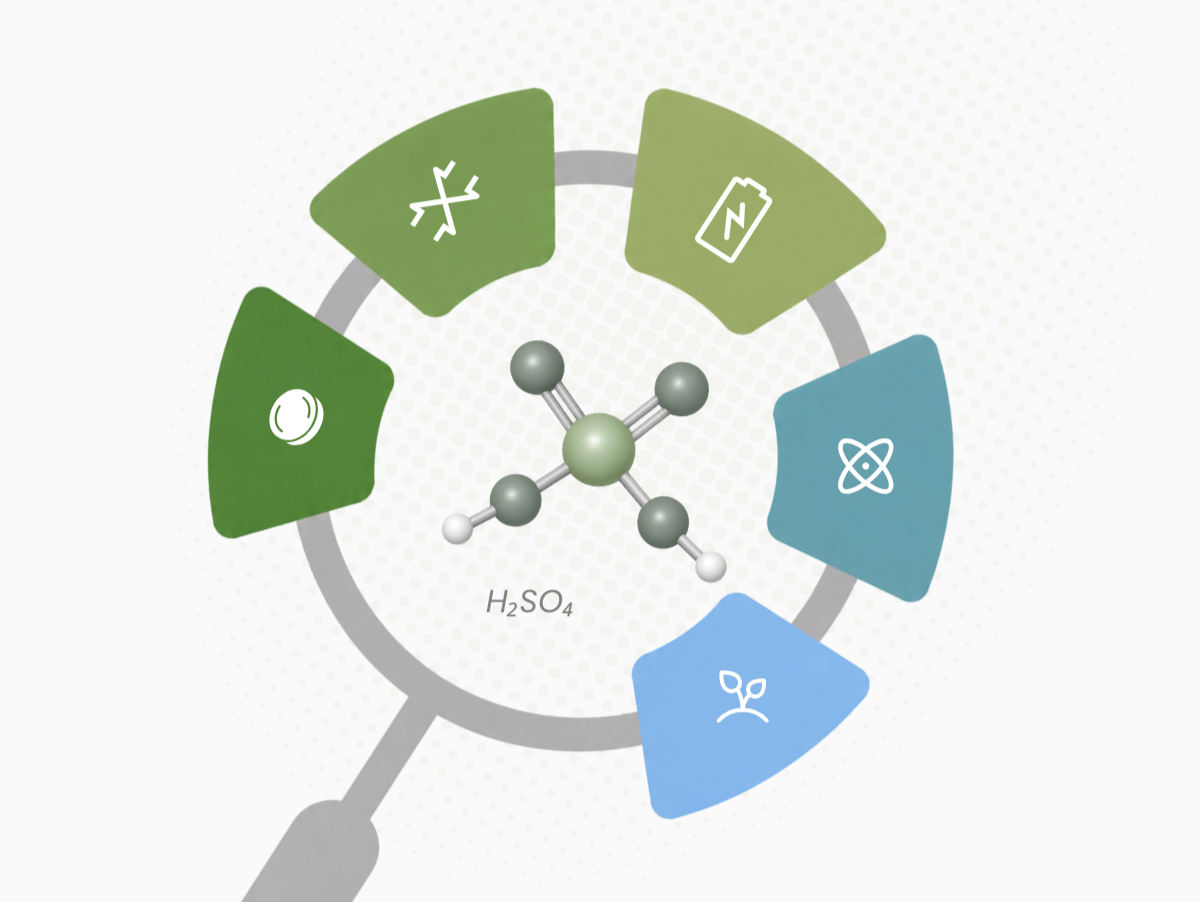
What is sulfuric acid, and where does it come from?
Sulfuric acid, with the chemical formula H₂SO₄, ranks among the most important compounds manufactured by the chemical industry [1]. Its production relies mainly on the contact process, in which sulfur dioxide (SO₂) is oxidized into sulfur trioxide (SO₃), then absorbed to form the concentrated acid [1].
In practice, this method unfolds in four main stages:
Combustion: sulfur or sulfide ores are burned to produce sulfur dioxide (SO₂).
Catalytic oxidation: the SO₂ is then converted into sulfur trioxide (SO₃) in the presence of a vanadium(V) oxide catalyst, typically at temperatures between 420 and 620 °C.
Absorption: the SO₃ is absorbed into concentrated sulfuric acid to form oleum.
Dilution: the oleum is then carefully diluted to reach the desired concentration of sulfuric acid.
This sequence depends on tight control of reactions, temperatures, and emissions. Modern "double contact double absorption" plants can reach an SO₂ conversion rate of about 99.8% [7]. This efficiency partly explains why the contact process has become the dominant industrial route for producing sulfuric acid at scale.
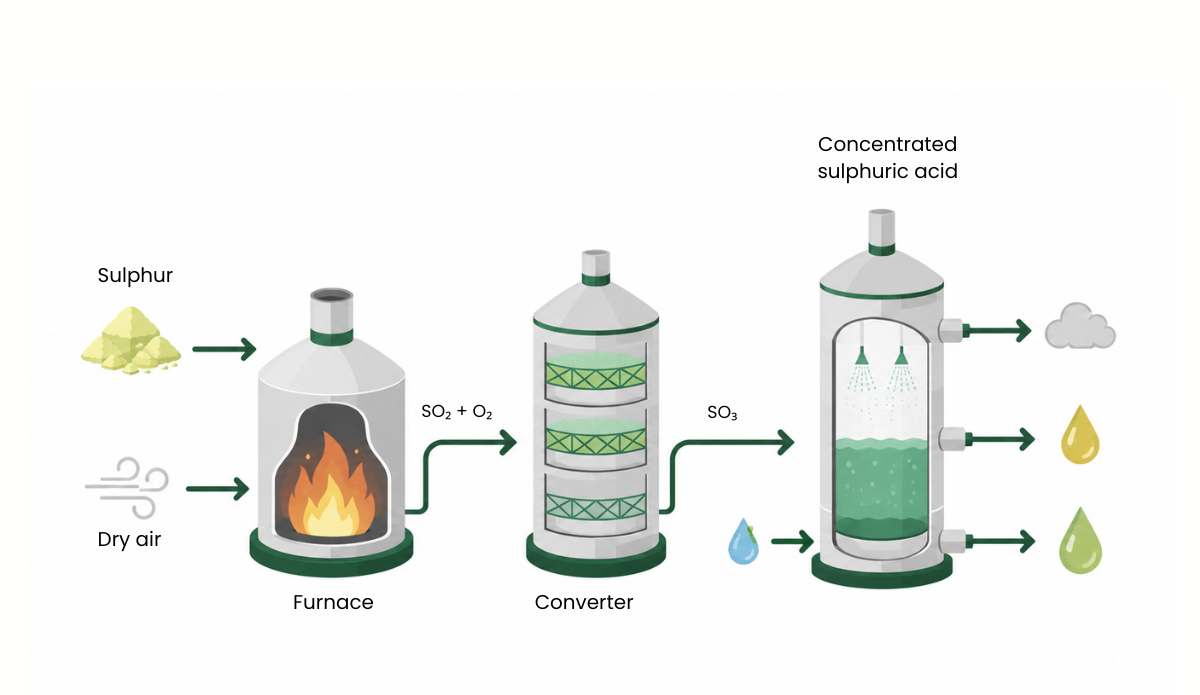
Figure 1 : The manufacture of sulphuric acid, H₂SO₄, through the Contact Process
Where does the sulfur come from?
Since sulfuric acid depends on sulfur, its supply is closely tied to other industries. Today, most elemental sulfur doesn't come directly from deposits mined for their own sake, but from the purification of petroleum, natural gas, and certain metallurgical streams.
In the United States, about 8.0 million tonnes of elemental sulfur were recovered in 2023, mainly from oil refineries and natural gas processing plants [8]. Metallurgy also contributes to the supply: sulfuric acid produced from non-ferrous metal smelters accounted for roughly 7% of total sulfur output in all its forms, while about 90% of the sulfur consumed was in the form of sulfuric acid [8].
This creates an important dynamic: the sulfur used to make the acid is often a byproduct of energy or metallurgical activities. Most elemental sulfur therefore comes from the processing of sour gas and crude oil, making it the primary precursor to sulfuric acid [9].
The most manufactured chemical in the world
This dependence also stems from the sheer scale of demand. Global sulfuric acid production stood at about 231 million tonnes in 2011-2012, giving the compound the status of the highest-volume inorganic chemical, with China, the United States, India, Russia, and Morocco among the leading producers [1]. More recent market estimates confirm this trend: global volume is projected to grow from about 309 million tonnes in 2023 to roughly 373 million tonnes by 2028, a compound annual growth rate of about 3.8% [10].
How sulfuric acid makes critical mineral extraction possible
It's in ore processing that this compound reveals its role as an invisible enabler. Several critical mineral supply chains depend, at one stage or another, on its ability to dissolve, convert, or purify metallic compounds.
Lithium: batteries that start with acid
In the hard-rock lithium supply chain, spodumene is one of the most important minerals. The conventional sulfuric acid method remains the dominant technology for extracting lithium from it [2]. The scale of reagents required illustrates this dependence well: producing one tonne of lithium carbonate takes about 1.34 tonnes of spodumene concentrate and roughly 0.48 tonnes of sulfuric acid [2].
The "acid roasting" approach relies on a sequence of conversion, reaction, and purification stages. The ore is first heated to convert α-spodumene into β-spodumene, a more reactive form. It's then treated with excess concentrated sulfuric acid at around 200-250 °C, which forms soluble lithium sulfate. This is dissolved, and the resulting solution is neutralized and purified [2].
Acid can also come into play when purifying lithium drawn from brines, even when the main extraction relies on evaporation instead. So depending on the geology and the method chosen, its role shifts, though it remains tied to several key transformation stages.
Nickel and cobalt: among the most acid-intensive processes
The lithium case shows how significant sulfuric acid can be in certain transformation chains. Nickel and cobalt laterites, for their part, show just how intensive some hydrometallurgical techniques can get. High-pressure acid leaching, commonly known as HPAL, aims to extract metals from lateritic ores by exposing them to a sulfuric acid solution at high temperature and under strong pressure.
Operating conditions are demanding, with temperatures around 250 to 270 °C and pressures of roughly 30 to 50 atm, or about 3,000 to 5,000 kPa. These conditions allow for high recovery rates, around 95% for nickel and 90% for cobalt [3]. These parameters explain why HPAL counts as a specialized technology: it's built to unlock metals contained in ores that are otherwise hard to treat.
This performance comes with a cost in reagents, though: HPAL relies on sulfuric acid as its leaching agent, and acid consumption can climb significantly, especially when ores contain higher levels of magnesium and calcium [3].
Rare earths, copper, and uranium
The same logic extends to other strategic resources, each with its own quirks:
For rare earths, bastnäsite can be treated through sulfation. The concentrate is heated in sulfuric acid at about 98% concentration, at 400-500 °C, to break down the mineral and convert the rare earths into sulfates [11]. One acid sulfation route reports a recovery rate near 100% of rare earths in solution [4].
For copper, the SX-EW method (solvent extraction followed by electrowinning) uses dilute sulfuric acid on heaps of low-grade oxidized ore. The dissolved copper is then recovered through electrolysis.
For uranium, sulfuric acid leaching is the most common route across many conventional operations, including among the large facilities studied by LLNL. It dissolves uranium from the ore ahead of the purification stages [5]. The resulting concentrate, often called "yellowcake" or U₃O₈, forms a foundation of the nuclear fuel cycle [5].
Table 1 — The role of sulfuric acid in processing chains
| Resource | Process or stage | Role of sulfuric acid |
|---|---|---|
| Lithium (hard rock / spodumene) | Acid roasting of spodumene | Converts lithium into soluble sulfate, using about 0.48 t of H₂SO₄ per tonne of lithium carbonate² |
| Nickel and cobalt (laterites) | High-pressure acid leaching (HPAL) | Acts as the leaching agent to dissolve metals at high temperature and under pressure |
| Rare earths (bastnäsite) | Roasting / acid sulfation | Turns rare earths into soluble sulfates, with recovery near 100% in the cited procedure⁴ |
| Copper (oxidized ores) | Leaching + SX-EW | Puts copper into solution ahead of recovery through solvent extraction and electrolysis |
| Uranium | Acid leaching | Dissolves uranium from ore ahead of the purification stages |
| Phosphate fertilizers | Digestion of phosphate rock | Produces phosphoric acid, a major step in manufacturing phosphate fertilizers |
Beyond mining: fertilizers, smelters, and environmental concerns
Sulfuric acid's role isn't limited to extracting and processing critical minerals. It also plays a part in other major industrial sectors, including phosphate fertilizer production, metallurgy, and certain activities tied to emissions or mining residues.
This importance stands out clearly in the fertilizer sector. Nearly 60% of sulfur consumption goes toward producing phosphate fertilizers [6]. In this process, phosphate rock is treated with sulfuric acid to produce phosphoric acid, a key intermediate in manufacturing several fertilizers. Sulfuric acid is thus tied not only to mining and metallurgical chains, but also to a significant share of global agricultural output.
Conclusion - Beyond the deposits
Sulfuric acid shows that critical mineral supply chains don't rest solely on access to deposits. They also depend on industrial methods, chemical reagents, and processing infrastructure able to turn ore into usable materials.
Produced in the hundreds of millions of tonnes each year, it holds a major place in the global chemical industry [1]. Its use across the lithium, nickel, rare earth, copper, uranium, and phosphate fertilizer chains highlights its reach across several strategic sectors.
With demand for critical minerals potentially quadrupling by 2040 according to the IEA [12], these industrial dependencies serve as a reminder that the energy transition rests as much on underground resources as on the technical capacity needed to transform them.
References
[1] "Sulfuric Acid." Essential Chemical Industry, Centre for Industry Education Collaboration, University of York, 2016, www.essentialchemicalindustry.org/chemicals/sulfuric-acid.html.
[2] Li, H., et al. "Lithium Extraction from Spodumene by the Traditional Sulfuric Acid Process: A Review." Minerals, vol. 13, no. 6, 2023. Academia.edu, www.academia.edu/103902513.
[3] Zhang, Zhen-fang, Wei-bo Zhang, Zhen-guo Zhang, and Xiu-fa Chen. "Nickel Extraction from Nickel Laterites: Processes, Resources, Environment and Cost." China Geology, vol. 8, 2025, pp. 187-213., www.sciencedirect.com/science/article/pii/S2096519225000114.
[4] "Rare Earth Oxide Bastnasite." 911Metallurgist, 16 Feb. 2021, www.911metallurgist.com/blog/rare-earth-oxide-bastnasite/.
[5] "Uranium Mining and Milling." Lawrence Livermore National Laboratory, 7 Mar. 2018, https://www.leidoseemg.com/haleuEIS.references/docs/LLNL%202018_Uranium%20Mining%20and%20Milling.pdf.
[6] Jasinski, Stephen M. "Fertilizers—Sustaining Global Food Supplies." USGS Fact Sheet FS-155-99, U.S. Geological Survey, 1999, pubs.usgs.gov/fs/fs155-99/fs155-99.html.
[7] "Contact Process." Wikipedia, Wikimedia Foundation, en.wikipedia.org/wiki/Contact_process.
[8] U.S. Geological Survey. "Sulfur." Mineral Commodity Summaries 2024, U.S. Geological Survey, Jan. 2024, pp. 172-173, pubs.usgs.gov/periodicals/mcs2024/mcs2024-sulfur.pdf.
[9] Al-Muntasheri, Ghazi A., et al. "Sustainable Applications Utilizing Sulfur, a By-Product from Oil and Gas Processing." Journal of Environmental Chemical Engineering, vol. 8, no. 5, 2020. ScienceDirect, www.sciencedirect.com/science/article/abs/pii/S0956053X19303769.
[10] "Sulfuric Acid Market Size & Share Analysis – Growth Trends & Forecasts (2023-2028)." GlobeNewswire / Mordor Intelligence, 14 Aug. 2023, www.globenewswire.com/news-release/2023/08/15/2725784/0/en/Sulfuric-Acid-Market-Size-Share-Analysis-Growth-Trends-Forecasts-2023-2028.html.
[11] Peelman, Sebastiaan, et al. "Leaching of Rare Earth Elements: Past and Present." 1st European Rare Earth Resources Conference (ERES2014), EuRare, 2014, pp. 446-456, www.eurare.org/docs/eres2014/seventhSession/SebastiaanPeelman.pdf
[12] International Energy Agency. The Role of Critical Minerals in Clean Energy Transitions. World Energy Outlook Special Report, IEA/OECD, 2021 (rev. 2022), www.iea.org/reports/the-role-of-critical-minerals-in-clean-energy-transitions.
