

Understanding the two Sources of Sulfur: Native Sulfur and Recovered Sulfur
In 2024, global sulfur production reached roughly 85 million tonnes across all sources combined [7]. Long associated with natural deposits and the bright yellow crystals mined from underground, sulfur today comes mainly from industrial processes tied to petroleum refining and natural gas treatment.
This shift has changed how the resource moves through the economy. On one hand, native sulfur forms naturally in certain geological settings, particularly volcanic or evaporitic ones. On the other, recovered sulfur is obtained as an industrial byproduct, later put to use in a range of applications. In both cases, it feeds primarily into the production of sulfuric acid, a key compound for phosphate fertilizers and numerous industrial sectors [6].
Native sulfur: an age-old geological resource
What is native sulfur?
Native sulfur refers to sulfur found in nature in its elemental form, meaning not chemically bonded to other elements. It is a natural mineral form of sulfur that crystallizes in the orthorhombic system and typically appears as masses, coatings, or crystals ranging from bright yellow to yellowish-brown [1].
This form of sulfur can be observed in certain geological environments where conditions allow it to accumulate in pure form. It is commonly linked to volcanic and evaporitic settings, or to the weathering of sulfide minerals. Its natural occurrence makes it one of the few chemical elements that can be found directly in native form, without any prior industrial processing [1].
How does it form? Three main geological settings
The formation of native sulfur depends on the chemical, biological, and geological conditions present in the environment. Three broad settings are generally recognized:
Volcanic environments: Native sulfur can form around fumaroles, hot springs, and solfatara fields, crystallizing directly from volcanic gases. On Mauna Loa, in Hawaii, native sulfur crystals form notably through a reaction between sulfur dioxide (SO₂) and hydrogen sulfide (H₂S) released from volcanic fissures [1].
Sedimentary and evaporitic environments: Native sulfur is also linked to evaporitic deposits, meaning rocks formed by the evaporation of seawater, as well as to salt diapirs. In these settings, it can form through bacterial reduction of sulfate minerals under anaerobic conditions, that is, in the absence of oxygen [1].
Alteration of sulfide minerals: Native sulfur can also appear when sulfide minerals weather on contact with water and air. These reactions can release elemental sulfur in certain surface or near-surface geological settings [2].
Geochemical microbiology has added a further nuance in recent years: bacterial sulfate reduction can generate large accumulations of elemental sulfur even without molecular oxygen, when hydrocarbons come into contact with sulfate minerals in the presence of liquid water [3]. This finding shows that certain hydrocarbon-bearing sedimentary basins can offer favorable conditions for native sulfur formation, even outside the more visible volcanic settings.
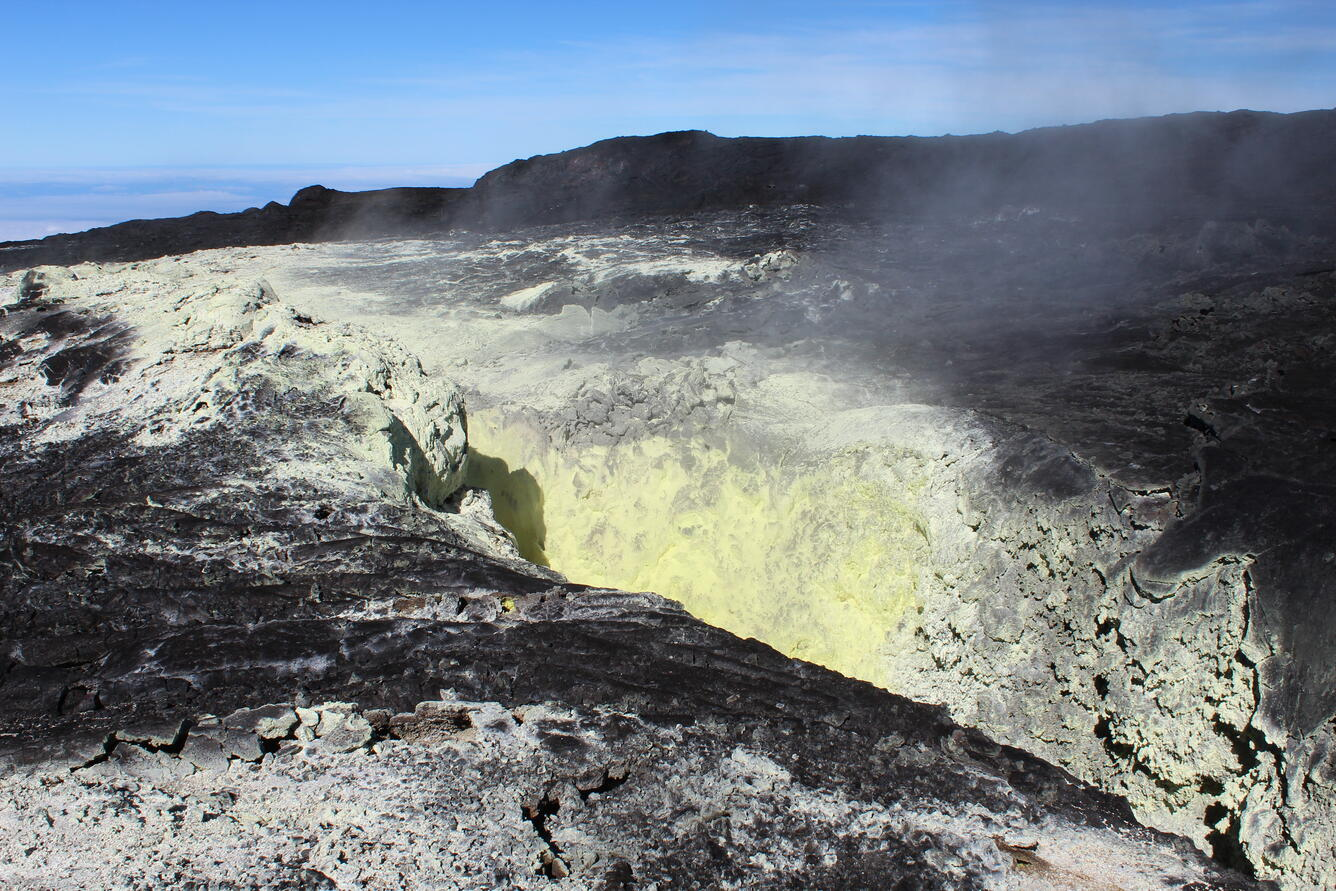
Native sulfur crystals formed by the reaction of SO₂ and H₂S on Mauna Loa volcano, Hawaii (USGS, 2017)
Major native deposits still known today
These formation mechanisms have, over geological time, produced large-scale deposits that still exist today in several regions of the world. Economically significant native sulfur deposits are found mainly in the Miocene and Pliocene evaporitic basins of Poland and Ukraine, in the Middle East (Iraq, Iran), in Mexico, and in parts of the former USSR. These deposits are generally associated with cap rocks above salt domes or with carbonate reservoirs containing hydrocarbons [9].
In Poland, several deposits in the Carpathian foredeep, such as Osiek, Grzybów, and Jeziórko, illustrate this connection between evaporites, bacterial activity, and native sulfur accumulation. These resources supported substantial production in the past, though only a portion of the geological volumes can generally be considered economically recoverable [9].
In Mexico, deposits associated with salt domes have also been mined using the Frasch method, particularly in the states of Veracruz and Tabasco. This output remains limited on a global scale, though, especially when compared with the recovered sulfur produced today by the oil and gas industries [9].
The Frasch method: a major innovation in native sulfur mining
Mining sulfur deposits buried deep underground long posed a serious technical challenge. In the late 19th century, the Frasch process got around this difficulty by extracting sulfur directly in liquid form, without conventional mine excavation. This method played a decisive role in the growth of native sulfur production during the 20th century, particularly in the United States and Poland [5].
How the Frasch process works
Developed by engineer Herman Frasch, the process rests on a simple idea: melt the sulfur directly within the deposit, then bring it up to the surface. To do this, a system of three concentric pipes is used. Superheated water is injected underground to liquefy the sulfur, after which compressed air pushes the molten sulfur up to the surface [4].
Sulfur melts at a fairly low temperature, around 115°C, which makes this approach technically feasible. Water injected at over 160°C is enough to liquefy it within the deposit [1][6]. Patented in 1891, the process could reach deposits located more than 150 meters underground [5]. Its efficiency was considerable for the time: according to available data, it could recover between 75% and 92% of the recoverable sulfur in a salt dome, with purity reaching up to 99.5% [5].
The golden age and the decline
For much of the 20th century, the Frasch process held a central place in sulfur supply, notably in the salt domes of Texas and Louisiana, as well as in Poland [5]. It gradually lost ground, however, as recovered sulfur, produced as a byproduct of petroleum refining and natural gas treatment, became more competitive [6].
This decline is especially visible in the United States. In Texas, Frasch sulfur output reached 3.45 million long tons in 1954, then 3.67 million long tons in 1965. The market was later undercut by large volumes of low-cost recovered sulfur, notably from sour gas in western Canada. Starting in the 1970s, several producers shut down their Frasch operations in Texas. By 1990, Texas's Frasch sulfur production still stood at 2.3 million metric tons, though it was already declining compared with the previous year [10].
In the United States, the last Frasch mine closed in Louisiana in 2000. Since then, American elemental sulfur output has come from recovered sources, mainly tied to the oil and gas industries [6].
Recovered sulfur: when an industrial waste becomes a global resource
The decline of the Frasch process was not due to a drop in sulfur's usefulness, but rather to the rise of another supply source: recovered sulfur. This is obtained mainly as a byproduct of petroleum refining and natural gas treatment. This pathway gradually became dominant because it allows a compound that must be removed from fossil fuels before use to be put to good use anyway.
The Claus process: turning waste into a resource
The Claus process plays a central role in this pathway. It converts hydrogen sulfide (H₂S), a toxic gas found notably in what is known as "sour" natural gas, into elemental sulfur. Removing H₂S meets technical, health, and environmental requirements, since this compound cannot be left in gas destined for transport or use.
The principle relies on a two-step reaction. Part of the H₂S is first burned with air to form sulfur dioxide (SO₂). This SO₂ then reacts with the remaining H₂S over a catalyst, following the overall reaction: 2 H₂S + SO₂ → 3 S + 2 H₂O [6]. The elemental sulfur produced is then condensed, recovered, and can be directed toward various industrial uses.
In refineries, a complementary process called hydrodesulfurization (HDS) also removes sulfur from fuels such as gasoline and diesel to meet applicable petroleum product standards. The sulfur removed this way is generally converted into H₂S, then processed in Claus units to produce elemental sulfur [6].
Recovered sulfur's place in global production
The development of these processes has profoundly reshaped the geography of sulfur supply. Today, most global output comes from processing fossil fuels rather than direct extraction of native sulfur. In 2024, global sulfur production across all sources was estimated at around 85 million tonnes [7].
This output is therefore closely tied to countries with substantial refining capacity, natural gas treatment, or other sulfur-generating industrial processes. Major producers include China, the United States, Russia, Saudi Arabia, the United Arab Emirates, Kazakhstan, and Canada [7].
Why sulfur remains an important industrial resource
Whether mined in native form or recovered as an industrial byproduct, sulfur mainly feeds into the same applications. Its most important role lies in the production of sulfuric acid, a foundational compound used across several industrial chains, including phosphate fertilizers, the processing of certain ores, and various chemical applications [6].
A key input for agricultural production
Sulfuric acid ranks among the most widely produced and consumed inorganic chemicals in the world. It is used mainly to manufacture phosphate fertilizers, including diammonium phosphate (DAP) and monoammonium phosphate (MAP), both widely used in modern farming systems [6]. According to the USGS, about 90% of the sulfur consumed is used in the form of sulfuric acid [7].
Sulfur also plays a direct role in plant nutrition. It is needed for the synthesis of certain amino acids, vitamins, and enzymes. When soils lack it, crop yields and quality can suffer [8]. This dual function, industrial and agronomic, explains its importance throughout the food production chain.
Uses beyond fertilizers
Sulfuric acid is not limited to agriculture. It is also used in processing mineral raw materials, manufacturing chemicals, refining, and several other industrial processes. Elemental sulfur is also involved in more specialized applications, such as certain sulfur-based polymers, sulfur concrete, and lithium-sulfur batteries.
Conclusion: A resource at the heart of several industrial chains
Native sulfur and recovered sulfur represent two distinct sources of the same resource. The former forms naturally in certain geological settings, while the latter is obtained as an industrial byproduct, mainly during petroleum refining and natural gas treatment [6][7].
This distinction helps clarify sulfur's place within modern industrial chains. Less visible than other raw materials, it nonetheless remains essential to the production of sulfuric acid, a compound used in phosphate fertilizers, the processing of certain ores, and numerous chemical processes.
Tracing sulfur's origins and main uses shows that it is at once a geological, industrial, and agricultural resource. Its importance stems mainly from the diversity of its applications and its role across several fundamental sectors of the economy.
To stay informed on developments in natural resources and the energy transition, follow Squatex on LinkedIn.
References
[1] Keller, Tomáš. "Native Sulphur – Mineral Properties, Photos and Occurrence." MineralExpert, 2017, mineralexpert.org/article/native-sulphur-mineral-overview.
[2] Wisconsin Geological and Natural History Survey. "Sulfur." Minerals of Wisconsin, University of Wisconsin–Madison, 2014, home.wgnhs.wisc.edu/minerals/sulfur/.
[3] Amrani, Alian, et al. "Formation of Large Native Sulfur Deposits Does Not Require Molecular Oxygen." Frontiers in Microbiology, vol. 10, 2019, article 24, doi:10.3389/fmicb.2019.00024.
[4] United States Geological Survey. "Sulfur — A Potential Resource with a Volatile History." USGS Educational Resources, U.S. Department of the Interior, 2013, pubs.usgs.gov/gip/2002/sulfur/.
[5] Georgia Gulf Sulfur Corporation. "Sulfur History." Georgia Gulf Sulfur Corporation, 2010, www.georgiagulfsulfur.com/sulfur/history.
[6] Ober, Joyce A. "Materials Flow of Sulfur." U.S. Geological Survey Open-File Report 02–298, U.S. Geological Survey, 2002, pubs.usgs.gov/of/2002/of02-298/of02-298.pdf.
[7] Lori E. Apodaca "Sulfur." Mineral Commodity Summaries 2025, U.S. Geological Survey, 2025, pp. 172–173, https://pubs.usgs.gov/periodicals/mcs2025/mcs2025-sulfur.pdf.
[8] Narayan OP, Kumar P, Yadav B, Dua M, Johri AK. Sulfur nutrition and its role in plant growth and development. Plant Signal Behav. 2023, doi: 10.1080/15592324.2022.2030082. https://pmc.ncbi.nlm.nih.gov/articles/PMC10730164/
[9] Kotarba, Maciej J. "Native Sulphur Deposits in Miocene and Pliocene Evaporites of Central Europe and the Middle East." Geological Quarterly, vol. 56, no. 2, 2012, pp. 231–248, geoquarterly.org.
[10] Kleiner, Diana J. "Sulfur Industry." Handbook of Texas Online, Texas State Historical Association, 1976, updated 27 Apr. 2019, www.tshaonline.org/handbook/entries/sulfur-industry
