

Slim hole drilling: a low environmental impact exploration technique
Exploring underground resources, whether energy, minerals, or geological reservoirs, often relies on a preliminary drilling phase. This step helps build a clearer picture of the subsurface before committing to larger investments, but it remains expensive and can disturb the surrounding land, particularly in remote or sensitive regions.
Against this backdrop, slim hole drilling offers a middle ground between preliminary reconnaissance and full-scale drilling. Its narrower diameter, lighter equipment, and simplified logistics can help cut both costs and the footprint of operations. In some oil and gas exploration contexts, cost reductions of 25 to 75% have been documented compared with conventional methods. [2] This method fits into a broader push toward more responsible exploration of underground resources.
What is slim hole drilling?
Before examining the benefits of this method, it is worth defining precisely what it involves and how it differs from conventional drilling. The term slim hole refers to an exploratory borehole drilled to a final diameter much smaller than that of a standard production well.
Characteristic diameters and technical design
The defining feature of a slim hole is its narrow diameter. It's generally defined as a well whose final diameter is under 6 inches. In geothermal and mining contexts where continuous coring is used, diameters are often even smaller, typically ranging between 3 and 4 inches. [1]
This design difference matters a great deal when drilling is used to gather geological data. In many slim hole projects, continuous coring makes it possible to bring up an intact cylinder of rock, known as a core, all the way from depth to the surface. This core gives direct insight into rock composition, fracturing, and certain geological properties, helping build a clearer understanding of the formations encountered.
An exploration tool first and foremost
The primary purpose of a slim hole is to collect detailed geological data before deciding whether a full-diameter production well is warranted. In practice, it's used to measure temperature gradients, assess the potential of an underground reservoir, and build a geological profile of the formation. [1]
The U.S. Geological Survey (USGS) defines this type of research drilling as a method for obtaining geological information from wells, boreholes, or cores in order to assess the potential of resources such as groundwater, minerals, or hydrocarbons. [6] In an exploration context, the data gathered can include continuous coring, borehole wall images captured with a borehole televiewer, daily reports, temperature profiles at various depths, and production and injection tests. [1]
Economic and environmental advantages
Documented cost savings
One of the main appeals of slim hole drilling lies in its ability to reduce the resources required during the early stages of exploration. Because of its smaller diameter, this approach generally calls for more compact equipment, smaller crews, and lower volumes of drilling fluid. In some oil and gas exploration contexts, these features have translated into cost reductions of 25 to 75% compared with conventional drilling. [2] This range varies depending on the site, target depth, and geological conditions, but it highlights the economic potential of the method when applied at the right stage of a project.
These savings stem from lighter logistics at several levels. Drilling rigs, crews, work platforms, and fluid volumes are all scaled down compared to a larger-diameter well. In remote or hard-to-reach regions, site preparation and road building can also be minimized, partly through the possible use of helicopter-transportable rigs. [1] [2] This benefit becomes especially valuable in projects where site access accounts for a significant share of costs and operational constraints.
This economic logic carries even more weight in geothermal projects, where drilling costs can account for roughly 50% of a project's total cost, including both production and reinjection wells. [9] Cutting expenses at the exploratory stage doesn't guarantee a project's viability on its own, but it can help manage financial risk before moving on to larger-scale work.
A reduced surface footprint and lower environmental impact
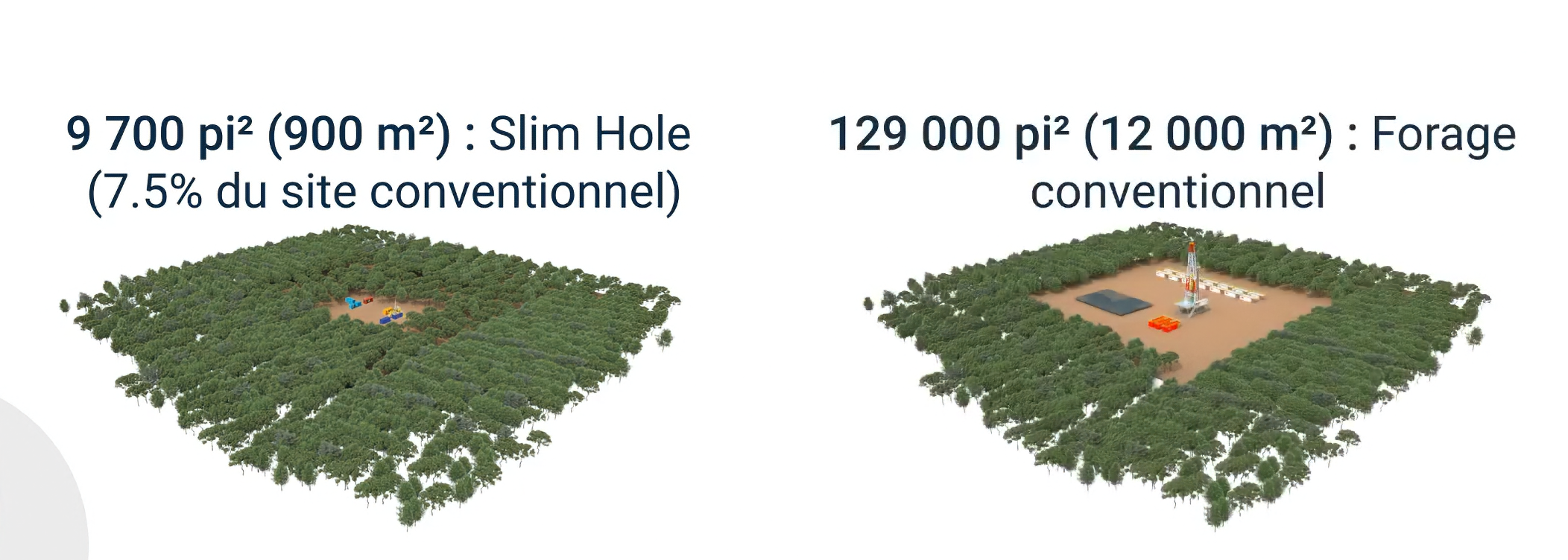
The same features that shrink costs also help reduce the environmental impact on-site. More compact equipment, smaller fluid volumes, and lighter logistics can all reduce the space required for operations. For comparison, a conventional drilling site can require roughly three acres of active surface area, plus similar amounts of nearby infrastructure. [4] By shrinking equipment size, slim hole drilling limits the ground footprint accordingly.
This advantage matters most when exploration targets remote areas, sensitive environments, or regions with stricter regulatory requirements. In some cases, a smaller footprint can be a meaningful factor in project evaluation and permitting. [1] Production and injection testing can also be easier to manage with a slim hole, since they involve much lower fluid volumes than a larger well would. [1]
Applications of slim hole drilling
Slim hole drilling can be applied in several settings where subsurface knowledge plays a central role. Its value rests on the same underlying logic in each case: gather useful geological data, reduce uncertainty, and limit the resources committed before undertaking larger operations. This approach fits naturally into geothermal energy, mineral exploration, certain oil and gas contexts, and emerging fields like natural hydrogen, where exploration methods are still taking shape.
Geothermal energy: reservoir assessment
In the geothermal sector, slim hole drilling pursues two main goals: first, confirming that commercially viable temperatures exist at usable depth; second, testing the reservoir's productivity. Together, these two steps make it possible to decide, with real evidence in hand, whether a full production well is justified. [5]
One key benefit of this method lies in the quality of data obtained through continuous coring. Unlike drill cuttings, which are made up of rock fragments that can be hard to tie precisely to a given depth, a core provides a far more direct cross-section of the formation being drilled through. It reveals rock composition, alteration, fracturing, and certain mechanical properties. This information then feeds into a more reliable understanding of the geothermal reservoir, particularly for conceptual and numerical models. [5]
This type of drilling proves all the more useful given how demanding geothermal environments are on equipment: formations there tend to be hot (between 160°C and over 300°C in production zones), often hard (with compressive strength above 240 MPa), abrasive, heavily fractured, and under-pressurized, all of which make drilling technically challenging and costly regardless of approach. [9]
This exploration potential fits into the broader picture of the energy transition. According to the U.S. Department of Energy, geothermal electricity produces roughly one-sixth the CO₂ of a natural gas plant, and closed-loop binary geothermal plants emit essentially zero atmospheric emissions. [3]
Mineral exploration, natural hydrogen, and hydrocarbons
Beyond geothermal energy, small-diameter exploratory drilling can also prove valuable in other sectors where early decisions hinge on a clearer read of the subsurface. Depending on the context, the type of information sought can vary. In mineral exploration, the goal may be to identify rock type, known as lithology, and pinpoint zones where valuable minerals are concentrated. In the oil and gas sector, analysis often focuses on stratigraphy, meaning how geological layers are arranged, along with reservoir delineation. For groundwater, the priority shifts toward assessing a hydrogeological resource: the presence, movement, and exploitation potential of water within underground formations.
In mineral exploration, research drilling produces geological information from cores, helping assess the potential of underground resources such as minerals, groundwater, or hydrocarbons. [6] These cores allow direct observation of lithology, alteration, fracturing, and mineralization indicators. They can also retain long-term value: when properly catalogued and stored, cores can be revisited for new analyses, cutting down on the need to repeat drilling already carried out. USGS research on core collections has in fact shown that poor cataloguing can lead to costly duplication, even when the relevant information already exists in earlier samples. [7]
In the oil and gas sector, slim hole drilling has mainly been documented as an exploration tool for gathering data before undertaking larger drilling operations. The information collected can help clarify stratigraphy, improve understanding of reservoir structure, and guide the next steps of a project. This sector was also among the first where the economic benefits of slim hole drilling were quantified, with exploration cost reductions of 25 to 75% reported relative to conventional methods. [2]
For groundwater, research drilling can help evaluate the hydrogeological potential of an area. This assessment aims to build a clearer picture of water presence within underground formations, its depth, its movement, and the conditions that might allow it to be used. Even when a well isn't intended for immediate production, the data gathered can support future resource management and help avoid heavier interventions at an early stage. [6]
For emerging resources such as natural hydrogen, the appeal of slim hole drilling is mainly exploratory. In a field where prospecting and assessment methods are still evolving, small-diameter drilling could help verify certain indicators, document reservoir conditions, and steer future work before larger investments are made.
Reaching Remote Areas and the Quality of Geological Data
Two further strengths deserve attention, especially for exploration in northern regions or hard-to-reach areas: the slim hole's ability to reach terrain that would otherwise be difficult to access, and the depth of data it can gather despite its compact scale.
Making remote and sensitive areas accessible
In northern, isolated, or hard-to-reach regions, logistics can quickly become one of the main barriers to exploration. Using more compact equipment helps limit certain preparatory work, such as building permanent access roads or setting up larger platforms. In the best-case scenarios, helicopter-transportable rigs can even cut down on the need for conventional access roads. [1] [2]
This advantage matters most when the target areas carry significant environmental, regulatory, or operational constraints. A lighter approach doesn't remove the need for assessment and planning, but it can offer extra room to maneuver when exploring areas where conventional methods would be harder to deploy.
Detailed geological data despite a reduced format
Despite its small scale, a slim hole delivers a data set that's just as complete as one from a larger well: continuous coring with a detailed log, borehole imaging, fluid records, temperature profiles at multiple depths, and results from production and injection tests. [1]
The edge that continuous coring holds over conventional cuttings makes all the difference here. Where rock fragments from a standard well get mixed together and can come from several depths at once, an intact core delivers a near-complete geological cross-section of the formation, enabling precise characterization of lithology, alteration, fracturing, and mechanical properties. [5] This wealth of information feeds directly into reservoir models, whether for geothermal energy, mineral exploration, or other underground resources.
Conclusion
Slim hole drilling reflects a broader shift in exploration practices toward approaches that are more targeted, lighter, and better suited to on-the-ground constraints. By shrinking both the diameter of the well and the scale of operations, this method delivers useful subsurface information while keeping resource commitments low at a project's early stages.
Its value stands out most clearly when exploration takes place in areas that are remote, sensitive, or costly to access. In these settings, slim hole drilling can help guide decisions, cut down on uncertainty, and reserve larger-scale interventions for the most promising sites. It fits within a more gradual approach to exploration, one where data quality and a tightly controlled surface footprint become essential criteria.
To stay informed about the latest developments in responsible exploration, follow Squatex on LinkedIn.
References
[1] Finger, John T., et al. "Steamboat Hills Exploratory Slimhole: Drilling and Testing." Sandia National Laboratories Report SAND94-0551, 1994. U.S. Department of Energy, https://data.nbmg.unr.edu/public/Geothermal/GreyLiterature/Finger_SteamboatHillsSlimhole_1994.pdf.
[2] Finger, John T. "Slimhole Drilling for Geothermal Exploration." Geothermal Energy R&D Program: Drilling Technology, Sandia National Laboratories, 1994. U.S. Department of Energy, https://www.osti.gov/servlets/purl/10163778.
[3] "Environmental Analysis." Office of Geothermal Technologies, U.S. Department of Energy, May 27, 2019. https://www.energy.gov/eere/geothermal/environmental-analysis.
[4] "Footprint Reduction." Office of Fossil Energy, U.S. Department of Energy, 2016. https://www.energy.gov/sites/prod/files/2016/07/f33/Footprint%20Reduction.pdf.
[5] Mackenzie, Ken M., et al. "Use of Deep Slimhole Drilling for Geothermal Exploration." Proceedings, The 5th Indonesia International Geothermal Convention & Exhibition 2017, Jakarta, 2017. International Geothermal Association, https://www.geothermal-energy.org/pdf/IGAstandard/Indonesia/2017/Mackenzie.pdf.
[6] "Research Drilling Program." U.S. Geological Survey, https://www.usgs.gov/special-topics/research-drilling-program.
[7] Hodges, Mary K.V., et al. Updated Procedures for Using Drill Cores and Cuttings at the Lithologic Core Storage Library, Idaho National Laboratory, Idaho. U.S. Geological Survey Open-File Report 2018-1001 (DOE/ID-22244), 2018. https://pubs.usgs.gov/of/2018/1001/ofr20181001.pdf.
[9] Finger, John, and Doug Blankenship. Handbook of Best Practices for Geothermal Drilling. Sandia National Laboratories, SAND2010-6048, 2010. U.S. Department of Energy, https://www1.eere.energy.gov/geothermal/pdfs/drillinghandbook.pdf.
