
CAES: Why is this technology essential for decarbonizing electrical grids?
Introduction
The energy transition has entered an acceleration phase. Driven by climate policies and falling technology costs, solar and wind power are progressively establishing themselves as pillars of modern electrical systems. Indeed, renewable energies represent a growing share of the global electricity mix: according to the International Energy Agency (IEA), their share would increase from 12% in 2022 to 30% in 2030 and nearly 45% by 2050 [1].
This rapid progression is profoundly changing the structure of electrical grids. Unlike conventional thermal power plants, whose production can be adjusted to demand, variable renewable sources depend on weather conditions.
The IEA thus emphasizes that the massive integration of renewables will require a major expansion of long-duration storage capacities to preserve grid stability and reliability by 2040.
In other words, the larger the share of renewables, the more crucial the question of electricity availability becomes. The challenge is no longer simply to produce low-carbon energy, but to ensure its timely alignment with demand. In this context, the development of long-term storage solutions, such as Compressed Air Energy Storage (CAES), is becoming a key element in the decarbonization of electricity grids.
The systemic challenge of intermittency at grid scale
A structural transformation of grids
The massive integration of renewable energies is profoundly transforming the operation of electrical systems. Their production is neither constant nor entirely predictable: it varies on a daily, seasonal, and meteorological cycle scale.
This variability introduces new imbalances between supply and demand, making it essential to develop solutions capable of absorbing surpluses and compensating for deficit periods.
Variations that exceed the daily scale
While daily fluctuations — such as the drop in solar production in the evening — are now well identified, seasonal variations represent an even more structural challenge.
In northern regions, solar production exhibits particularly marked seasonality. Analyses conducted in Finland show that a photovoltaic system can produce more than ten times more energy in spring or summer than in winter [3].
This asymmetry is explained by the strong variation in weather conditions: in spring and summer, the region benefits from nearly 9 hours of daily sunshine on average, while in autumn and winter, this duration drops to about 2 hours per day, with greater cloud cover and prolonged snow cover. This dynamic creates energy surpluses concentrated over a few months and structural deficits during the cold season.
"Dunkelflaute" episodes
Beyond seasonal cycles, certain extreme weather episodes further accentuate these imbalances. The German term dunkelflaute refers to periods characterized by little wind or sun, resulting in a simultaneous drop in wind and solar production [7].
These episodes can last several days and test the resilience of electrical systems heavily dependent on renewables. They concretely illustrate the need to have solutions capable of ensuring continuity of supply during extended periods of low production.
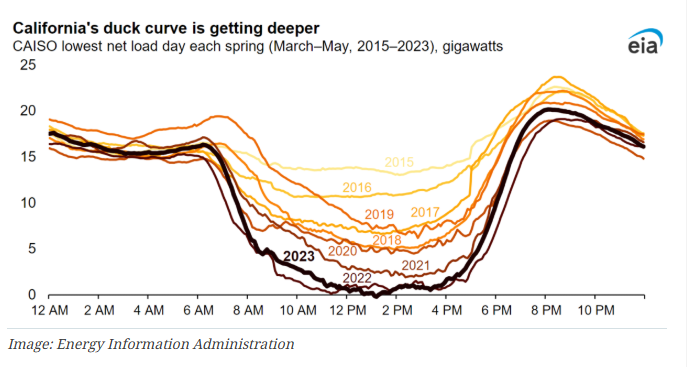
Source: Energy Information Administration
Short-term vs long-duration storage: two different needs
Faced with this multi-scale variability, storage solutions do not all address the same needs. Electrical systems must mobilize tools adapted to distinct time horizons.
It is essential to distinguish:
Short-term storage (2–4 h): used primarily to balance supply and demand on a daily scale and stabilize the grid. Lithium-ion batteries are currently widely deployed for these uses [4].
Long-duration storage: designed to compensate for more extended periods of low renewable production, which can last several hours or several days [5].
It is in this second category that CAES finds its relevance. Its ability to restore energy over extended durations makes it a strategic lever to support the growth of renewable energies [6].
Integration of offshore and onshore wind
The rise of wind power, whether onshore or offshore, is progressively transforming the architecture of electrical grids. These installations are often located far from major consumption centers, while their production remains dependent on weather conditions. This can result in temporary local surpluses that do not always coincide with grid needs.
In this context, CAES can constitute a flexibility lever complementary to transmission infrastructure. Rather than relying exclusively on reinforcing transmission lines to transport electricity to high-demand areas, storage near production sites allows for deferring injection onto the grid and valorizing energy when market conditions or demand are more favorable.
This approach helps optimize the use of existing infrastructure and limit congestion constraints, particularly in regions where renewable production is growing faster than transmission capacities.
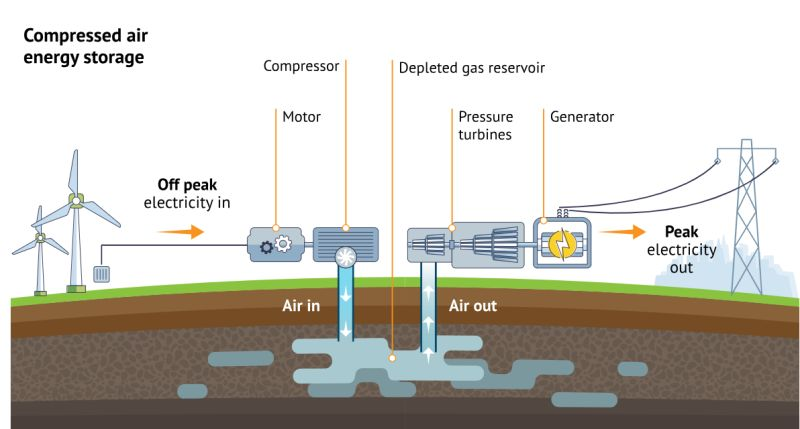
Source: Energy Encyclopedia (EE)
Stabilization of grids with high solar penetration
Unlike electrochemical batteries, generally optimized for short cycles, CAES is distinguished by low self-discharge, allowing stored energy to be retained over extended periods [8]. This characteristic is particularly relevant in systems where solar production is dominant. Photovoltaic production has a marked daily profile — peak at midday, rapid decline in the evening — to which significant seasonal variations are added, especially at high latitudes.
CAES is distinguished by low self-discharge, a documented characteristic [8], which allows stored energy to be retained over extended periods. Analyses also indicate that CAES systems can offer discharge durations ranging from several hours to several days [6].
By absorbing surpluses produced during periods of high irradiation and restoring them when production decreases, CAES helps smooth the net variability injected into the grid. This role becomes particularly relevant in electrical systems where the increase in the share of renewables requires strengthening flexibility mechanisms [2].
Support for island and isolated grids
Beyond large interconnected grids, flexibility and storage challenges arise even more acutely in island territories and isolated communities. In these contexts, the absence of connection to main grids requires local electricity production, often provided by diesel generators.
This dependence results in high energy costs and strong exposure to fuel price fluctuations, as well as logistical constraints related to diesel transport and storage. At the Canadian scale, approximately 200 communities depend entirely on diesel for heating and electricity production [8].
In this context, the integration of renewable energies combined with long-duration storage solutions like CAES could help progressively reduce diesel consumption while improving local energy security. Storage would allow valorizing renewable production when conditions are favorable and maintaining supply during less productive periods.
Conclusion
CAES appears as a relevant component of the long-duration storage ecosystem, as electrical grids will need to strengthen their flexibility capacities on a large scale over the coming decades [2].
Its ability to provide energy over several hours, even several days [6], combined with low self-discharge [8], makes it a solution adapted to systems with high renewable penetration. The use cases analyzed — wind integration, solar stabilization, and support for isolated grids — illustrate the diversity of its potential applications.
The question is no longer whether CAES will play a central role in decarbonization, but rather how we will seize this strategic opportunity. Explore Squatex's renewable energy initiatives on our website and our social media.
References
[1] International Energy Agency. World Energy Outlook 2023. IEA, 2023, https://www.iea.org/reports/world-energy-outlook-2023
[2] International Energy Agency. Electricity Grids and Secure Energy Transitions. IEA, 2023, https://iea.blob.core.windows.net/assets/ea2ff609-8180-4312-8de9-494bcf21696d/ElectricityGridsandSecureEnergyTransitions.pdf
[3] Shekar, Vinay, Antonio Caló, and Eva Pongrácz. Experiences from Seasonal Arctic Solar Photovoltaics (PV) Generation – An Empirical Data Analysis from a Research Infrastructure in Northern Finland. Renewable Energy, vol. 217, 2023, article 119162. Elsevier, https://oulurepo.oulu.fi/bitstream/handle/10024/46065/nbnfi-fe20231106143316.pdf
[4] National Renewable Energy Laboratory. Battery Energy Storage System (BESS) and Battery Management System (BMS). NREL, 2021, https://www.nrel.gov/docs/fy21osti/79236.pdf
[5] National Renewable Energy Laboratory. Storage Futures Study. NREL, 2021, https://docs.nrel.gov/docs/fy22osti/81779.pdf
[6] Olabi, A. G., et al. Compressed Air Energy Storage Systems: Components and Operating Parameters – A Review. Renewable and Sustainable Energy Reviews, https://www.sciencedirect.com/science/article/abs/pii/S1364032122005901
[7] Agora Energiewende. Renewables cut German electricity costs and emissions; lack of momentum seen in buildings and transport sectors. https://www.agora-energiewende.org/news-events/renewables-cut-german-electricity-costs-and-emissions-lack-of-momentum-seen-in-buildings-and-transport-sectors
[8] Environment and Climate Change Canada (ECCC), Goal 7 of the Federal sustainable development strategy https://www.canada.ca/en/environment-climate-change/services/climate-change/federal-sustainable-development-strategy/goals/affordable-clean-energy.html
