

What is CAES and how does it work?
Introduction
In 2024, China commissioned the world's largest compressed air energy storage (CAES) facility: a 4.2 GWh project capable of reducing up to 490,000 tonnes of CO₂ per year [8]. This announcement illustrates the growing interest in large-scale storage solutions, which have become indispensable as renewable energy takes a central place in electrical grids.
The intermittency of renewable energy represents a major challenge for the stability of electrical grids. When the sun shines intensely or the wind blows strongly, electricity production can far exceed demand. Conversely, during calm or nighttime periods, production drops while consumption may remain high. This imbalance between supply and demand raises a fundamental question: how can surplus energy be stored efficiently to be redistributed at the right moment?
What Is Compressed Air Energy Storage?
Compressed air energy storage (CAES) represents an innovative approach to large-scale energy storage. Also known as CAES, this technology transforms surplus electricity into potential energy in the form of compressed air, stored in underground geological formations to be converted back into electricity when demand requires it.
How It Works: The Charging Phase
When renewable electricity production exceeds grid demand — for example during a peak in wind or solar production — a CAES system uses this surplus to power a compressor. The air is then compressed and injected into an underground storage structure, most often a salt cavern [1][3]. Concretely, surplus electricity powers the compressor, which increases air pressure and pushes it into a natural underground storage zone, where it can be stored for a long time with relatively low self-discharge, over periods ranging from hours to days, or even months depending on the scale of the system [2].
How It Works: The Discharge Phase
The true value of CAES becomes apparent during periods of high electricity demand. When grid needs increase — typically in the evening when households return from work and switch on appliances and heating systems — the air stored in underground caverns is released. This pressurized air is heated and directed toward turbines, similar to those used in conventional power plants. The expansion of the compressed air turns these turbines, which drive generators producing the electricity needed to meet demand [1][3].
This compression and expansion cycle thus allows the temporal decoupling of electricity production and consumption, offering essential flexibility for the large-scale integration of renewable energy into the energy mix.
Geological Storage Infrastructure
The choice of underground storage is not arbitrary. Compressed air has a relatively low energy density, which requires considerable storage volumes to achieve significant capacities. Underground geological formations represent the most economical and practical solution to meet this requirement [4].
Salt caverns currently represent the preferred option for CAES storage. These cavities are artificially created in salt basins through a controlled dissolution process. Rock salt deposits are found in various regions of the world, thus offering broad geographic potential for the deployment of CAES technology [4].
In Europe, nearly one third of natural gas stocks are already stored in this type of cavern, with none having collapsed, which attests to their reliability [4].
The Different Types of CAES Systems and Their Efficiency
There are three main families of CAES systems, distinguished by their heat management and energy performance.
Diabatic CAES: The First Generation
Compressing air inevitably generates heat. When air is confined in a reduced space, particles come closer together and collide more frequently, causing a rise in temperature. At a pressure of 70 bar, air can reach approximately 650°C depending on the compressed volume [4].
This heat poses a major technical problem. Salt caverns cannot accommodate air at temperatures above 42°C without risking deterioration of their structure. To work around this limitation, traditional diabatic CAES systems dissipate excess heat through cooling towers, thereby losing a significant portion of the energy invested in compression [4].
The two diabatic CAES installations currently in operation — Huntorf in Germany and McIntosh in Alabama — have adopted an approach that feeds the recovered compressed air into a gas turbine. While this method does improve turbine efficiency compared to standard operation, it still requires the combustion of natural gas, representing 50 to 60% of the consumption of an equivalent-sized gas power plant. This dependence on fossil fuels limits the environmental appeal of this first generation of CAES [4].
Adiabatic CAES: Toward a Fossil-Fuel-Free Solution
The term "adiabatic" refers to a process where no thermal energy enters or leaves the system at any stage — it is therefore a thermally closed system. Adiabatic CAES technologies balance heat management across the entire compression and expansion cycle to ensure no energy is wasted [4].
In an advanced adiabatic system, the heat generated during compression is extracted and stored separately in a dedicated thermal storage system. This heat is then reinjected into the system during the expansion phase, eliminating the need to rely on fossil fuels or any other external fuel source to reheat the air before it passes through the turbines [4].
Next-generation adiabatic systems deliver remarkable performance. The proprietary technology developed by companies such as Storelectric achieves an efficiency of approximately 62% for a 40 MW installation, rising to up to 67% for 500 MW installations. These figures have been validated by numerous recognized multinational engineering firms, including Costain, Fortum, Siemens, and Mott MacDonald. The adiabatic approach is constructible with existing technologies while remaining economically viable [4].
Isothermal CAES: Maintaining a Constant Temperature
The third approach, isothermal CAES, aims to maintain a constant temperature throughout the compression and expansion process. This method contrasts with the diabatic approach (which uses fuel) and the adiabatic approach (which stores compression heat) [5].
Although theoretically advantageous, isothermal technology remains less mature than its diabatic and adiabatic counterparts. The technical challenges associated with maintaining a constant temperature during high-pressure compression still hinder its large-scale commercial deployment.
What Are the Goals of CAES in the Energy Transition?
Addressing the Intermittency of Renewable Energy
The inherent variability of renewable sources creates a constant mismatch between electricity production and consumption [2]. CAES makes it possible to decouple the moment energy is produced from the moment it is consumed, thereby facilitating the large-scale integration of wind and solar power.
CAES provides an effective mechanism for decoupling the timing of renewable generation from the timing of electricity demand. This temporal flexibility fundamentally transforms how renewable energy can be integrated into the grid. Rather than having to instantly balance production and consumption, operators can now store energy produced during off-peak hours and release it during peak periods.
-> Read more on "CAES: Why Is This Technology Essential to the Decarbonization of Electrical Grids?"
Long-Term Energy Storage
One of the distinguishing characteristics of CAES lies in its long-term storage capacity. CAES systems can store energy for extended periods, ranging from a few hours to several days. This capability is crucial for smoothing out fluctuations from intermittent renewable energy sources.
Unlike some storage technologies limited to short discharge durations, CAES can store large amounts of energy for extended periods without significant degradation. This characteristic makes it particularly well-suited to seasonal energy management strategies, where electricity produced during the summer months could theoretically be stored to meet increased winter demand.
Grid Stabilization and Peak Management
CAES storage systems can inject or absorb energy rapidly to stabilize grid frequency and voltage. This rapid response capability is essential for maintaining the quality and reliability of electricity supply, particularly in a context where the share of variable renewable energy is constantly increasing.
Peak demand management represents another major economic advantage. Rather than building and maintaining peaking plants that operate only a few hours per year during periods of maximum demand, CAES makes it possible to use electricity produced during off-peak hours (often at lower cost) to meet peak-hour needs.
Reduction of Greenhouse Gas Emissions
In advanced adiabatic systems, CAES can minimize or completely eliminate the need for natural gas to reheat air during the expansion phase, thereby substantially reducing greenhouse gas emissions.
Operational data confirms the positive environmental impact of CAES. The Feicheng facility reduces coal consumption by nearly 190,000 tonnes and carbon dioxide emissions by 490,000 tonnes annually [8]. Another Chinese project saves 42,000 tonnes of coal and 109,000 tonnes of CO₂ per year [9].
The Competitive Advantages of CAES
Beyond its role in the energy transition, CAES possesses technical and economic characteristics that set it apart from other energy storage solutions, particularly for large-scale and long-term applications.
Exceptional Lifespan and Cycle Count
With a lifespan exceeding 40 years and more than 13,000 charge-discharge cycles, CAES has one of the lowest levelized energy costs among energy storage systems, despite its high initial capital cost [2].
Low Self-Discharge
The minimal daily self-discharge of CAES enhances its long-duration storage capability, making it particularly suited to long-term energy management applications [2].
Unlike batteries that progressively lose their charge even when not in use, compressed air in a well-sealed underground cavern can be stored for weeks or even months with negligible energy losses. This characteristic opens the door to seasonal storage strategies, where surplus energy from one season could be preserved for another.
Leveraging Existing Geological Infrastructure
Furthermore, this technology proves particularly well-suited to large-scale applications, taking advantage of existing infrastructure such as salt caverns or depleted gas fields.
This ability to repurpose natural geological formations or end-of-life oil and gas infrastructure offers a dual advantage. On one hand, it reduces development costs by avoiding the construction of massive artificial storage structures. On the other hand, it enables the industrial repurposing of sites historically dependent on fossil fuel extraction, thereby contributing to the just transition of those regions.
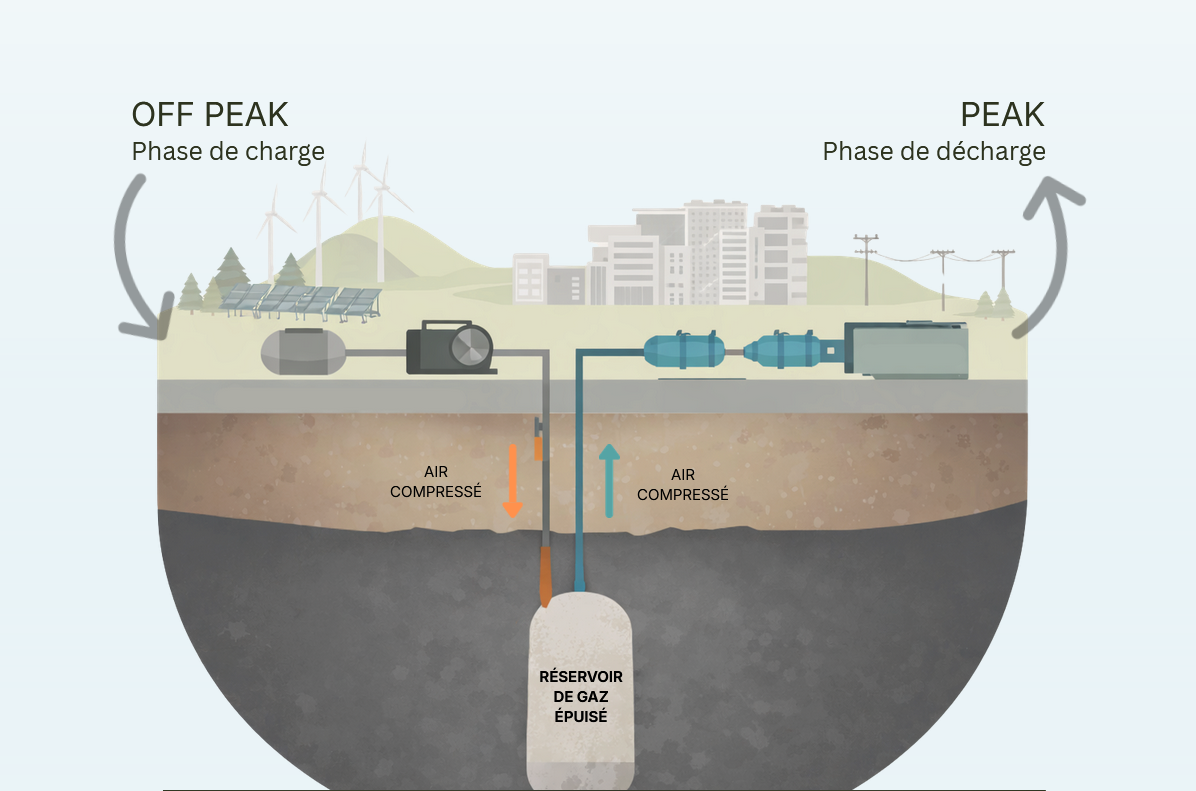
CAES system
Thermal Storage Performance
Innovations in thermal storage systems associated with adiabatic CAES continue to improve overall performance. Among the materials tested for compression heat storage, rock-bed thermal energy storage delivered the best performance, producing 586 MWh of energy with a round-trip efficiency of 0.76 [6].
These developments in complementary thermal storage technologies demonstrate that CAES is an active area of innovation, with continued potential for performance improvement and cost reduction.
Conclusion
Compressed air energy storage is establishing itself as a robust and sustainable solution to support the scale-up of renewable energy. With a lifespan exceeding 40 years, efficiency reaching up to 72.1% in the most recent installations, and emission reductions of up to 490,000 tonnes of CO₂ per year for a single project, CAES delivers remarkable performance [2][8]. Its ability to leverage existing geological infrastructure and its independence from critical minerals make it a strategic alternative to batteries for long-duration storage.
As the global market is expected to reach $5.31 billion in 2025 [10] and China plans for CAES to provide a quarter of its storage capacity by 2030 [9], Quebec possesses the geological resources and expertise needed to integrate this technology into its energy transition strategy. Its integration represents a strategic opportunity to help optimize the use of hydroelectric and renewable resources within the province's energy transition framework. Its integration represents a strategic opportunity to help optimize the use of hydroelectric and renewable resources within the province's energy transition framework.
Follow Squatex on LinkedIn to discover our vision and thoughts on key technologies of the energy transition.
References
[1] Climate Technology Centre & Network. Compressed Air Energy Storage (CAES). United Nations, https://www.ctc-n.org/technologies/compressed-air-energy-storage-caes.
[2] Bazdar, Elaheh, et al. "Compressed Air Energy Storage in Integrated Energy Systems: A Review." Renewable and Sustainable Energy Reviews, vol. 167, 2022, article 112701. Elsevier, https://www.sciencedirect.com/science/article/abs/pii/S1364032122005901.
[3] Compressed Air Energy Storage. Energy Education, University of Calgary, https://energyeducation.ca/encyclopedia/Compressed_air_energy_storage.
[4] Adiabatic v Isothermal CAES. Storelectric, https://storelectric.com/adiabatic-v-isothermal-caes/.
[5] What Are the Main Types of CAES Systems? Energy Sustainability Directory, https://energy.sustainability-directory.com/learn/what-are-the-main-types-of-caes-systems/.
[6] Rock-Bed Thermal Energy Storage Performance in CAES.Journal of Energy Storage, https://www.sciencedirect.com/science/article/abs/pii/S2352152X25022881.
[8] China Scales Up Long-Duration Storage with 4.2 GWh Compressed Air Project. ESS News, 2024, https://www.ess-news.com/2025/11/27/china-scales-up-long-duration-storage-with-4-2-gwh-compressed-air-project/.
[9] Global Market for Modular CAES Storage. Tree Associates, https://www.tree-associates.com/library/global-market-for-modular-caes-storage-1.
[10] Compressed Air Energy Storage Market Analysis. Data Insights Market, https://www.datainsightsmarket.com/reports/compressed-air-energy-storage-84616.
