

Why Has Lithium Become Indispensable? The Applications Transforming Our Daily Lives
Discover how lithium is revolutionizing far more than electric batteries: from the glass on your stovetop to the aircraft of the future, this critical metal is shaping our technological future.
Introduction
In 2024, global lithium consumption surged by 29% to reach 220,000 tonnes [1], marking an unprecedented acceleration in demand for this lightweight metal. This explosive growth reflects a little-known reality: lithium is not limited to electric vehicle batteries.
Did you know that the glass on your stovetop, the lubricating greases used in the aerospace industry, and even future nuclear reactors all depend on lithium? While this mineral is often associated with the energy transition, its industrial versatility remains largely unknown to the general public. Yet this diversity of applications explains why the Canadian government has identified lithium as a critical mineral for the national economy [2].
This article explores the many faces of lithium: from its dominant role in energy storage to its essential industrial applications in ceramics, lubrication, medicine, and cutting-edge technologies. Understanding this diversity helps us grasp why this metal represents a major strategic issue for the global economy.
Energy Storage: A Sector in Full Transformation
The battery industry currently dominates the lithium market, but its recent evolution reveals trends that are redefining the entire energy sector.
The Growing Dominance of Batteries in Global Demand
The numbers speak for themselves. In 2023, batteries accounted for 87% of total lithium demand [2], a spectacular increase compared to 74% in 2022 [3]. This 13-percentage-point rise in a single year illustrates the acceleration of the global energy transition. The current breakdown of demand reveals this concentration: 87% for batteries, 4% for ceramics and glass, 2% for lubricating greases, 1% for air treatment, 1% for continuous casting fluxes, 1% for medical applications, and 4% for other uses [4].
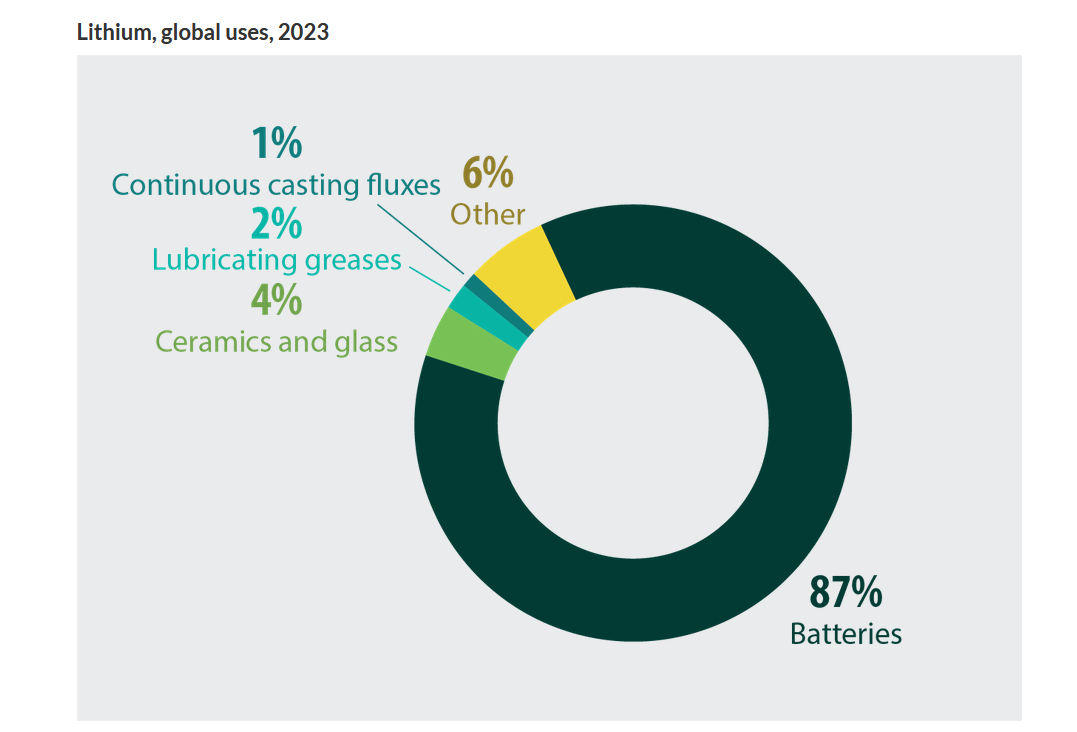
Source: Natural Resources Canada
This transformation of the market did not happen overnight. It is the result of several years of massive investment in energy storage technologies and a collective awareness of the urgency of the climate crisis. Today, the largest share of new lithium demand comes directly from the battery industry, which absorbs a growing proportion of global production.
The Explosion of the Electric Vehicle Market
The electric automotive sector is experiencing unprecedented growth. According to the International Energy Agency (IEA), more than one in five new cars sold in 2024 was electric [5], with sales exceeding 17 million units worldwide. This progression confirms the durable entrenchment of electrification in the global automotive market and accelerates the transformation of critical mineral supply chains, including lithium.
Beyond sales volumes, the transformation is structural: the continued decline in battery costs, improvements in vehicle range, and favorable public policies supporting electrification all underpin a long-term growth trajectory. In its forward-looking scenarios, the IEA projects sustained expansion of the global electric vehicle fleet by 2030, implying a substantial increase in demand for battery materials, of which lithium is an essential component.
Grid-Scale Energy Storage: A Silent Revolution
Alongside the rise of electric vehicles, stationary storage is experiencing rapid expansion. Indeed, the energy sector now accounts for more than 90% of total demand for lithium batteries [6]. This figure encompasses both vehicle batteries and those dedicated to grid-scale storage.
In 2023, global battery deployment increased by 42 gigawatts compared to the previous year [6], a rise of more than 130%. This acceleration is driven by the growing need to store energy produced by intermittent renewable sources such as wind and solar. Lithium batteries make it possible to smooth out production and ensure the stability of electrical grids.
The IEA also emphasizes that tripling global renewable energy capacity by 2030 will require a massive expansion of electricity grids and storage capacity. This development confirms the strategic importance of lithium in the transformation of global energy systems.
Ceramics and Glass: Discreet but Essential Industrial Applications
Although representing only 4 to 5% of global demand, lithium plays a technically irreplaceable role in the manufacturing of high-performance ceramics and glass that populate our daily lives.
Lithium in Glass: Performance and Energy Efficiency
In the glass industry, lithium provides considerable technical advantages. It improves the durability, corrosion resistance, and thermal resistance of glass products. These properties are found in many everyday objects: glass-ceramic stovetops, glass containers, specialty glass, and fiberglass.
The addition of lithium also transforms manufacturing processes. It increases the glass melting rate, reduces viscosity, and lowers the melting temperature [7]. These modifications allow for higher production, substantial energy savings, and significant molding advantages. By improving productivity and reducing energy consumption in glass manufacturing, lithium indirectly contributes to reducing the carbon footprint of this industry — an environmental benefit often overlooked in discussions about critical metals.
Ceramic Applications: Technical Excellence and Versatility
Lithium plays a key role in optimizing ceramic formulations. Its incorporation makes it possible to lower firing temperatures and reduce the coefficient of thermal expansion, while improving the mechanical strength of ceramic bodies [7]. This combination of properties promotes the production of more durable materials, while reducing the energy consumption required for manufacturing processes.
In glazes, lithium compounds act as effective fluxes. They help adjust viscosity during application and improve the quality of finishes, particularly by influencing gloss, color stability, and surface uniformity [7]. These characteristics are sought both for aesthetic reasons and for their technical advantages in terms of durability and performance.
Spodumene, the primary lithium ore used in the ceramics industry, is particularly valued for the production of very low thermal expansion materials [12]. This property makes it indispensable in applications subject to high thermal stress, including:
Microwave oven trays
Electromagnetic stovetop panels
Turbine blades
Spark plugs
Lightweight ceramics for industrial applications
Industrial Lubricants: Performance Under Extreme Conditions
Lithium-based greases quietly dominate the global lubrication market, representing three-quarters of a multi-billion-dollar industry thanks to their exceptional technical properties.
Domination of the Global Lubrication Market
Lubricating greases represent 2% of total lithium demand [4], a modest proportion that conceals the strategic importance of this application. Lithium-based greases account for 75% of a market estimated at 4 billion US dollars [7], testament to their dominant position in the lubrication industry.
This overwhelming dominance is no coincidence. It is explained by superior technical properties that make lithium greases difficult to replace in many critical applications. Industries that depend on these lubricants prioritize reliability and long-term performance, justifying lithium's considerable market share in this sector.
Technical Properties and Advantages
Lithium-based greases generally exhibit good stability, high-temperature characteristics, and water resistance properties [7]. These qualities allow these lubricants to maintain their viscosity and lubricating capacity under extreme conditions of temperature and humidity.
Unlike alternatives, these greases better resist oxidation, thereby extending maintenance intervals. This longevity reduces operating costs and downtime — two crucial factors in industrial environments where every minute of immobilization represents significant financial losses.
Critical Industrial Applications
The versatility of lithium greases is reflected in the diversity of their applications:
In the automotive sector, they lubricate wheel bearings, universal joints, and suspension systems. These components are subject to significant mechanical stress and considerable temperature variations, requiring reliable and durable lubricants.
In heavy industry, they are essential for construction machinery, mining equipment, and marine applications. These environments expose lubricants to particularly severe conditions: abrasive dust, high loads, constant vibrations, and exposure to the elements.
In aerospace, where reliability under extreme conditions is paramount, lithium greases ensure the safe operation of critical components. Aviation tolerates no compromise on lubricant quality, and lithium greases meet the rigorous standards of this demanding sector.
Stability and Strategic Importance
The dependence of critical industries on lithium greases makes this a strategic application. A disruption in the supply of these lubricants could paralyze entire sectors of the economy, from aviation to road transport and heavy industry. The expertise in high-performance lubrication represents a valuable industrial know-how that few alternatives can match to this day.
Medical Applications: An Established and Expanding Therapeutic Potential
Beyond its industrial applications, lithium has possessed recognized therapeutic properties for decades, with a medical potential that continues to broaden.
At the global market level, medical applications represent approximately 1% of total lithium demand [4]. While this proportion remains modest compared to batteries or industrial uses, its human significance is considerable. The volumes used are relatively stable, reflecting a structured pharmaceutical market characterized by predictable needs and constant demand linked to long-term treatments.
Alongside these established uses, scientific research continues to explore new fields of application. Recent work, notably conducted at Harvard University, highlights the neuroprotective properties of lithium, particularly in the context of neurodegenerative diseases such as Alzheimer's disease. These advances suggest an expanded therapeutic potential, moving beyond the traditional framework of psychiatry and opening the way for new perspectives in neurological health.
Next-Generation Nuclear Technologies: The Isotope at the Heart of the Energy Future
Lithium also plays a lesser-known but critical role in advanced nuclear technologies, where its specific isotopes are becoming indispensable for molten salt reactors and nuclear fusion.
Enriched Lithium for Molten Salt Reactors
Next-generation molten salt nuclear reactors use a particular form of the element — enriched lithium-7 — as a key component of the fluid that transfers heat inside the reactor. This technical specificity opens the door to a highly specialized market segment, distinct from traditional battery-related uses.
Today, global consumption of this isotope amounts to approximately one tonne per year, primarily for certain conventional nuclear reactors [8]. However, if molten salt reactors are deployed at scale, demand could reach approximately 250 tonnes per year. Such a progression would represent a major shift in the need for enriched material.
Lithium-6 and Nuclear Fusion: The Fuel of the Future
Another isotope, lithium-6, plays a strategic role in nuclear fusion projects. It is used to produce tritium, one of the essential fuels for the operation of future fusion reactors. This function places this lightweight metal at the heart of technologies likely to transform electricity production over the coming decades.
Within the framework of the international ITER project, the experimental blanket module requires approximately 200 kilograms of enriched material. The DEMO reactor, which is to succeed ITER and demonstrate the commercial viability of fusion, could in turn require more than 60 tonnes per gigawatt of installed capacity [8].
Even if these volumes remain modest compared to the needs of the battery sector, they correspond to a niche market with high added value. Isotopes intended for nuclear applications command prices significantly higher than those used in conventional technologies, due to the complexity of enrichment processes and extremely high purity requirements.
Technical and Supply Challenges
Lithium enrichment requires advanced isotope separation technologies. Natural lithium contains approximately 7.5% lithium-6 and 92.5% lithium-7, requiring complex processes to achieve the enrichment levels required by nuclear applications.
The World Nuclear Association highlights that lithium requirements for advanced nuclear technologies [9] create specialized supply needs. These needs differ fundamentally from those of the battery industry, requiring dedicated facilities and specific technical expertise in isotopic separation.
Advanced nuclear technologies add a geopolitical dimension to lithium supply. Mastery of lithium enrichment is becoming a matter of energy sovereignty for nations aspiring to develop fourth-generation reactors or fusion power plants.
Aerospace Alloys: Lightness and Performance for the Aviation of the Future
In aeronautics and the space sector, every kilogram saved translates into major gains in performance and efficiency. It is in this context that aluminum-lithium alloys have established themselves as strategic materials, offering a superior strength-to-weight ratio compared to traditional aluminum alloys.
Technical Advantages of Aluminum-Lithium Alloys
NASA, for example, has developed advanced compositions such as alloy 2050, which incorporates copper, magnesium, silver, and a small proportion of lithium [10]. Designed to replace certain alloys used in the structures of commercial aircraft and launch vehicles, this material combines lightness, strength, and high-temperature stability.
These alloys stand out for their excellent resistance to stress corrosion cracking and fatigue crack propagation. They also retain good mechanical properties at very low temperatures — an essential asset for space launchers whose structures are exposed to cryogenic fuels such as liquid oxygen or hydrogen. Their weldability further enhances their appeal for demanding aerospace applications.
Applications in Commercial and Military Aviation
In commercial aviation, these materials are used for components such as leading and trailing edges, access panels, seat tracks, and wing skins. The weight reduction they enable directly improves the energy efficiency of aircraft.
In the military domain, where performance constraints are even higher, they are used in the manufacture of critical structural parts such as wing boxes, central fuselage sections, and certain control surfaces [11]. Their higher cost is justified by the gains in range, payload, and maneuverability.
Their use also extends to helicopters, rockets, and satellite systems [11], where they advantageously replace conventional alloys. This diversity of applications illustrates their central role in the evolution of modern aerospace structures.
Space and Cryogenic Applications
These alloys are among the preferred materials for cryogenic tanks in space propulsion systems [11]. Their ability to maintain strength and rigidity at extremely low temperatures makes them particularly well-suited for liquid oxygen and hydrogen tanks.
NASA uses them notably in plate form for the skins, spars, ribs, frames, and floor beams of its space structures [10]. Their adoption in American programs confirms their reliability under some of the most demanding conditions in modern engineering.
Environmental Impact and Efficiency
Beyond mechanical performance, the appeal of these alloys also lies in their indirect environmental impact. Lightening an aircraft means reducing its fuel consumption over its entire service life, which can exceed 25 years.
Even a reduction of a few hundred kilograms on a long-haul aircraft translates into substantial fuel savings and a significant reduction in CO₂ emissions. Thus, the integration of these materials contributes not only to technological innovation, but also to improving the energy efficiency of air transport.
Other Industrial Applications: Diversity and Continuous Innovation
Beyond the major applications, lithium finds specialized uses in several industrial sectors where its unique properties solve specific technical challenges.
Air treatment and confined environments: Air treatment represents approximately 1% of global demand [4]. Certain lithium-based compounds are used to absorb carbon dioxide, an essential function in environments where air quality must be rigorously controlled. These technologies are found notably in submarines and spacecraft, where efficient CO₂ removal is vital for crew safety. In these extreme contexts, the reliability of purification systems relies in part on these absorbent materials.
Continuous casting fluxes for metallurgy: Continuous casting also accounts for approximately 1% of global demand [4]. Fluxes containing lithium are used to improve the quality of produced steel, by promoting better homogeneity and more regular surfaces. In modern steelmaking, these improvements help reduce defects and optimize the mechanical properties of finished products, thereby enhancing the efficiency of manufacturing processes.
Production of specialized polymers: In 2022, polymer production represented approximately 2% of total demand [3]. Lithium-based compounds serve as catalysts in the synthesis of technical polymers and synthetic elastomers. These catalysts enable precise control of the molecular structure of materials, directly influencing their mechanical, thermal, and chemical properties. They are thus found in numerous high-performance industrial and consumer products.
Conclusion
Lithium stands out as a truly cross-cutting metal in the modern economy. While batteries currently dominate global demand at 87%, other sectors — ceramics, glass, industrial lubricants, medicine, advanced nuclear, and aerospace — continue to play a structuring role in the global ecosystem of this strategic material.
This diversity of uses explains its status as a critical mineral in Canada and in many other developed economies. Beyond electric mobility, it supports the modernization of electricity grids, manufacturing innovation, and the development of cutting-edge technologies. The growth in demand observed in 2024, with a 29% increase to reach 220,000 tonnes, illustrates a dynamic that is set to endure.
But more than the volumes, it is the strategic scope of this lightweight metal that commands attention. Its cross-cutting role in energy, industry, health, and advanced technologies makes it a key indicator of the economic transformations currently underway.
Follow Squatex's developments on LinkedIn to discover how critical metals are shaping strategic supply chains and participating in the global energy transformation.
References
[1] U.S. Geological Survey. "Mineral Commodity Summaries 2025: Lithium." USGS, 2025, https://pubs.usgs.gov/periodicals/mcs2025/mcs2025-lithium.pdf
[2] Natural Resources Canada. "Lithium Facts." Natural Resources Canada, 2024, https://natural-resources.canada.ca/minerals-mining/mining-data-statistics-analysis/minerals-metals-facts/lithium-facts
[3] U.S. Geological Survey. "Mineral Commodity Summaries 2022: Lithium." USGS, 2022, https://pubs.usgs.gov/periodicals/mcs2022/mcs2022-lithium.pdf
[4] U.S. Geological Survey. "Mineral Commodity Summaries 2024: Lithium." USGS, 2024, https://pubs.usgs.gov/periodicals/mcs2024/mcs2024-lithium.pdf
[6] IEA. Batteries and Secure Energy Transitions, 2024, https://www.iea.org/reports/batteries-and-secure-energy-transitions/executive-summary
[7] AVZ Minerals / Roskill. "Generic Lithium Market Report." AVZ Minerals, 2019, https://avzminerals.squarespace.com/s/20191021-Generic-Lithium-Market.pdf
[8] "Enriched Lithium and Advanced Nuclear." NEI Magazine, 2024, https://www.neimagazine.com/analysis/enriched-lithium-and-advanced-nuclear/
[9] World Nuclear Association. "Lithium." World Nuclear Association Information Library, 2024, https://world-nuclear.org/information-library/current-and-future-generation/lithium
[10] NASA. "Aluminum-Lithium Alloys for Aerospace Applications." NASA Technical Reports Server, 2020, https://ntrs.nasa.gov/api/citations/20200004605/downloads/20200004605.pdf
[11] Total Materia. "Aluminum-Lithium Alloys." Total Materia Articles, 2024, https://www.totalmateria.com/en-us/articles/aluminum-lithium-alloys-1/
[12] Stanford Advanced Materials. "An Overview on Lithium Applications." SAM Articles, 2024, https://www.samaterials.com/content/an-overview-on-lithium-applications.html
