

Is Natural Hydrogen Really a Renewable Resource?
With potential reserves estimated between 1 and 10 trillion tons in the Earth's crust [1], natural hydrogen is generating growing interest in the context of energy transition. Unlike industrially produced hydrogen, it already exists in the subsurface, generated by active geological processes. This reality raises a central question: can natural hydrogen truly be qualified as a renewable resource?
The answer is not binary. It depends on the speed at which hydrogen forms, how it accumulates in exploitable reservoirs, and humanity's ability to extract it without exceeding its regeneration rates. This article offers an accessible scientific analysis: definition of the "renewable" character, formation and regeneration mechanisms, comparison with other energy resources, and concrete examples of active reservoirs around the world.
What is Natural Hydrogen and How Does It Form?
Natural hydrogen exists naturally in the Earth's crust, long before humanity began to produce it artificially. Also called geological hydrogen or white hydrogen, it fundamentally differs from other types of hydrogen currently in use. Unlike gray hydrogen produced from natural gas, blue hydrogen obtained with CO₂ capture, or green hydrogen from electrolysis powered by renewable energy, natural hydrogen is already formed in the subsurface.
Geological Origin
The formation of natural hydrogen results from several active geological mechanisms:
Serpentinization: The first process, called serpentinization, involves a chemical reaction between water and rocks rich in iron and magnesium.
Water Radiolysis: The second mechanism, water radiolysis, corresponds to the decomposition of water molecules under the effect of natural radiation present in the Earth's crust.
Mantle Degassing: Finally, degassing from the Earth's mantle also contributes to the presence of hydrogen in superficial geological layers [3].
Moreover, natural hydrogen emissions have been discovered on all continents. Current geochemical models estimate that the global flux of natural hydrogen to the Earth's surface varies between 3 and 23 million tons per year [1]. USGS scientists emphasize that hydrogen could be found in higher concentrations in geological contexts that have not yet been explored.
Although known for a long time by geologists, natural hydrogen was only seriously considered as an energy resource after the discovery of the Bourakébougou well in Mali in 2012. This well has been supplying a village with electricity for over a decade [4], demonstrating the viability of this resource for concrete applications. According to researchers, natural hydrogen is continuously generated by various geochemical processes in the Earth's crust and mantle [3].
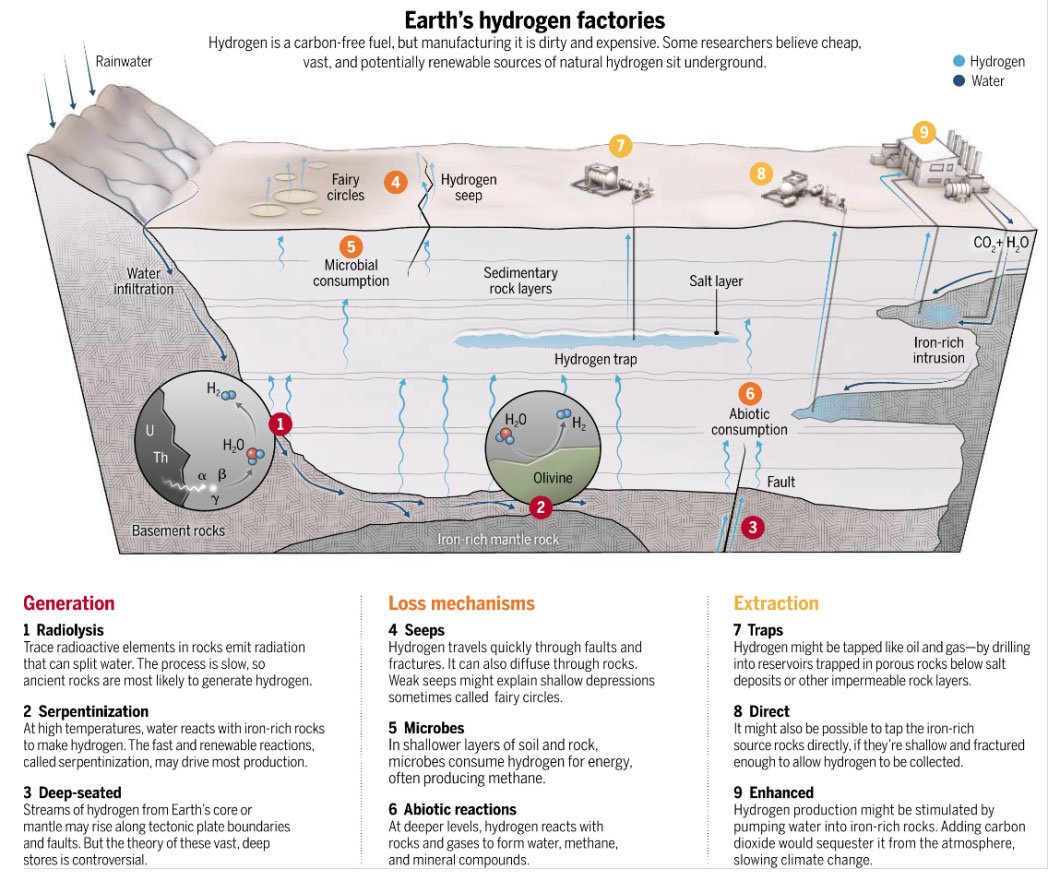
Image source: H2 Mobile, science.org
Renewable vs. Abundant: A Crucial Distinction
Understanding the difference between "renewable" and "abundant" is essential for evaluating the true potential of natural hydrogen. A resource is considered renewable when it regenerates at a rate equal to or greater than its consumption rate, thus allowing sustainable exploitation over the long term [5]. This definition provides a clear framework for analyzing the case of natural hydrogen.
Scientific research indicates that hydrogen regenerates continuously in the Earth's crust through active geological processes. However, regeneration rates vary considerably depending on geological contexts. Some sites could produce a few kilograms of hydrogen per year, while others could generate several tons annually [3]. This variability complicates the assessment of this resource's renewable character.
Comparison with fossil fuels, however, illuminates this question. Hydrocarbons require millions of years to form from organic matter buried and subjected to extreme conditions of temperature and pressure. Natural hydrogen, on the other hand, can form over much shorter time scales thanks to active geochemical processes that operate continuously in the Earth's crust [2]. This fundamental temporal difference directly influences the resource's regeneration capacity.
Scientists nevertheless emphasize that the distinction between "renewable" and "inexhaustible" holds particular importance for natural hydrogen [3]. The generation rate of natural hydrogen and its potential for sustainable extraction remain key scientific uncertainties that require more research. The International Energy Agency (IEA) specifies that hydrogen production must be sustainable and not deplete geological reservoirs faster than they regenerate [2].
A relevant analogy can be drawn with geothermal energy. Like the latter, natural hydrogen depends on active geological processes. Excessive exploitation could locally exceed regeneration, but on a global scale, potential theoretical reserves remain considerable [1]. This comparison helps conceptualize the sustainability issues related to natural hydrogen exploitation.
The Regeneration Mechanisms of Natural Hydrogen
The question of renewability depends directly on understanding the geological processes that produce hydrogen. These natural mechanisms determine the Earth's capacity to regenerate this resource and, consequently, its potentially renewable character.
Serpentinization represents one of the most important processes of natural hydrogen production. This process occurs when water interacts with ultramafic rocks rich in iron and magnesium. The resulting chemical reaction releases hydrogen continuously as long as water and reactive rocks are present. Researchers have demonstrated that serpentinization can continuously generate hydrogen as long as water and reactive rocks remain available [3]. This process remains active for millions of years in certain tectonic zones, particularly at oceanic ridges and subduction zones.
Water radiolysis constitutes a second key mechanism of natural hydrogen production. The natural radioactive decay of elements present in the Earth's crust, mainly uranium, thorium, and potassium, produces radiation that decomposes water molecules and releases hydrogen. The USGS indicates that continuous hydrogen generation through radiolysis provides a stable and predictable source over geological time scales [1]. Unlike serpentinization, which depends on specific geological conditions, radiolysis occurs diffusely, but is highly dependent on local concentration of radioactive elements.
Estimates of global production rates vary considerably depending on the geochemical models used. Recent studies suggest that the global flux of natural hydrogen to the Earth's surface could reach 23 million tons per year [1]. However, these estimates carry large uncertainties related to the complexity of subsurface processes and the lack of empirical data at the global scale.
Natural hydrogen production shows strong geographical variability. Certain regions show significantly higher production rates than others. Oceanic ridge zones, ancient cratons, and active fault zones constitute particularly favorable environments for hydrogen generation [3]. This heterogeneous distribution implies that certain regions of the globe could offer much greater exploitation potential than others.
The case of the Bourakébougou well in Mali provides empirical demonstration of natural hydrogen regeneration. After more than ten years of exploitation to supply a village with electricity, this well continues to produce hydrogen [4]. This observation suggests active reservoir regeneration, although the precise mechanisms and regeneration rates require further study to be fully understood.
Conclusion
Natural hydrogen regenerates continuously through active geological processes such as serpentinization and radiolysis, with estimated fluxes that can reach 23 million tons per year [1]. With potential reserves located between 1 and 10 trillion tons in the Earth's crust [1], this resource could represent a significant contribution to global energy needs over the long term, subject to sustainable exploitation conditions. However, the qualification as "renewable" fundamentally depends on exploitation management: extraction respecting local regeneration rates can be considered sustainable, while excessive exploitation could locally deplete reservoirs.
The question of whether natural hydrogen is renewable cannot therefore receive a simple answer. On a geological scale, production mechanisms are active and continuous. On a human scale, sustainability will depend on exploitation practices and our ability to monitor and manage this resource responsibly. The environmental advantage of natural hydrogen, particularly its potential for very low carbon footprint and reduced water consumption, makes it an attractive option for energy transition.
Follow advances in the field of energy and critical minerals by visiting our blog and following us on LinkedIn. The energy transition is being written today, and each new discovery brings us closer to a more sustainable energy future.
References
[1] U.S. Geological Survey. "USGS Releases First Global Assessment of Natural Hydrogen." USGS Newsroom, 15 octobre 2024, www.usgs.gov/news/national-news-release/us-geological-survey-releases-first-global-assessment-natural-hydrogen.
[2] International Energy Agency. "Hydrogen." IEA Energy System, 2024, www.iea.org/energy-system/low-emission-fuels/hydrogen.
[3] Zgonnik, Viacheslav. "The Occurrence and Geoscience of Natural Hydrogen: A Comprehensive Review." Nature Reviews Earth & Environment, vol. 3, 2022, pp. 393-407, doi:10.1038/s43017-022-00292-1.
[4] Prinzhofer, Alain, et al. "Natural Hydrogen Continuous Emission from Sedimentary Basins: The Example of a Brazilian H₂-Emitting Structure." International Journal of Hydrogen Energy, vol. 44, no. 12, 2019, pp. 5676-5685.
[5] International Renewable Energy Agency. "Renewable Energy: A Key Climate Solution." IRENA Publications, 2024, www.irena.org/publications.
[6] Warwick, Nicola J., et al. "Atmospheric Implications for Increased Hydrogen Use." Nature Climate Change, vol. 13, 2023, pp. 649-651, doi:10.1038/s41558-023-01703-3.
