

How does helium form beneath the Earth's surface?
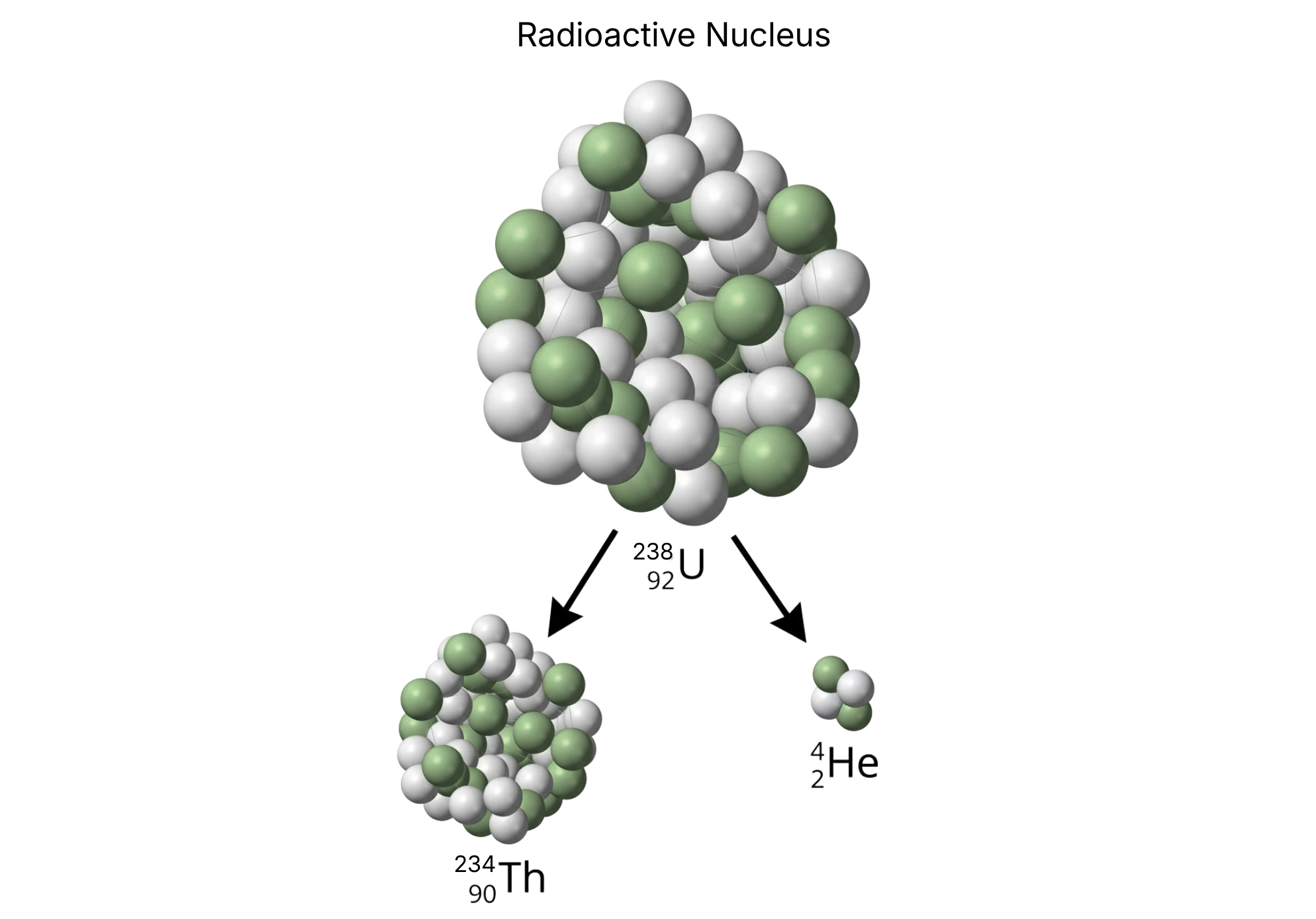
The vast majority of exploitable helium in gas deposits is the result of the radioactive decay of uranium and thorium in the Earth's crust, a process that spans geological timescales.
Although its presence is diffuse on a global scale, helium can reach significant concentrations in certain favorable geological contexts. These accumulations result from a combination of factors, including deep production, migration, and confinement, which allow the formation of exploitable resources when conditions are met.
Understanding its origin is therefore essential for assessing the exploration potential of a territory and for better grasping the role of uranium and thorium, which act as natural helium sources in the subsurface.
Helium in the crust: origin and scarcity
Helium is produced continuously throughout the Earth's crust, but it only reaches exploitable concentrations in certain favorable geological contexts. The formation of a deposit relies on the presence of a sufficient radiogenic source as well as an effective trapping system [1].
This distribution is explained by the physical properties of helium. Due to its very small atomic size, this gas migrates easily through many rocks. Clay formations, although effective at retaining certain gases such as methane, generally do not allow it to be durably confined. On the other hand, very low-permeability rocks, such as rock salt or anhydrite, can act as effective barriers and promote its accumulation. In environments where these conditions are met, helium can thus be preserved and reach concentrations of interest.
To learn more: "Understanding helium: a strategic resource"
Radioactive decay: the driver of helium production
The formation of helium in the subsurface relies on a fundamental process that occurs at the atomic scale and whose effects accumulate over long periods. To understand its origin, it is useful to examine both the microscopic mechanisms at work in rocks and their impact at the scale of geological systems.
Definition : Radioactive decay is the natural process by which an unstable atom, such as uranium or thorium, gradually transforms into a more stable atom by emitting energy and particles. This phenomenon occurs spontaneously and extends over millions to billions of years.
From atom to alpha particle: the physics explained simply
During their decay, several radioactive isotopes play a key role, notably uranium-238 (²³⁸U), uranium-235 (²³⁵U), and thorium-232 (²³²Th). During their transformation, they emit alpha particles, which correspond to helium-4 nuclei (⁴He). These nuclei eventually capture two electrons from the surrounding medium and become stable helium atoms [2].
To illustrate this mechanism, let us take uranium-238 as an example. During its complete decay into lead-206, this isotope emits 8 alpha particles, i.e. 8 helium nuclei, each consisting of two protons and two neutrons [3]. Once expelled from the atomic nucleus during the reaction, this helium nucleus slows down, captures two electrons, and becomes a neutral, stable helium atom. This process, repeated on a very large scale and over long periods, leads to continuous helium production within minerals.
Helium production at the rock scale: slow but cumulative
The amount of helium produced in a rock is directly related to its radioactivity. The more alpha particles a rock emits, the more helium it generates [4]. This rate has moreover been measured with precision: the average local production rate of ⁴He in the crust is estimated at 3.5 ± 1.4 × 10⁻¹³ cm³ STP g⁻¹ rock yr⁻¹ for steady-state production from local uranium and thorium [5]. On a human timescale, this quantity is almost negligible. However, over millions of years and in large volumes of rock rich in uranium and thorium, helium gradually accumulates and can reach significant quantities.
When rocks are fractured, for example under the effect of tectonics or drilling activities, the accumulated helium can be released more rapidly into groundwater. In some cases, these releases can be 300 to 600 times greater than the local production rate [5]. This behavior shows that helium can leave its source rock, migrate through the subsurface, and, when conditions are favorable, accumulate in exploitable reservoirs.
Source rocks: which geologies generate the most helium?
Not all rock types generate the same amount of helium. Ancient granitic and metamorphic formations, naturally enriched in uranium and thorium, constitute the best "factories" of radiogenic helium.
Definition : Felsic rocks (such as granites and gneisses) generally contain more radioactive elements, including uranium and thorium, than mafic or basaltic rocks. They thus constitute the main helium source rocks in the Earth's crust.
The helium present in the Earth's crust is primarily derived from the decay of uranium and thorium. The more a rock contains these elements and the older it is, the more time it has had to produce helium [1]. This explains why Precambrian terrains, hundreds of millions of years old, are often considered areas of interest for helium exploration.
Thus, the rocks with real potential are those that are both ancient and significantly enriched in uranium and thorium. These particular contexts constitute the main helium sources on a geological scale.
Real figures: examples of basins with quantified helium potential
Recent studies conducted on sedimentary basins in China allow these dynamics to be concretely illustrated with quantified data :
In the Ordos Basin, the northern part shows average uranium contents of 2.59 µg/g and thorium contents of 15.20 µg/g in basement rocks, with a helium generation intensity of 0.750 × 10⁻⁶ cm³/(Ma·g). The great thickness of the basement in this region gives it a strong helium generation potential [6].
In the Shixi and Linxing blocks, uranium and thorium contents vary significantly from one sub-block to another, reflecting the natural heterogeneity of the source rocks. The estimated volumes of helium generated amount to 4.92–6.94 × 10⁸ m³ for the Shixi block, and 75.7–110.4 × 10⁸ m³ for the Linxing block [7]. These orders of magnitude illustrate how much generation potential can vary from one region to another depending on the nature of the source rocks.
The same process behind geothermal heat and thorium energy
The radioactive decay of uranium and thorium does not only generate helium. It also produces heat. This often overlooked link establishes a natural convergence between three areas of interest for deep subsurface exploration: helium formation, geothermal energy, and the energy potential of thorium.
Uranium, thorium, and potassium: the three drivers of radiogenic geothermal heat
The decay of these three elements generates a significant amount of heat in the Earth's crust, which can potentially be harnessed for geothermal energy production [9]. Precambrian felsic rocks, enriched in uranium and thorium, constitute the main source of this radiogenic heat in certain geological provinces [9]. In other words, the same geological environments that produce radiogenic helium are also natural candidates for geothermal exploitation. This is a remarkable convergence of interests for anyone involved in deep subsurface exploration.
Thorium: from source rock to energy resource
Beyond its role in helium and heat production, thorium is attracting growing interest as a nuclear fuel. The International Atomic Energy Agency (IAEA) reports increasing enthusiasm among its member states for the use of thorium in advanced nuclear fuel cycles, notably due to its natural availability, physical properties, and proliferation resistance [8].
Among the main advantages of thorium as a fuel, one may note its natural abundance, its improved thermophysical properties compared to uranium oxide, its ability to operate in high conversion ratio cycles, as well as its proliferation resistance characteristics [8]. Moreover, in closed thorium cycles, radioactive decay generates not only helium, but also uranium-233 (²³³U), a fissile fuel that would in principle allow natural fissile resources to be conserved through breeding [8].
Conclusion
The formation of helium in the subsurface is the result of a process as discreet as it is persistent. Uranium-238 alone produces 8 helium nuclei during its complete decay [3], and this mechanism repeats itself, nucleus by nucleus, in considerable volumes of rock, for hundreds of millions of years.
This same process is also at the origin of the geothermal heat produced in the Earth's crust, and thorium, a co-actor in this mechanism, is today being studied as a potential source of low-carbon nuclear energy. These three realities converge within the same geological environment, offering a new perspective on how deep subsurface exploration can be envisioned. Thus, understanding the geological formation of helium illustrates an often overlooked reality: subsurface exploration does not concern just one type of resource at a time.
Deep subsurface exploration, guided by a thorough understanding of geology, is increasingly emerging as a strategic approach for identifying the resources that will power tomorrow's technologies.
Follow Squatex news on LinkedIn to stay informed of advances in energy and critical resource exploration
References
[1] Brown, A.A. "Formation of High Helium Gases: A Guide for Explorationists." Search and Discovery, article 80115, 2010. AAPG, https://www.searchanddiscovery.com/documents/2010/80115brown/ndx_brown .
[2] "(Uranium-Thorium)/Helium Thermochronology – an overview." ScienceDirect Topics, Elsevier, https://www.sciencedirect.com/topics/earth-and-planetary-sciences/uranium-thorium-helium-thermochronology .
[3] International Atomic Energy Agency. Radioactive Decay Data Tables: A Handbook of Decay Data for Application to Radiation Dosimetry and Radiological Assessments. International Atomic Energy Agency, 1989, https://www-pub.iaea.org/MTCD/Publications/PDF/PUB_DOC_488_web.pdf .
[4] Evans, Robley D. "Alpha-Helium Method for Determining Geological Ages." Physical Review, vol. 65, 1944, pp. 216–222. American Physical Society, https://link.aps.org/doi/10.1103/PhysRev.65.216 .
[5] Méjean, Pauline, et al. "Fracturing-Induced Release of Radiogenic ⁴He and ²³⁴U into Groundwater." Water Resources Research, vol. 53, 2017, pp. 5677–5689. Université du Québec à Montréal / AGU, https://archipel.uqam.ca/10472/1/Mejean_et_al_Water_Resources_Research_2017_53_5677-5689.pdf .
[6] "The Characteristics and Helium Generation Potential of Basement Rocks in the Northern Ordos Basin." Frontiers in Earth Science, vol. 13, 2025. Frontiers Media, https://www.frontiersin.org/journals/earth-science/articles/10.3389/feart.2025.1581673/full .
[7] "Effectiveness Assessment and Spatial Distribution of Potential Helium Source Rocks in the Shixi and Linxing Blocks." China Geology and Environment, vol. 53, no. 6, 2025. ResearchCommons, https://cge.researchcommons.org/journal/vol53/iss6/11/ .
[8] International Atomic Energy Agency. "Near Term and Promising Long Term Options for Deployment of Thorium Based Nuclear Energy." IAEA Coordinated Research Project T12026, 2017. IAEA, https://www.iaea.org/projects/crp/t12026 .
[9] "Radiogenic Heat Production (RHP) Over an Area in SE…" GeoConvention 2024 Abstracts, 2024. GeoConvention, https://geoconvention.com/wp-content/uploads/abstracts/2024/104337-radiogenic-heat-production-rhp-over-an-area-in-s.pdf .
