

What Is Cap Rock and Why Is It Important for CO₂ Storage?
Beneath our feet, hundreds or even thousands of meters down, rock formations have held pressurized fluids — oil, natural gas, saline water — in place for millions of years. This natural containment isn't accidental. It relies on a layer of rock with very low permeability that sits above the underground reservoir and prevents fluids from migrating into the layers above or toward sensitive environmental receptors. This is what's known as the caprock.
Today, this geological concept is taking on new importance in the context of the energy transition. The geological storage of industrially captured CO₂, along with the underground storage of hydrogen intended in particular for large-scale renewable energy storage, are among the applications being studied for deep geological formations. Yet the effectiveness and safety of these approaches depend largely on a component that's often overlooked by the public: the quality of the caprock.
Understanding what a caprock is, which rocks can serve this purpose, what properties they need, and how they're assessed helps clarify the geological foundations of underground fluid storage.
What Is a Caprock?
The Geological Definition of a Caprock
To understand the role of a caprock, we first need to revisit an essential geological property: permeability. In geology, permeability refers to a rock's ability to let fluids flow through its pores, microfractures, or internal pathways. A highly permeable rock, such as coarse sandstone, allows water or gas to move relatively freely. A rock with very low permeability, on the other hand, forms a natural barrier that severely restricts this flow.
The definition of a caprock rests directly on this property. It's an underground formation with low permeability, situated above a geological reservoir, that helps prevent fluids such as brine, gas, hydrocarbons, or CO₂ from migrating upward into shallower layers, aquifers, or the surface. [2] It essentially acts as the reservoir's natural seal.
In the context of geological CO₂ storage, the caprock is the low-permeability layer that covers the storage formation. Its job is to keep the CO₂ confined within the reservoir, whether in dense or vapor phase, reducing the risk of migration into shallower strata or sensitive environments.
Another important concept is seal capacity. This refers to the maximum height of a CO₂ column a caprock can hold back before the pressure generated by the fluid's buoyancy exceeds the capillary entry pressure. Once that threshold is crossed, CO₂ can begin entering the pores of the rock and migrating through the seal. [3] In other words, even an extremely low-permeability rock has a physical limit: if the applied pressure grows too high, containment can fail.
The Caprock's Role in a Geological Storage System
A geological storage system isn't just a cavity in the subsurface. To keep injected fluids confined, it typically relies on several complementary components:
a porous, permeable formation, which serves as the reservoir holding the CO₂, hydrogen, or other fluids;
a caprock with very low permeability, acting as a barrier to vertical fluid migration;
in some cases, a secondary reservoir and a secondary seal, which can help trap CO₂ if the primary seal loses some of its effectiveness. [1]
To picture how this works, imagine the geological reservoir as a porous rock volume filled with fluid. The caprock then acts as a sealing layer sitting on top. Without this barrier, injected fluids would tend to rise due to buoyancy, especially when they're less dense than the water present in deep formations.
A caprock therefore needs more than just low permeability at the time of initial assessment. It must also maintain its integrity over time, despite interactions between CO₂, brine, and the rock's minerals. It must likewise withstand pressure changes and shifts in the mechanical stress field that can occur during and after fluid injection. [1]
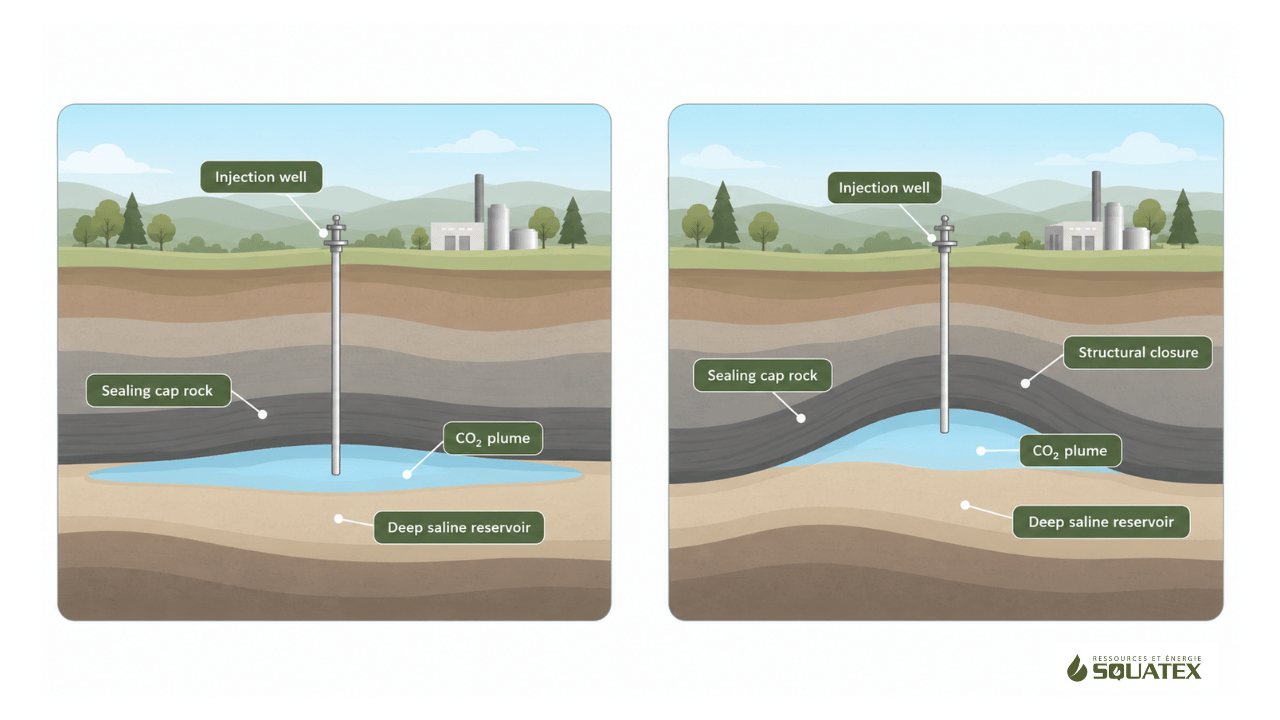
Figure 1: CO₂ storage beneath cap rock in a deep saline aquifer
What Types of Rock Can Serve as a Caprock?
The Main Families of Caprocks
Not all rocks are equally suited to confining pressurized fluids. The most effective caprocks generally belong to two broad families: mudrocks (argillites) and evaporites. These two types make up the main regional seals for natural oil and gas reservoirs, as well as for commercial gas storage sites in saline aquifers. [2]
A few definitions help distinguish these rock families:
Argillites and mudstones are fine-grained sedimentary rocks made up mainly of clay minerals and silts. Their low permeability strongly restricts fluid movement.
Shales are also fine-grained sedimentary rocks, often rich in clay minerals, and can contain organic matter. In the context of underground hydrogen storage, they're among the most commonly studied caprocks for their potential confining role. [5]
Evaporites form through the gradual evaporation of saline waters over long geological timescales. They include halite (rock salt) and anhydrite. Their extremely low permeability makes them particularly effective natural barriers.
Other lithologies can also act as barriers when their permeability is low enough. Confining intervals can include shales, anhydrites, coals, salts, or other minerals capable of limiting vertical CO₂ migration, as long as pressures stay below the fracture pressure or the capillary entry pressure. [3] Evaporites can also include fine-grained lithologies cemented by chlorides, sulfates, or carbonates, such as calcite and dolomite. [2]
That said, it's worth avoiding judging a caprock purely by its rock type. For instance, some carbon-rich shales, despite high organic carbon content, may fail to form effective membrane or capillary seals for CO₂ because of their particular wettability characteristics. [3] The quality of a geological seal ultimately depends on physical, capillary, geochemical, and mechanical properties specific to the site being studied.
Table 1: Main Types of Caprocks and Their General Characteristics
| Rock Type | Main Composition | Impermeability | Example Minerals |
|---|---|---|---|
| Argillites / Mudstones | Clays, fine silts | Very high | Illite, smectite, kaolinite |
| Shales | Clay + organic matter | High | Clay + kerogen |
| Halite (rock salt) | Sodium chloride | Extremely high | NaCl |
| Anhydrite | Calcium sulfate | Very high | CaSO₄ |
| Cemented carbonates | Calcite, dolomite | Variable | CaCO₃, CaMg(CO₃)₂ |
Sources: [2], [3], [5]
What Properties Should a Caprock Have?
Permeability and Capillary Pressure: The Two Fundamental Criteria
Assessing the quality of a caprock mainly comes down to two properties: permeability, which governs fluid flow, and capillary pressure, which affects a fluid's ability to enter the seal.
Permeability measures how easily a rock lets fluids move through its pores and internal pathways. The lower it is, the more effectively the rock restricts the migration of CO₂, hydrogen, or other stored fluids.
Capillary pressure, meanwhile, is the pressure needed for an injected fluid, like CO₂, to displace the formation water naturally present in the seal's pores. [3] The higher this pressure, the more resistant the rock is to fluid intrusion. Think of it like pushing air through a water-saturated sponge: a certain amount of pressure is required to push out the water that's already there.
In practice, several parameters help evaluate caprock quality:
very low permeability, ideally in the nanodarcy range for good petroleum seals;
a high threshold pressure, which limits gas entry into the seal's pores;
very fine pore throats, which reduce a fluid's ability to pass through the rock;
favorable wettability, which influences how CO₂, water, and minerals interact;
high tortuosity, especially important for underground hydrogen storage, since it makes the migration path more convoluted.
Table 2: Factors Influencing a Caprock's Sealing Capacity
| Criterion | Role in Evaluating a Caprock | Key Fact to Remember |
|---|---|---|
| Permeability | Measures how easily the rock lets fluids flow through it | Good petroleum seals can have permeability below 10 nD² |
| Threshold pressure | Indicates the pressure needed for gas to begin entering the seal | A threshold pressure above 7 MPa is associated with good petroleum seals² |
| Pore throat size | Directly affects the seal's containment capacity | Pore sizes below 15 nm are cited for some excellent seals² |
| Interfacial tension and wettability | Determine how CO₂, water, and rock interact within the pores | These factors directly influence capillary entry pressure³ |
| Tortuosity | Makes the fluid's path longer and more complex through the rock | High tortuosity can improve hydrogen containment capacity⁶ |
For geological CO₂ storage, these criteria help determine whether a caprock can retain the injected fluid without exceeding capillary entry pressures or conditions that could fracture the seal. A reservoir sandstone can have far greater permeability than an effective caprock, which explains why the contrast between reservoir and seal matters so much.
For underground hydrogen storage, evaluation needs to pay especially close attention to the pore network's properties. Pores smaller than 1 nm, high tortuosity, and certain pressure conditions can all improve a caprock's ability to limit hydrogen migration. [6] Since the hydrogen molecule is so small, its containment depends heavily on site-specific characteristics, which is why dedicated analysis is needed before any storage project moves forward.
The Role of Caprocks in Storage Durability
Evaluating a caprock has to account for the long timescales involved in geological CO₂ storage. According to climate models, a residence time of at least 10,000 years would be needed to keep injected CO₂ from reentering the atmosphere-ocean system. [2] This requirement underscores just how central a reliable geological seal is to long-term storage durability.
Several conditions are generally sought to support effective confinement:
storing CO₂ in its supercritical state, meaning above 31°C and 7.4 MPa [2];
a sufficiently thick caprock, with a thickness of around 30 m considered preferable to reduce the risk that small fractures could compromise the seal [2];
an injection pressure suited to the mechanical properties of both the reservoir and the seal;
detailed characterization of faults, fractures, and structural discontinuities [4].
Faults and fractures within a caprock formation are among the elements that need careful characterization, since they can influence fluid migration pathways. [4] Analyzing them helps build a better understanding of the geological system's behavior and supports the design, monitoring, and long-term management of carbon capture and storage projects.
The overall storage potential remains considerable. Depleted oil and gas reservoirs are estimated to offer a sequestration capacity of between 400 and 900 gigatonnes of CO₂. [1] That potential, however, depends on reservoir quality, caprock integrity, and the conditions specific to each site.
Underground hydrogen storage is also drawing growing interest, particularly in depleted gas reservoirs. This option is being explored as a possible solution to support large-scale renewable energy storage. [7] As with CO₂, its development hinges on a solid understanding of the reservoir, the geological seal, geochemical reactions, and the subsurface's mechanical behavior.
Conclusion
The caprock is an essential piece of underground storage. Its low permeability, sealing capacity, and long-term stability all help keep CO₂, hydrogen, or other fluids confined within deep geological formations.
That said, evaluating a caprock needs to fit into a broader analysis that includes the reservoir, injection pressures, faults, geochemical reactions, and site-specific conditions. Understanding the subsurface this way makes it easier to appreciate the potential of geological storage in the energy transition.
Caprocks are a good reminder that the success of these projects depends just as much on the seal's quality as on the reservoir's capacity to hold fluids over time.
Follow Squatex on LinkedIn to stay up to date on the latest developments in renewable energy exploration and natural resources.
References
[1] Adu-Gyamfi, Benjamin, et al. “Assessment of Chemo-Mechanical Impacts of CO₂ Sequestration on the Caprock Formation in Farnsworth Oil Field, Texas.” Scientific Reports, vol. 12, 2022, article 13023. https://doi.org/10.1038/s41598-022-16990-x.
[2] Springer, Niels, et al. Capture, Storage and Use of CO₂ (CCUS): Seal Capacity and Geochemical Modelling. GEUS Rapport 2020/30, Geological Survey of Denmark and Greenland, 2020. https://data.geus.dk/pure-pdf/GEUS-R_2020_30_web.pdf.
[3] IEAGHG. Caprock Systems for CO₂ Geological Storage. Technical Report 2011/01, IEA Greenhouse Gas R&D Programme, 2011. https://publications.ieaghg.org/technicalreports/2011-01 Caprock Systems for CO2 Geological Storage.pdf.
[4] Zappone, Alba, et al. “Fault Sealing and Caprock Integrity for CO₂ Storage: An In Situ Injection Experiment.” Solid Earth, vol. 12, 2021, pp. 319–343. https://doi.org/10.5194/se-12-319-2021.
[5] Bahar, Mohammad, and Reza Rezaee. “Impact of Hydrogen Solubility on Depleted Gas Field’s Caprock: An Application for Underground Hydrogen Storage.” The APPEA Journal, vol. 61, no. 2, 2021, pp. 366–370. https://doi.org/10.1071/AJ20161.
[6] Alafnan, Saad. “Assessing Leakage Risks of Hydrogen through Aquifers and Caprocks.” Energy & Fuels, vol. 38, no. 20, 2024, pp. 19739–19747. https://doi.org/10.1021/acs.energyfuels.4c03228.
[7] Zeng, Lingping, et al. “Role of Geochemical Reactions on Caprock Integrity during Underground Hydrogen Storage.” Journal of Energy Storage, vol. 65, 2023, article 107414. https://doi.org/10.1016/j.est.2023.107414.
