

Reducing global CO₂ emissions depends largely on transforming the energy system. However, a significant portion of industrial emissions does not come from energy combustion, but from chemical reactions inherent to production processes.
Energy production and use account for 75.7% of global emissions [3]. A non-negligible share of emissions nevertheless comes from sectors where decarbonisation is more complex. In industries such as cement, steel, or chemicals, a portion of CO₂ is generated directly by manufacturing processes, regardless of the energy source used. These so-called process emissions cannot therefore be eliminated through electrification or fuel substitution alone.
In this context, CCUS (carbon capture, utilisation and storage) emerges as a promising complementary solution to reduce these unavoidable emissions.
A portrait of global emissions: who are the biggest emitters?
The term "energy sector" here refers not only to electricity and heat production, but also to transport, manufacturing and construction, as well as buildings. In other words, all activities that consume fossil fuels to produce energy are grouped under this category. With this definition in mind, the broad outlines of global emissions become clear.
The five major emitting sectors identified are as follows:
Energy (electricity and heat production, transport, manufacturing and construction, buildings) dominates overwhelmingly with 75.7% of global greenhouse gas emissions. Within this sector, electricity and heat production alone accounts for 29.7% of total global emissions, followed by transport (13.7%), manufacturing and construction (12.7%), and buildings (6.6%) [3].
Agriculture ranks second with 11.7% of global emissions, mainly due to methane emissions from livestock and nitrous oxide emissions associated with fertilisers [3].
Industrial processes (chemicals, cement and others, excluding energy consumption) account for 6.5% of total emissions. This is a share that may seem modest in relative terms, but whose nature makes reduction particularly complex [3].
Waste accounts for 3.4% of global emissions, mainly through methane from landfill sites and wastewater treatment [3].
LULUCF (land use, land-use change and forestry), which includes deforestation and ecosystem degradation, contributes 2.7% (net value) [3].
Regarding the nature of the gases emitted, CO₂ represents 74% of all greenhouse gases, and among these CO₂ emissions, 92% come from the use of fossil fuels [3]. This is why the decarbonisation of the energy sector in the broad sense is at the heart of most climate strategies.
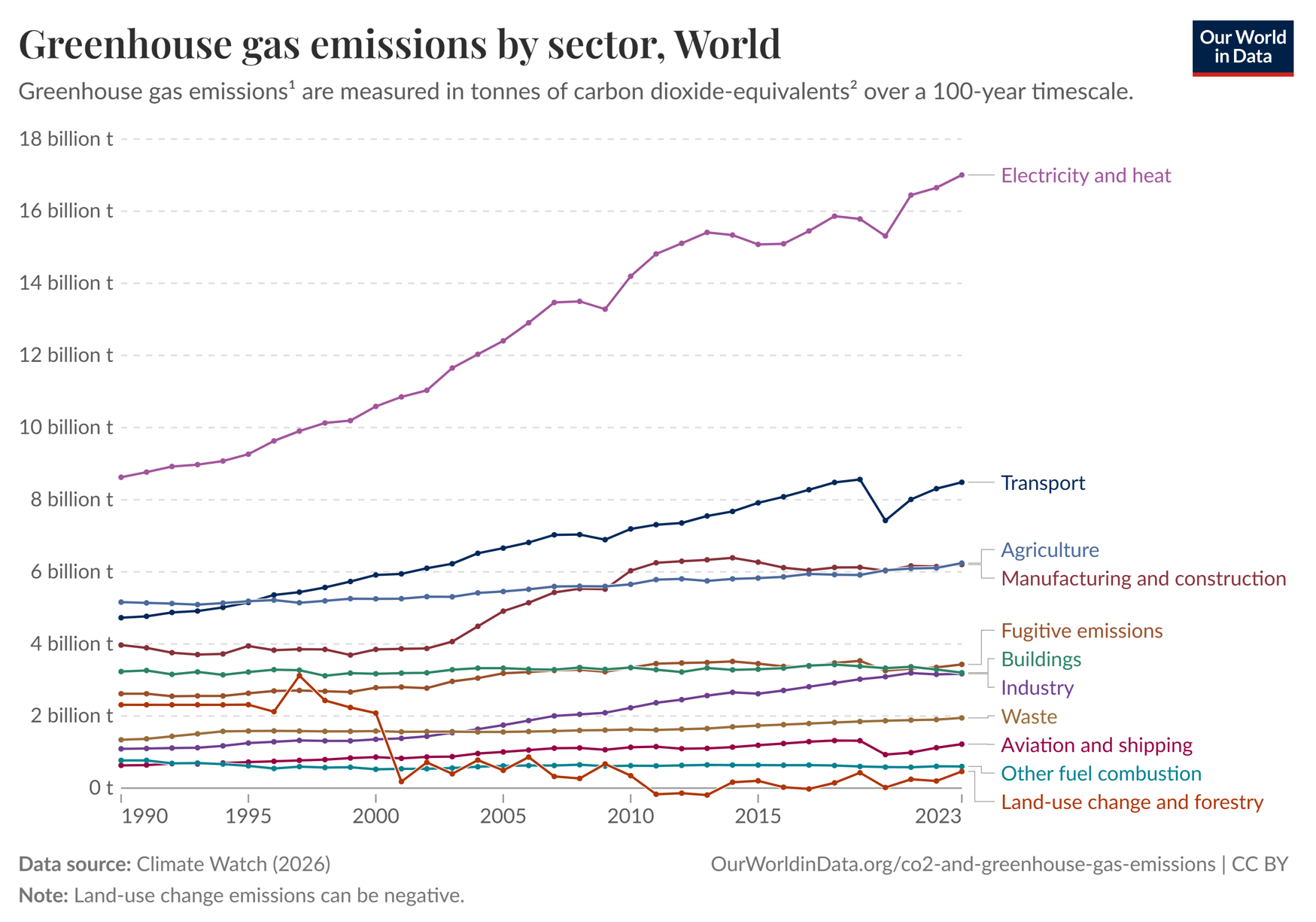
Figure 1: Breakdown of global GHGs by sector (electricity and heat, transport, manufacturing and construction, agriculture, buildings, waste). Source : Our World in Data
The worrying growth of industrial processes
Beyond the current weight of each sector, trends over time reveal a trajectory worth noting on the industrial side. Since 1990, industrial processes have been the fastest-growing source of emissions, with an increase of 225%, far ahead of electricity and heat production (+88%), transport (+66%), and manufacturing and construction (+60%) [3].
This trajectory is largely explained by global economic growth and the accelerated urbanisation of developing countries, which strongly drive demand for cement, steel and chemical products [1]. As a result, industry in the broad sense today accounts for nearly a quarter of CO₂ emissions from combustion and industrial processes, and absorbs 40% of global energy demand [1].
What is CCUS?
CCUS (Carbon Capture, Utilisation and Storage) refers to a set of technologies aimed at capturing CO₂ directly at the source of emission, particularly at industrial chimneys or power plants, and then transporting it for permanent storage in underground geological formations or for reuse in industrial processes.
Geological storage is described by the International Energy Agency (IEA) as a proven method for permanently isolating captured CO₂ from the atmosphere [2]. In practice, this means the gas is injected into porous rocks at great depth, where it remains trapped over the long term.
From an operational standpoint, the global infrastructure is still in its early stages, but it is progressing:
To date, 7 dedicated commercial sites for CO₂ storage are in operation worldwide, injecting approximately 10 Mt of CO₂ per year, and more than 100 other sites are under development [2].
Furthermore, 16 large industrial-scale CCUS facilities are already active and capture more than 30 Mt of CO₂ per year in sectors such as ammonia production, steel and hydrogen [1].
These figures show that CCUS is no longer at the experimental stage: it is already deployed in real industrial contexts, even if its large-scale development remains to be built.
One of the pillars of industrial CO₂ reduction
Since a quarter of industrial emissions come from unavoidable chemical reactions, simply substituting fuels is not enough. Process emissions are CO₂ emissions generated by chemical or physical reactions inherent to the manufacture of a material, and not by the combustion of a fuel. They therefore cannot be eliminated by replacing natural gas with green electricity, for example.
Several structural constraints explain why CCUS imposes itself as a complementary solution in this context:
A quarter of global industrial emissions are process emissions resulting from chemical or physical reactions and therefore cannot be avoided by changing energy source, representing nearly 2 GtCO₂ [1].
One third of industrial energy demand is used to produce very high-temperature heat, for which alternatives to fossil fuels are still few and not yet mature in the short term [1].
Industrial facilities have a lifespan of up to 50 years, which can lock in emissions for several decades, making any technological transition particularly slow [1].
In this context, the IEA estimates that CCUS can contribute to nearly one fifth (approximately 20%) of the emission reductions needed across the entire industrial sector [1]. In absolute terms, the IEA scenario aligned with the Paris Agreement projects more than 28 GtCO₂ captured from the industrial sector by 2060, with the vast majority coming from cement, steel and chemicals [1].
Sectoral contributions of CCUS: cement, steel and chemicals
Sector-by-sector analysis helps to understand where CCUS can have the most significant impact, and why it sometimes represents the most relevant solution available.
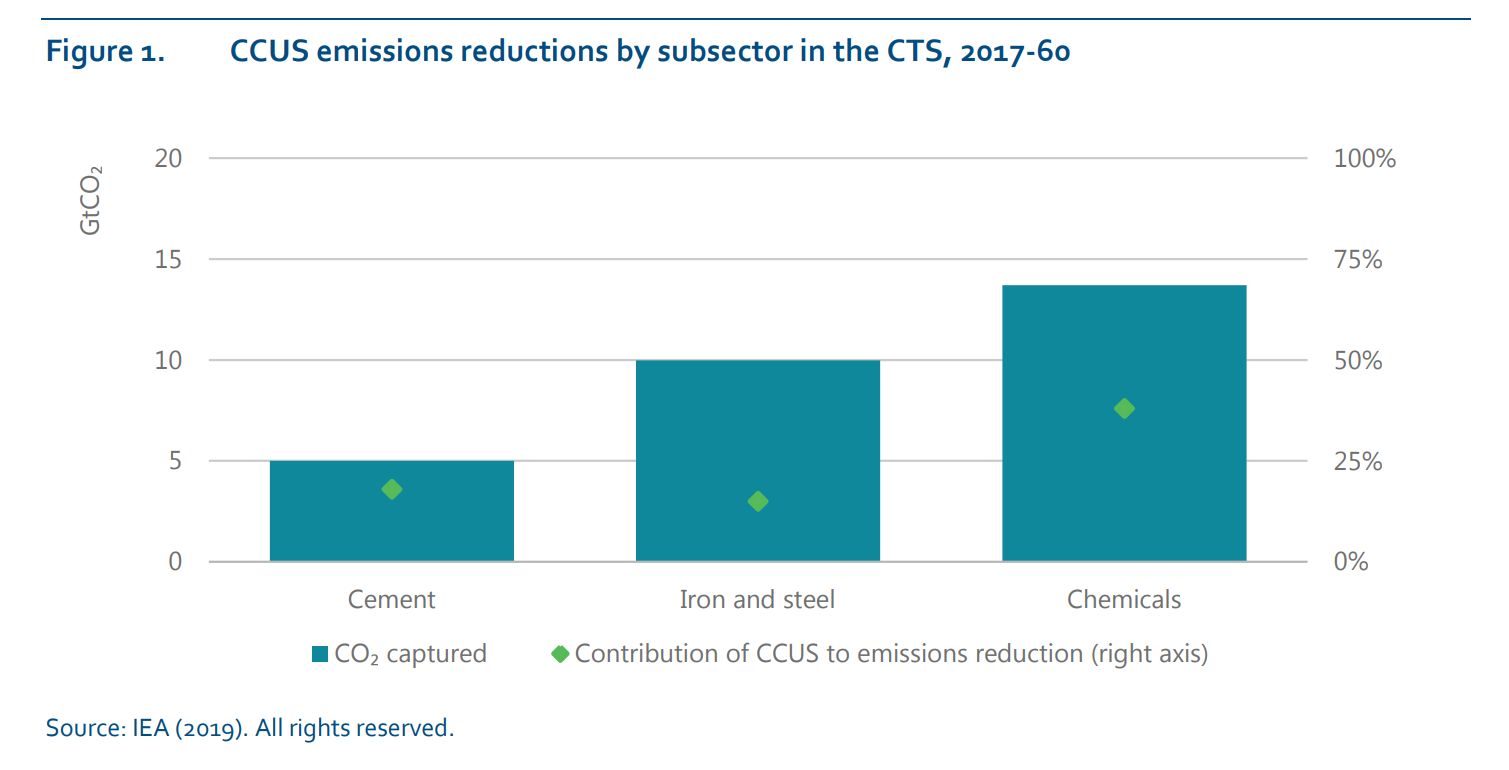
Figure 2: CCUS-related emission reductions by sub-sector in the Clean Technology Scenario (CTS), 2017–2060. Source: IEA
Cement
The cement sector illustrates well the problem of process emissions. Its manufacture relies on the calcination of limestone, a chemical reaction that releases CO₂ regardless of the energy source used. This reaction accounts for 65% of the sector's emissions [1]. This is why CCUS plays an important role in its decarbonisation, contributing to 15% of emission reductions in this sector between 2017 and 2060 in the IEA's Paris Agreement scenario, with cumulative capture estimated at approximately 5 GtCO₂ [1].
Steel and iron
Primary steelmaking relies on blast furnaces that use coke as a reducing agent, generating CO₂ emissions that are difficult to substitute in the short term. This explains why CCUS also contributes to 15% of emission reductions in the steel sector in the same scenario [1]. Cumulative capture in steel by 2060 is estimated at approximately 10 GtCO₂, nearly double that of cement, as production volumes are higher [1].
Chemicals and petrochemicals
It is in the chemicals sector that CCUS plays its most decisive role: it accounts for 38% of emission reductions in the sector, making it the most important lever for the decarbonisation of chemicals according to the IEA [1]. This position is explained by the diversity and complexity of chemical processes, which often generate relatively concentrated CO₂ streams, particularly in the production of ammonia or hydrogen from fossil fuels, which technically facilitates capture.
A technology already competitive in certain contexts
Beyond its future role, CCUS already presents concrete economic advantages today, particularly in sectors where CO₂ streams are naturally concentrated and therefore easier to capture.
In certain industrial processes, including ammonia production, hydrogen manufacturing from fossil fuels and natural gas processing, CCUS can be deployed at a cost as low as 15 to 25 USD per tonne of CO₂ [1].
Scale-up is already underway: in the IEA scenario, industrial capture will reach 0.3 GtCO₂ per year by 2030, then 1.3 GtCO₂ per year by 2060 [1].
If CCUS were excluded from decarbonisation strategies, the marginal abatement cost for industry in 2060 would double compared to the scenario that includes it [1]. This underlines its importance not only from an environmental standpoint, but also an economic one.
CCUS within a portfolio of solutions: complementarity, not exclusivity
This implies that CCUS is not a standalone solution. It is part of a set of complementary approaches, alongside other decarbonisation levers.
The so-called hard-to-abate sectors — industries whose CO₂ emissions are difficult to eliminate through electrification or renewable energy alone (due to very high-temperature thermal processes or unavoidable chemical reactions) — include cement, steel, chemicals, heavy transport, maritime shipping and aviation.
For these industries, a diversified portfolio of solutions is necessary [1]:
CCUS to capture emissions that cannot be avoided by other means, particularly process emissions.
Low-carbon hydrogen as a substitute energy carrier for high-temperature processes, where direct electrification is not yet feasible.
Energy efficiency to reduce energy consumption volumes and, consequently, associated emissions.
Electrification, where technologies allow it and renewable energy sources are available.
The role of CCUS in the energy transition
The energy sector in the broad sense concentrates the bulk of global emissions, but a significant share of industrial emissions remains particularly difficult to eliminate. Arising from chemical processes intrinsic to the production of materials such as cement, steel or chemicals, this component escapes the conventional strategies based on energy substitution.
In this context, CCUS establishes itself as an essential complementary lever, capable of addressing these unavoidable emissions and contributing significantly to industrial decarbonisation efforts. Its large-scale deployment depends, however, on the development of appropriate infrastructure, particularly with regard to the transport and geological storage of CO₂.
As storage needs grow, knowledge of the subsurface becomes a strategic issue. Geological formations are no longer merely resources to be exploited, but also solutions to be mobilised in the transition towards a low-carbon economy.
To stay informed of the latest news on the energy transition and low-carbon technologies, follow Squatex on LinkedIn.
References
[1] International Energy Agency (IEA). Transforming Industry through CCUS. IEA, May 2019. https://iea.blob.core.windows.net/assets/0d0b4984-f391-44f9-854f-fda1ebf8d8df/Transforming_Industry_through_CCUS.pdf
[2] International Energy Agency (IEA). CO2 Storage Resources and their Development — An IEA CCUS Handbook. IEA, 2022. https://iea.blob.core.windows.net/assets/42d294af-ce07-44c7-9c96-166f855088e8/CO2storageresourcesandtheirdevelopment-AnIEACCUSHandbook.pdf
[3] Ge, Mengpin, Johannes Friedrich and Leandro Vigna. "Where Do Emissions Come From? 4 Charts Explain Greenhouse Gas Emissions by Sector." World Resources Institute, December 2024. https://www.wri.org/insights/4-charts-explain-greenhouse-gas-emissions-countries-and-sectors
