

Building cooling represents a growing energy challenge. As temperatures rise and demand for air conditioning increases, maintaining comfortable indoor spaces can require significant amounts of electricity. This growing demand is driving research into more energy-efficient cooling solutions.
Among these solutions, geocooling takes advantage of a natural property of the ground: its relatively stable temperature throughout the year. This application of shallow geothermal energy allows heat to be transferred from a building to the ground or groundwater, while reducing reliance on mechanical cooling systems [1]. It relies on heat exchange processes whose efficiency depends, among other factors, on subsurface characteristics and the building's cooling needs.
Geocooling: Using the Ground's Natural Temperature to Cool Buildings
What Is Geocooling?
Geocooling is a cooling technique that uses heat exchange with the ground or groundwater to remove heat from a building. Rather than relying primarily on a refrigeration system, it uses naturally cooler subsurface temperatures to cool a fluid circulating through the installation [1].
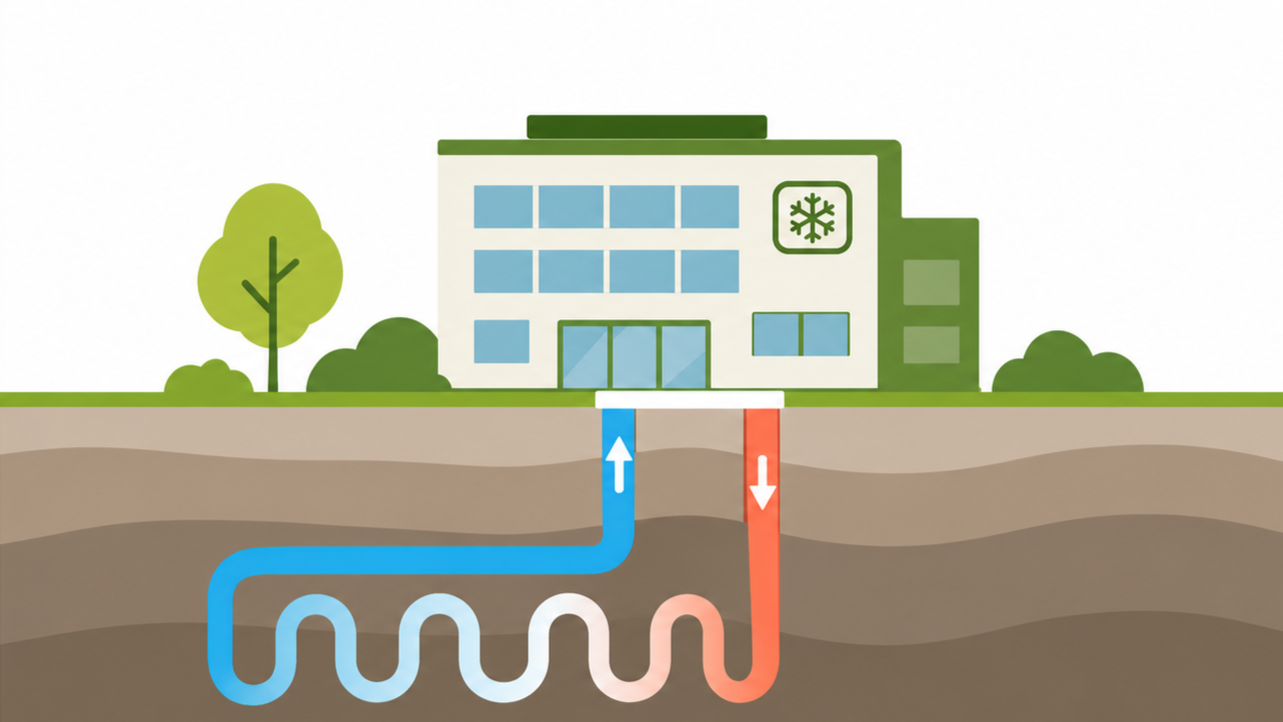
The principle is based on heat transfer: when a building is warmer than the underground environment to which it is connected, heat can be transferred to that environment. The ground then acts as a heat sink.
Geocooling is generally associated with passive cooling, also known as free cooling. In this configuration, the compressor of a geothermal heat pump is not used for cooling. Heat exchange occurs primarily through the circulation of fluids between the building and the underground heat exchange system [1].
This technique is an application of shallow geothermal energy, which uses the thermal properties of the near-surface ground to meet heating or cooling needs. Unlike geothermal applications that generate electricity from high-temperature resources, geocooling relies on relatively modest temperature differences.
Why Does the Ground Remain Cooler in Summer?
Ground temperature changes differently from air temperature. Near the surface, it responds to weather conditions and seasonal variations. At greater depths, these fluctuations gradually diminish, allowing the ground to maintain a relatively stable temperature throughout the year [2].
This stability is partly explained by the thermal inertia of the ground. Rocks and sediments store heat and transfer it gradually. In shallow layers, temperature is primarily influenced by long-term climatic conditions and solar radiation. At greater depths, it is also affected by the geothermal gradient, which describes the natural increase in temperature with depth [2].
In summer, when a fluid circulating through buried pipes is warmer than the surrounding ground, it releases some of its heat into the terrain. This heat transfer allows the subsurface to contribute to building cooling. Its effectiveness depends on several factors, including the depth of the heat exchangers, the thermal properties of the ground and the amount of heat that needs to be removed [2].
How Does a Geocooling System Work?
A geocooling system connects a building's cooling equipment to an underground heat exchanger. Heat is transferred from indoor spaces to the ground through one or more hydraulic circuits.
The Path of Heat from the Building to the Ground
The system relies on several components that enable fluid circulation and heat exchange:
The indoor circuit: collects heat from the building through compatible equipment, such as radiant floor cooling or a suitable distribution system.
The heat exchanger: transfers heat from the indoor circuit to the circuit connected to the ground, generally without mixing the fluids.
The geothermal circuit: a heat transfer fluid circulates through buried pipes or a suitable heat exchange system to release heat into the ground.
The circulation pumps: ensure the movement of fluids between the various components of the installation.
During passive cooling, the compressor remains switched off. However, the system still requires electricity to operate circulation pumps, hydraulic pumps and certain auxiliary equipment [1][3].
Passive Geocooling and Active Geothermal Cooling: What Is the Difference?
Geothermal systems can provide cooling in two main ways.
In passive mode, heat is transferred directly to the ground through fluid circulation and heat exchangers. If the installation includes a heat pump, it can be bypassed during cooling.
In active mode, a heat pump uses its compressor to cool the building. The extracted heat is then discharged into the ground. This configuration can meet cooling needs that may not be fully satisfied through direct heat exchange alone [3].
Table 1: Differences between passive geocooling and active geothermal cooling
| Feature | Passive geocooling | Active geothermal cooling |
|---|---|---|
| Role of the ground | Directly absorbs heat from the building | Absorbs heat rejected by the heat pump |
| Compressor | Generally switched off | In operation |
| Main electricity requirements | Circulation pumps and auxiliary equipment | Compressor, pumps and auxiliary equipment |
| Operating conditions | Sufficiently favourable ground temperature | Cooling assisted by a thermodynamic cycle |
Sources: BRGM [1] and Natural Resources Canada [3].
Both approaches use the thermal properties of the ground, but their electricity consumption and operating conditions differ.
How Energy-Efficient Is Geocooling?
The main energy advantage of geocooling lies in its ability to limit the operation of compression systems during periods when the ground can directly absorb heat from the building.
Why Does Geocooling Use Less Electricity?
In an active refrigeration system, the compressor consumes electricity to provide cooling. Passive geocooling eliminates this step when thermal conditions are favourable.
Electricity is still needed to circulate fluids, but consumption can be significantly lower than that of a system requiring continuous compressor operation [1].
One indicator used to assess this efficiency is the Energy Efficiency Ratio (EER). It relates the cooling energy provided to the electricity consumed by the system, depending on the scope of measurement [3][4].
The higher this ratio, the greater the cooling output relative to the amount of electricity consumed.
What Do the Figures Reveal About Actual Performance?
The performance of geocooling has been documented across various types of buildings, from residential properties to industrial and IT facilities. Some installations make it possible to quantify energy savings compared with conventional cooling systems.
An Office and Data Centre Complex in Germany
In Munich, Germany, the BMW-FIZ Research and Innovation Centre has been using a passive groundwater-based geocooling system since 2004. Naturally cool water is supplied from underground metro infrastructure to cool buildings and IT equipment before being reinjected into the ground. Conventional refrigeration equipment supplements the installation when demand exceeds its direct cooling capacity [2][4].
According to a study published in 2024, this installation achieved the following results:
90% savings in primary energy compared with an entirely conventional cooling system [2].
Approximately 10 GWh in annual electricity savings [2].
Measured Performance in a Residential Building in Switzerland
In Lugano, Switzerland, a residential building comprising 46 apartments uses a geocooling system connected to 13 borehole heat exchangers, each 200 metres deep. During summer, heat from the apartments is transferred to the ground without operating the heat pump compressors [5].
A scientific study published in 2021 analysed the actual performance of this installation over 40 months, between 2016 and 2019 [5]. The results show:
- A monthly energy efficiency ratio ranging from 12 to 30, corresponding to 12 to 30 kWh of cooling per kWh of electricity consumed by the circulation pumps [5].
- A maximum efficiency ratio of 30, measured in August 2018 following improvements to the system's controls [5].
This study illustrates the performance that geocooling can achieve under real-world conditions, while highlighting the influence of system settings and operating conditions on its efficiency.
How Can Geocooling Contribute to Low-Carbon Cooling?
Passive geocooling can provide a cooling solution with a low operational carbon footprint. By using the ground directly to remove heat, it reduces the amount of electricity required for cooling, particularly by avoiding compressor operation. Lower energy requirements can also help reduce associated greenhouse gas emissions [1][2].
However, geocooling is not entirely emissions-free. Its overall carbon footprint depends on several factors, including the source of electricity, equipment manufacturing, installation work and the system's lifespan.
What Types of Buildings Can Use Geocooling?
Geocooling can meet the cooling needs of various types of buildings, provided their thermal characteristics and subsurface conditions are suitable. Its applications range from individual installations to networks serving multiple buildings.
From Residential Buildings to Institutional Facilities
Geothermal cooling can be used in various settings, including:
Residential buildings: single-family homes and apartment buildings [3][5].
Commercial and institutional buildings: offices, schools, hospitals and other facilities requiring temperature regulation [2][4].
Shared thermal energy networks: building complexes or neighbourhoods sharing underground heating and cooling infrastructure [2].
Some installations also use energy foundations, which incorporate heat exchangers into structural elements such as foundation piles or underground walls. This approach integrates geothermal heat exchange directly into the building's infrastructure [2].
Data Centres: A Growing Need for Cooling
Data centres represent a particularly relevant application for underground cooling. Their servers and IT equipment continuously generate heat, which must be removed to maintain suitable operating conditions [6].
According to the International Energy Agency (IEA), cooling and environmental control accounted for approximately 7% of electricity consumption in efficient hyperscale data centres in 2024, compared with more than 30% in some less efficient enterprise data centres [7].
These requirements come amid the continued expansion of digital infrastructure. According to the IEA's central projections published in 2026, global data centre electricity consumption across all uses could increase from 485 TWh in 2025 to 950 TWh in 2030 [8].
In this context, geocooling and underground thermal energy storage (UTES) are among the solutions being explored to reduce electricity requirements for cooling. Their integration depends on several factors, including geological conditions, the ground's heat exchange capacity and the management of heat rejected throughout the year [2][6].
Conclusion
Geocooling relies on a physical property of the ground: its relatively stable temperature can help remove some of the heat accumulated in buildings. In passive mode, this transfer occurs without operating a heat pump compressor, which can significantly reduce electricity requirements.
Field measurements demonstrate promising energy performance, although the significance of these results depends on the specific conditions of each installation. Ground temperature, thermal properties, equipment and cooling demand profiles all influence the performance that can be achieved.
This application of shallow geothermal energy is relevant to both residential buildings and certain shared infrastructure systems. The growing cooling needs of data centres are also creating new research opportunities in underground heat exchange and thermal energy storage.
Geological characterization remains central to these applications: understanding subsurface properties helps determine the conditions under which the ground can contribute to meeting the energy needs of buildings.
References
[1]: Bureau de recherches géologiques et minières (BRGM). "Refroidissement et rafraîchissement : un atout avec ou sans pompe à chaleur géothermique." Les géothermies, s. d., https://www.geothermies.fr/refroidissement-et-rafraichissement-un-atout-avec-ou-sans-pompe-chaleur-geothermique.
[2]: Figueira, João S., et al. "Shallow Geothermal Energy Systems for District Heating and Cooling Networks: Review and Technological Progression through Case Studies." Renewable Energy, vol. 236, December 2024, article 121436, https://doi.org/10.1016/j.renene.2024.121436.
[3]: Natural Resources Canada. "Heating and Cooling with a Heat Pump." Government of Canada, 24 December 2025, https://natural-resources.canada.ca/energy-efficiency/energy-star/heating-cooling-heat-pump.
[4]: Stadtwerke München. "Fernkälte: das Klimatisierungssystem der Zukunft." SWM, s. d., https://www.swm.de/geschaeftskunden/fernkaelte.
[5]: Belliardi, Marco, et al. "A Method to Analyze the Performance of Geocooling Systems with Borehole Heat Exchangers. Results in a Monitored Residential Building in Southern Alps." Energies, vol. 14, no. 21, 7 November 2021, article 7407, https://doi.org/10.3390/en14217407.
[6]: Pandey, Upasana, et al. "Aquifer Thermal Energy Storage: Groundwater for Efficient Data Center Cooling in the United States." Groundwater, vol. 64, no. 4, July–August 2026, pp. 394–404, https://doi.org/10.1111/gwat.70084.
[7]: International Energy Agency. "Energy Demand from AI." Energy and AI, 10 April 2025, https://www.iea.org/reports/energy-and-ai/energy-demand-from-ai.
[8]: International Energy Agency. "Executive Summary." Key Questions on Energy and AI, 16 April 2026, https://www.iea.org/reports/key-questions-on-energy-and-ai/executive-summary.
