

What Is the Natural State of Hydrogen on Earth?
Hydrogen accounts for roughly 75% of the mass of visible ordinary matter and nearly 92% of the atoms in the Universe [1][4]. On Earth, however, it's rarely found as a free gas. This gap comes down to its physical and chemical properties, which make it prone to escaping into space or bonding with other elements.
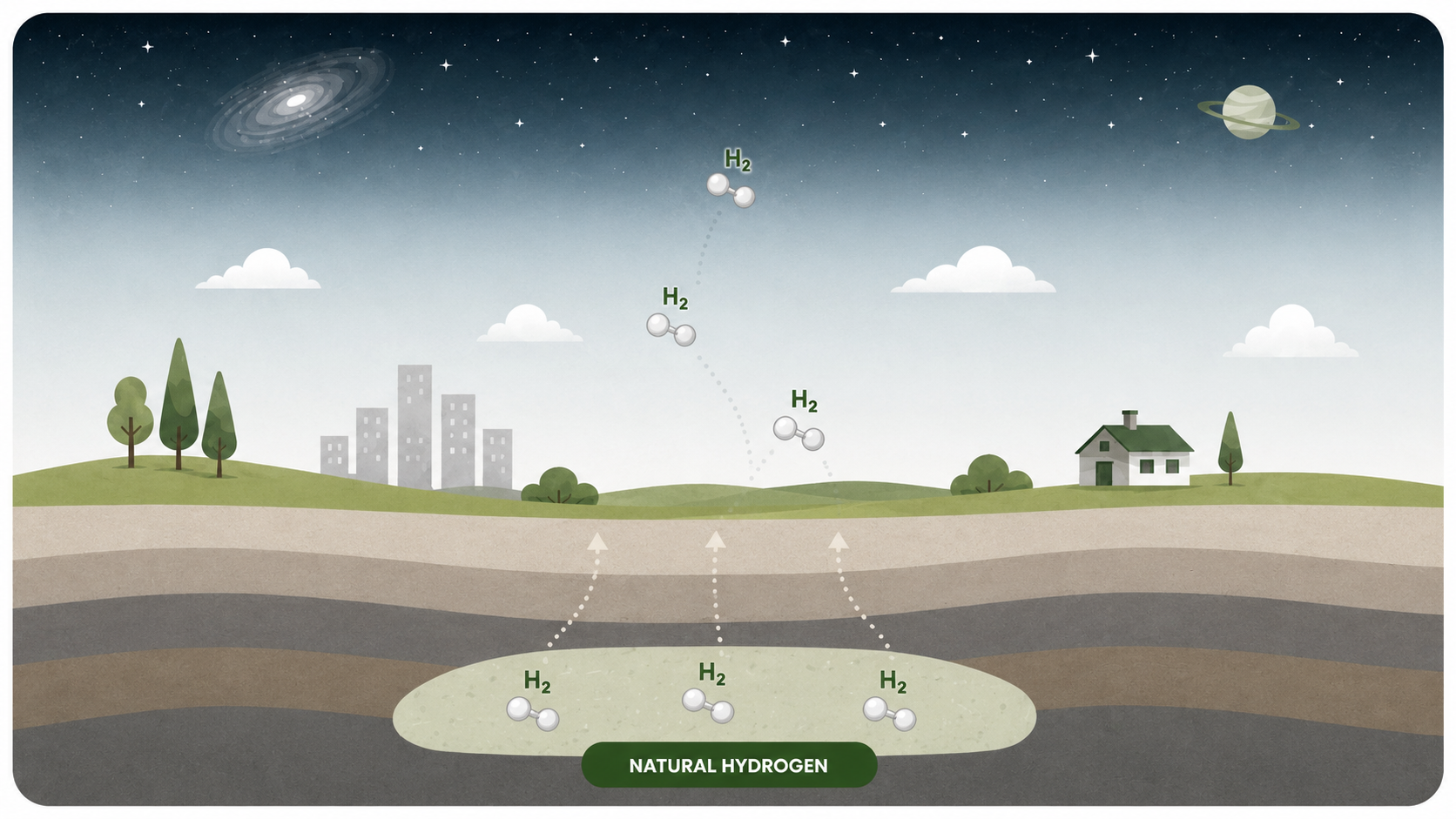
In its natural state, hydrogen is mostly found in bound form, particularly within water and hydrocarbons, while free molecular hydrogen (H₂) remains extremely rare in the atmosphere. It can, however, form and accumulate in certain underground geological settings.
Hydrogen in Its Natural State: Fundamental Properties
Hydrogen in its natural state is both the simplest and the most abundant chemical element in the Universe. Its low mass and distinctive physical properties explain why it behaves differently in space, in Earth's atmosphere, and underground.
In What Form Does Hydrogen Exist Naturally?
A diatomic molecule is made up of two atoms bonded together. Under ordinary conditions, when hydrogen appears in its elemental gaseous form, its atoms typically pair up to form dihydrogen (H₂) molecules [1].
At room temperature and pressure, pure molecular hydrogen is a colorless, odorless, tasteless gas. It has the lowest atomic mass of any element [1] and the lowest density among gases [2]. This combination makes it extremely light and directly affects how it moves through Earth's atmosphere.
Hydrogen only changes state at very low temperatures. Its boiling point sits at -252.87°C, while its melting point reaches -259.14°C [4]. As a result, it stays gaseous under typical ambient conditions. At 0°C and one atmosphere of pressure, its density is about 0.0899 g/L [4].
Table 1: Main Physical Properties of Molecular Hydrogen (H₂)
| Property | Value |
|---|---|
| Atomic number | 1 |
| Atomic mass | 1.008 |
| Melting point | -259.14°C (-434.45°F) |
| Boiling point | -252.87°C (-423.17°F) |
| Density at 0°C and 1 atm | 0.0899 g/L |
The Most Abundant Element in the Universe, but Not on Earth
These remarkable physical properties make more sense when you compare hydrogen's role in the universe to its presence on our planet.
On a cosmic scale, hydrogen dominates overwhelmingly: it makes up roughly 75% of the mass of visible ordinary matter and close to 92% of the atoms in the Universe [1][4]. It also plays a central role within stars. At the Sun's core, hydrogen nuclei fuse to form helium, a process that releases enormous amounts of energy as heat and light.
Although, on Earth, things look quite different.
Why Is Free Hydrogen So Rare at Earth's Surface?
The scarcity of free hydrogen in Earth's atmosphere comes down mainly to two factors. Its very low mass makes it easy for hydrogen to escape into space, while its chemical reactivity encourages it to combine with other compounds.
A Light Gas That Can Escape the Atmosphere
One of the mechanisms behind this is known as Jeans escape, named after astronomer James Jeans. It happens when particles in the upper atmosphere move fast enough to exceed the speed needed to break free into space.
Because of its low mass, dihydrogen (H₂) is among the gases most likely to leave Earth's atmosphere. Once a molecule reaches the upper atmospheric layers, it can pick up enough speed to escape the planet's gravitational pull [5].
Earth loses roughly 3 kilograms of this element every second through various atmospheric escape mechanisms. Jeans escape alone is thought to account for about 10 to 40% of this current loss [5]. That amount may seem small on a planetary scale, but its buildup over time helps keep H₂ concentrations in the air consistently low.
An Element Usually Bonded to Other Atoms
Escape into space only explains part of the picture. Hydrogen is certainly present on Earth, but rarely as free H₂ gas. It makes up just 0.5 to 1.0 parts per million of the atmosphere [3]. Put another way, out of a million air molecules, fewer than one is typically dihydrogen.
It's mainly present in stable compounds, including:
water, in the form of H₂O;
hydrocarbons, such as petroleum and natural gas;
various minerals and organic molecules.
Hydrogen therefore accounts for about 0.75% of the mass of Earth's crust [3], while water remains its primary reservoir at a global scale [2]. It isn't absent from Earth, then, but is generally incorporated into other molecules. Its scarcity in free form is mainly due to its extremely low mass and its tendency to react with other elements.
This surface scarcity doesn't mean dihydrogen is absent from the planet altogether, though. In certain geological settings, it can form, migrate, and sometimes build up underground.
Free Hydrogen Still Exists, Just Below the Surface
While free hydrogen is nearly absent at Earth's surface, the same isn't true underground. Decades of accumulated scientific observations show that gaseous H₂ forms and circulates in certain specific geological zones.
This underground presence has sparked growing interest in natural hydrogen, also known as geological hydrogen. When it's produced without any biological involvement, it's more precisely referred to as abiotic hydrogen. This can result from reactions between water and rock, from water radiolysis, or from certain deep degassing processes [7].
Where Is Natural Hydrogen Found?
Emissions and concentrations of H₂-rich gas have been observed in various underwater and continental settings [8]. These environments include:
mid-ocean ridges, where hot rocks come into contact with seawater;
transform faults, along which two tectonic plates slide past one another;
continental margins, located at the edges of continents;
intraplate settings, found within the tectonic plates themselves [8].
ultramafic rocks, rich in iron and magnesium, often associated with hydrothermal circulation.
The main geological sources behind the production of this natural hydrogen include the serpentinization of mafic and ultramafic rocks, water radiolysis within continental cratons (ancient, stable cores of the Earth's crust), as well as magmatic or deep degassing [6][7].
Geological Hydrogen as a Potential Energy Resource
For a long time, the presence of H₂ underground went largely unstudied, due to its low mass, high mobility, and the lack of suitable detection tools.
That's changing now. Scientific research is working to better understand the formation mechanisms, migration pathways, trapping conditions, and the recharge capacity of reservoirs.
The question of hydrogen's natural state, once a purely theoretical matter, is now taking on a very concrete dimension within the context of the energy transition. This emerging resource is drawing growing interest for its energy potential and its possible contribution to decarbonization. When it can be located, characterized, and produced under favorable conditions, geological hydrogen represents a high-potential energy source, with no direct CO₂ emissions at the point of use. That's why Squatex is actively exploring this field, in line with its work in subsurface exploration and the development of natural energy resources.
To stay up to date on developments in this field, follow Squatex on LinkedIn.
References
[1] Module 1: Hydrogen Properties. U.S. Department of Energy, Office of Energy Efficiency and Renewable Energy, www.energy.gov/documents/fcm01r0pdf.
[2] "Hydrogen." Periodic Table of Elements, Royal Society of Chemistry, www.periodic-table.rsc.org/element/1/hydrogen.
[3] "Hydrogen." Molecule of the Week, American Chemical Society, 22 June 2020, www.acs.org/molecule-of-the-week/archive/h/hydrogen.html.
[4] "Hydrogen." SATHEE CUET Chemistry Notes, Indian Institute of Technology Kanpur, sathee.iitk.ac.in/sathee-cuet/cuet-ug/chemistry/english/study-materials/notes/hydrogen.
[5] Catling, David C. "Our Planet's Leaky Atmosphere." Scientific American, 24 Apr. 2008, www.scientificamerican.com/article/how-planets-lose-their-atmospheres/.
[6] Mao, Shaowen, et al. "Geologic Hydrogen: A Review of Resource Potential, Subsurface Dynamics, Exploration, Production, Transportation and Research Opportunities." Energy & Environmental Science, vol. 18, 2025, doi:10.1039/D5EE02910D.
[7] "Current Perspectives on Natural Hydrogen: A Synopsis." MESA Journal, Geological Survey of South Australia, Dept. for Energy and Mining, July 2022, www.energymining.sa.gov.au/industry/geological-survey/mesa-journal/previous-feature-articles/current-perspectives-on-natural-hydrogen-a-synopsis.
[8] Hao, Yongliang, et al. "The Origin and Occurrence of Natural Hydrogen." Energies, vol. 16, no. 6, article 2400, 2023, MDPI, doi:10.3390/en16062400.
