

Which rare earth elements have the most economic value today?
Rare earths occupy an increasingly important place in the global economy. They are found in electric vehicles, wind turbines, smartphones, defense systems, and a multitude of advanced technologies that have become essential to the energy transition. Yet, despite their name, their importance does not stem solely from their geological scarcity, but above all from the unique properties they bring to certain high-performance materials.
Behind the expression "rare earths" actually lies a family of 17 chemical elements with very different uses, markets, and values. Some are abundant and relatively inexpensive, while others face growing supply tensions and attract major strategic interest from industries and governments. According to the International Energy Agency (IEA), global demand for rare earths used in permanent magnets has nearly doubled since 2015 and continues to grow rapidly [2].
The strategic use of REEs
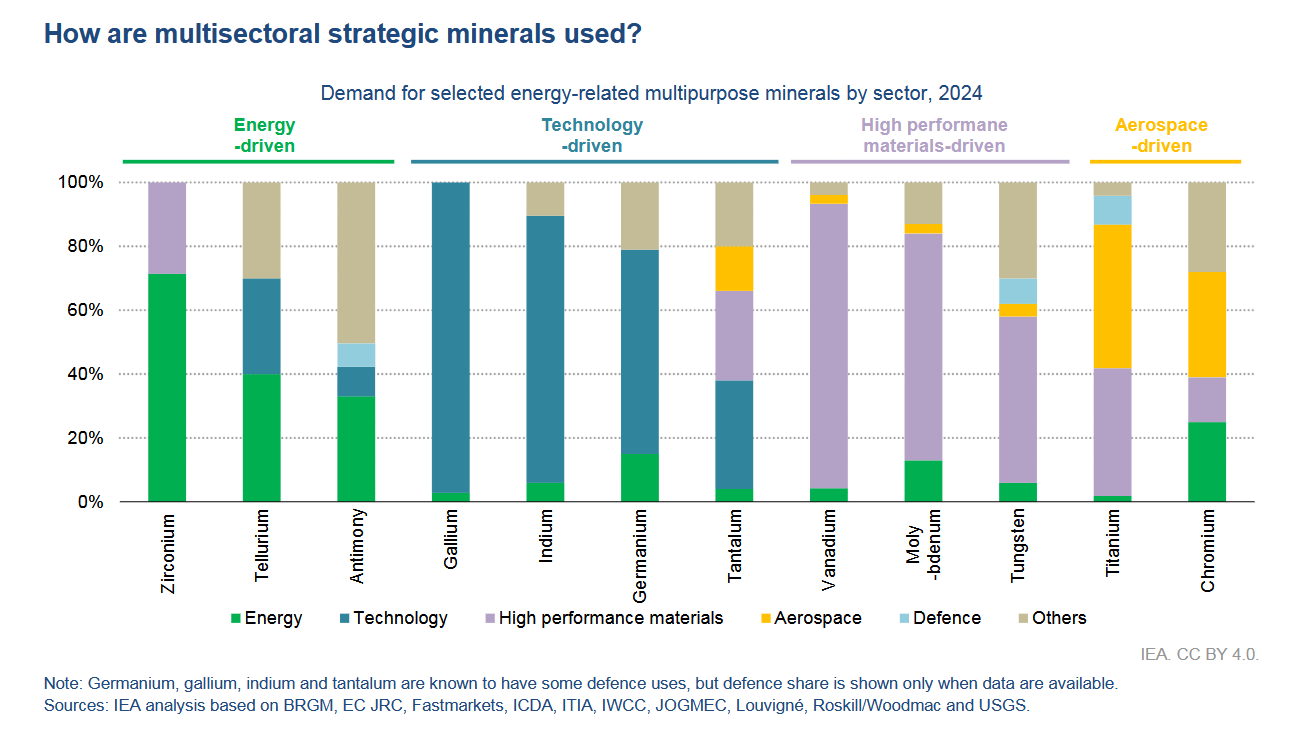
Before examining each element individually, it is essential to understand why permanent magnets constitute the main vector of economic value in the rare earth sector. Magnets represent the world's leading use of these materials, absorbing 47.6% of global demand [5].
At the heart of this dynamic are NdFeB magnets, composed of neodymium, iron, and boron. These are the most powerful commercially available permanent magnets in the world, and they equip a growing range of applications:
Electric vehicle motors, where their power-to-weight ratio is superior to that of any other type of magnet available on the market.
Offshore wind turbine generators, which require magnets capable of operating in variable wind conditions and maintaining high energy efficiency.
Industrial robots, AI-powered data centers, and defense systems, where magnet performance directly influences the reliability and energy consumption of equipment.
This demand is growing strongly: the share of clean technologies in total rare earth consumption rose from 8% in 2015 to over 20% in 2024 [2]. It is in this context that magnetic elements — neodymium, praseodymium, dysprosium, and terbium — have acquired unprecedented economic importance.
Source : IEA
To go further: "Which green technologies depend on critical minerals?"
Which rare earths have the most economic value?
The market's most sought-after elements
Neodymium (Nd)
Average price 2025: ~$73/kg (oxide)[1]
Main sectors of use: Electric vehicle motors, offshore wind turbine generators, consumer electronics, robotics.
Neodymium is a silvery metal belonging to the lanthanide group. As the main component of NdFeB magnets, it is the basis for nearly all high-efficiency motors used in EVs and wind turbines. Its demand is directly correlated with the acceleration of the global energy transition.
Thus, since 2015, global consumption of magnetic rare earths — of which Nd is the most abundant — has doubled to exceed 90,000 tonnes in 2024[2]. The share of EV motors in total magnetic rare earth demand is also expected to rise from 9% in 2024 to 22% in 2050, according to the IEA's reference scenario (STEPS)[2]. Over an even longer horizon, some scientific analyses cited by the IEA project a growth in neodymium demand for permanent magnets of between 4 and 7 times current levels by the end of the energy transition period[8].
Praseodymium (Pr)
Average price 2025: ~$74/kg (Pr oxide, 99.99%) / ~$69/kg (mixed NdPr oxide)[1]
Main sectors of use: High-performance magnets for industrial and aerospace motors, specialized protective visors.
Praseodymium is frequently extracted and marketed jointly with neodymium, in the form of the mixed NdPr oxide, which constitutes the sector's commercial standard at approximately $69/kg in 2025[1]. This co-production reflects the geochemical proximity of the two elements in deposits.
Its magnetic properties make it a substitute for or complement to neodymium in many high-performance applications. This gives it direct exposure to the same demand dynamic: rare earth consumption linked to clean technologies, of which NdPr oxide is a major component, rose from 11,000 tonnes in 2021 to 19,000 tonnes in 2024, with a projection of 38,000 tonnes in 2030[2].
Dysprosium (Dy)
Average price 2026:~221.48 USD/KG [9]
Main sectors of use: Additive in high-temperature NdFeB magnets, EV motors, wind turbine generators.
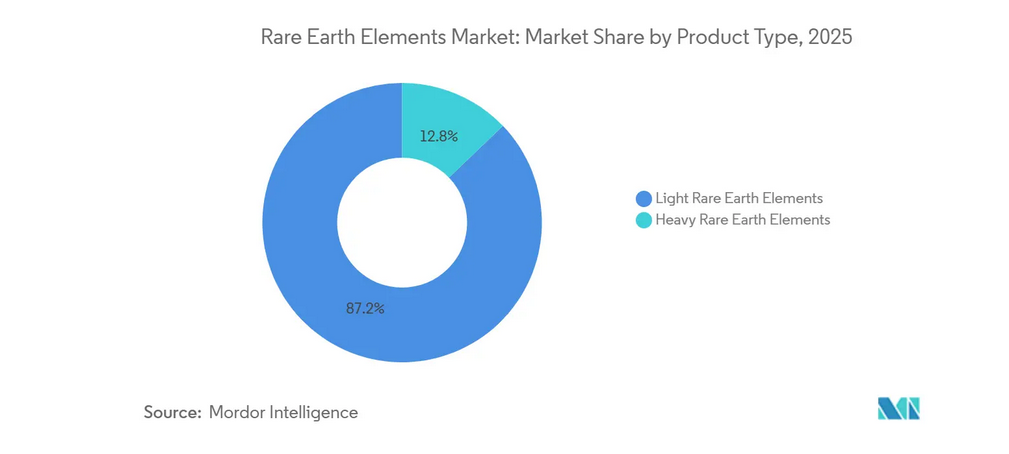
Dysprosium is a heavy rare earth whose role may seem modest in volume — it is incorporated at only 2 to 5% in NdFeB magnets — but it is in fact indispensable to their operation in harsh environments. By improving the thermal resistance of magnets, it makes them usable in high-temperature conditions such as those of electric vehicle motors, or in offshore wind turbine generators[7]. Without this additive, NdFeB magnets would lose a significant part of their performance in these critical applications.
Its economic value is therefore closely tied to its difficulty to substitute. The majority of global dysprosium demand is linked to the manufacture of permanent magnets[2]. Europe and North America together accounted for between 20 and 35% of this demand for the main magnetic elements, including dysprosium[2].
Terbium (Tb)
Average price (2026): ~965.1 USD/KG [9]
Demand (2024): 0.6 kt[2]
Main sectors of use: Additive for high-performance NdFeB magnets, phosphors for displays and lighting, magneto-optical glasses.
Terbium is, like dysprosium, a heavy rare earth used as an additive in NdFeB magnets to further increase their thermal stability and performance under extreme conditions. It can be used jointly with dysprosium or as a partial substitute depending on the required technical specifications.
Source: Mordor Intelligence
The other strategic rare earths: Sm, Eu, Gd, Ce, La, Y, and Sc
Samarium (Sm)
Average price (2026): ~9.95 USD $/kg (oxide) [9]
Demand (2024): 1.6 kt [2]
Main sectors of use: Samarium-cobalt (SmCo) magnets for aerospace and defense, ceramics, phosphors.
Although its unit price is significantly lower than that of magnetic rare earths like neodymium, samarium occupies a strategic niche that is difficult to fill. SmCo magnets are indeed preferred in very high-temperature environments or in military applications where NdFeB magnets reach their performance limits. These sectors — notably aerospace and defense — do not tolerate technical compromises, which gives samarium a usage value greater than its unit price suggests.
Europium (Eu)
Average price (2025): ~$27/kg (oxide)[1]
Main sectors of use: Phosphors for television screens and LED lighting, lasers, optical glasses.
Europium is a good example of the fact that the economic value of a rare earth does not derive solely from its geological scarcity, but from its precise functionality in specific applications. Its role in phosphors gives it an industrial value far greater than its relative availability in nature[7]. Concretely, this element is responsible for the red component in trichromatic color displays.
Gadolinium (Gd)
Average price (2025): ~$30/kg (oxide 99.99%)[1]
Demand (2024): 4.0 kt[2]
Main sectors of use: Contrast agent for magnetic resonance imaging (MRI), optical glass, optical fibers, special steel.
Gadolinium has a particularly diversified usage profile. Its main medical application, as a contrast agent in MRI, is difficult to substitute in the short term, particularly in healthcare facilities in developing countries where the adoption of this equipment is growing strongly. This medical demand represents a relatively stable consumption floor, independent of energy transition cycles.
Cerium (Ce)
Average price (2025): ~$1.71/kg (oxide)[1]
Main sectors of use: Polishing powder for glass and semiconductors, catalysts for oil refining, additives for automotive glass.
Cerium is the most abundant and least expensive rare earth, its main use being glass polishing[7]. Its low unit value, however, contrasts with its industrial ubiquity: it often represents the majority fraction of a rare earth deposit, which poses a valorization challenge during extraction. In other words, mining operators frequently find themselves with large quantities of cerium to sell on a low-priced market, which affects the overall economics of projects.
Lanthanum (La)
Average price (2025): ~$1.00/kg (oxide)[1]
Main sectors of use: Catalysts for gasoline engines, nickel-metal hydride (NiMH) batteries, high-quality optical glasses.
Like cerium, lanthanum stands out for the scale of its volumes rather than its unit price. It is notably used in the composition of catalysts used on a large scale in oil refining and gasoline engines[7], a massive industrial application that generates continuous demand.
Its strategic importance is also recognized at the governmental level: the U.S. government planned, for fiscal year 2025, a strategic acquisition of 1,100 tonnes of lanthanum for its national reserves[1]. This clearly illustrates that even a rare earth with low market value can represent an industrial security stake.
Yttrium (Y)
Average price (2026):32.24 USD/Kg [9]
Demand (2024): 6.2 kt[2]
Main sectors of use: Phosphors for displays and LEDs, high-temperature ceramics, laser glasses, metal alloys.
Yttrium is often associated with rare earths, even though it does not directly belong to the lanthanide family. This classification is explained by its similar chemical properties and its frequent presence in the same deposits. It plays an important role in several specialized technological applications, notably high-temperature ceramics, laser glasses, and certain phosphors used in displays and advanced lighting.
Scandium (Sc)
Global market:USD 667.0 Million [9]
Average price (2025) (Sc):~$1,200/kg [10]
Main sectors of use: Aluminum-scandium alloys for aerospace, electrodes for solid oxide fuel cells.
Like yttrium, scandium is technically distinct from the 15 lanthanides, but it is generally included in the rare earth category by industrial convention. Its market is small in volume, but its strategic value is high due to the advanced properties it confers on aluminum-scandium alloys, particularly sought after in aerospace and certain advanced energy technologies. Scandium also appears on the USGS list of 60 critical minerals (2025)[4].
Resources with contrasting values
This overview highlights a central reality of the rare earth market: their value is not distributed uniformly across the different elements of the group. A handful of elements, notably those used in permanent magnets, today concentrate most of the demand and play a decisive role in the value chains of the energy transition. This dynamic is directly linked to the rise of low-carbon technologies, particularly electric vehicles and wind power, which are expected to continue to support market growth in the coming years [2].
That said, the so-called "less critical" rare earths, such as cerium or lanthanum, remain essential to the functioning of many industrial processes. Although more abundant and less costly per unit, they are involved on a large scale in production chains that are often invisible but indispensable to modern technologies.
To stay informed about developments in the critical and strategic minerals sector, follow Squatex on LinkedIn.
References
[^1]: U.S. Geological Survey. "Rare Earths." Mineral Commodity Summaries 2026, U.S. Geological Survey, Feb. 2026. https://pubs.usgs.gov/periodicals/mcs2026/mcs2026-rare-earths.pdf.
[^2]: International Energy Agency. Global Critical Minerals Outlook 2025. IEA, 2025. https://iea.blob.core.windows.net/assets/ef5e9b70-3374-4caa-ba9d-19c72253bfc4/GlobalCriticalMineralsOutlook2025.pdf.
[^4]: U.S. Geological Survey. "2025 List of Critical Minerals." USGS, Nov. 2025. https://www.usgs.gov/media/images/2025-list-critical-minerals.
[^5]: Natural Resources Canada. "Rare earth elements facts." Government of Canada, Oct. 2024. https://ressources-naturelles.canada.ca/mineraux-exploitation-miniere/donnees-statistiques-analyses-exploitation-miniere/faits-mineraux-metaux/faits-elements-terres-rares.
[^6]: Government of Quebec, Géologie Québec. "Rare earth elements." Mineral Substances Portal, Mar. 2022. https://gq.mines.gouv.qc.ca/portail-substances-minerales/elements-des-terres-rares/.
[^7]: AFP. "Rare earths in questions: metals essential to the economy of tomorrow." Connaissance des Énergies, 2 Feb. 2025. https://www.connaissancedesenergies.org/afp/les-terres-rares-en-questions-des-metaux-indispensables-leconomie-de-demain-250203.
[^8]: Ghorbani, Y., Ilankoon, I. M. S. K., Dushyantha, N., and Nwaila, G. T. "Rare Earth Permanent Magnets for the Green Energy Transition: Bottlenecks, Current Developments and Cleaner Production Solutions." Resources, Conservation and Recycling, vol. 212, 2025, article 107966. Elsevier. https://www.sciencedirect.com/science/article/pii/S0921344924005573.
[^9]: IMARC Group, 2026. https://www.imarcgroup.com
